Orforglipron
Also known as: LY3502970
Orforglipron is an orally active small-molecule (nonpeptide) agonist of the glucagon-like peptide-1 (GLP-1) receptor. Discovered under the codes LY3502970 and OWL833, it binds a distinct pocket of the receptor and signals with a bias toward G protein activation. It has been tested in phase 3 trials in obesity and type 2 diabetes, and the FDA approved it for weight management in 2026.
Last reviewed · Identity data matched to PubChem · 11 peer-reviewed sources
Key facts
- Class: small-molecule, nonpeptide GLP-1 receptor agonist (partial, G protein-biased)
- Formula C48H48F2N10O5; molecular weight 883.0 g/mol (PubChem CID 137319706)
- CAS Registry Number 2212020-52-3; four defined stereocenters
- Development codes LY3502970 and OWL833
- Binds the human GLP-1 receptor with a reported Ki of about 1 nM
- Phase 3 trials completed in obesity and in early type 2 diabetes
- FDA approved in 2026 for chronic weight management in adults
Chemical Identity
| Molecular formula | C48H48F2N10O5 |
|---|---|
| Molecular weight | 883.0 g/mol |
| Monoisotopic mass | 882.3777 Da |
| CAS number | 2212020-52-3 |
| PubChem CID | 137319706 |
| InChIKey | USUWIEBBBWHKNI-KHIFEHGGSA-N |
| Compound type | Small molecule |
| H-bond donors / acceptors | 1 / 10 |
| XLogP3 | 6.8 |
What Is Orforglipron?
Orforglipron is a synthetic small molecule that activates the GLP-1 receptor without being a peptide. It was reported in 2020 under the codes LY3502970 and OWL833 as an orally active nonpeptide GLP-1 receptor agonist.[1]
Approved GLP-1 receptor agonists before it were peptide based, and the discovery authors noted that small-molecule activators with suitable drug properties had proven difficult to obtain.[1] A 2026 review groups orforglipron with other orally active small-molecule GLP-1 receptor agonists, such as danuglipron, and notes that these molecules resist the enzymatic degradation that affects peptides.[2]
Orforglipron has been studied for type 2 diabetes and weight management in a program that runs from phase 1 studies in healthy adults to phase 3 trials.[3][4][5]
Chemical Structure and Molecular Identity
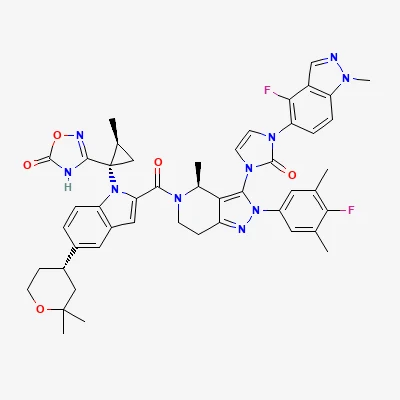
Orforglipron is a small organic molecule with no amino-acid sequence. PubChem (CID 137319706) lists its molecular formula as C48H48F2N10O5 and its molecular weight as 883.0 g/mol, and its CAS Registry Number is 2212020-52-3.
Structural features
- Core: an indole bearing a 2,2-dimethyltetrahydropyran ring and linked through an amide to a tetrahydropyrazolo[4,3-c]pyridine system.
- Aromatic substituents: a 4-fluoro-3,5-dimethylphenyl group and a 4-fluoro-1-methylindazole joined through an imidazolone ring, accounting for the two fluorine atoms.
- Acidic group: a 1,2,4-oxadiazol-5-one attached to a methylcyclopropyl ring on the indole nitrogen.
- Stereochemistry: four defined stereocenters, given in the IUPAC name as (1S,2S) on the cyclopropane and (4S) at the tetrahydropyran and pyrazolopyridine positions.
PubChem’s computed properties include an XLogP of 6.8, a topological polar surface area of 144 Ų, 1 hydrogen-bond donor, 10 hydrogen-bond acceptors and 7 rotatable bonds. Its molecular weight is well above the 500 Da guideline of Lipinski’s rule of five, which is notable for an orally active drug candidate. The InChIKey is USUWIEBBBWHKNI-KHIFEHGGSA-N.
Research History and Development
Orforglipron moved from a 2020 structural and pharmacology report to phase 1 studies published in 2023, a phase 2 obesity trial in 2023, and phase 3 trials published in 2025.
Discovery
The 2020 discovery paper reported a high-resolution structure of the compound bound to the active-state GLP-1 receptor and efficacy studies in humanized GLP-1 receptor transgenic mice and nonhuman primates.[1]
Phase 1
A phase 1a study in 92 healthy adults tested single and multiple ascending doses over up to 4 weeks.[3] A phase 1b study in people with type 2 diabetes randomized 68 participants (51 to orforglipron and 17 to placebo) for 12 weeks across several treatment arms.[4]
Phase 2 and phase 3
A 36-week phase 2 trial randomized 272 adults with obesity, or overweight plus a weight-related condition, and without diabetes to one of four dose levels or placebo.[5] Two phase 3 trials followed: a 40-week trial in 559 adults with early type 2 diabetes managed with diet and exercise, and a 72-week multinational trial in 3,127 adults with obesity without diabetes.[6][7] A 2025 systematic review listed orforglipron among the GLP-1 receptor agonists then in phase 3 obesity trials.[8]
Mechanisms Studied in Research
Orforglipron is a high-affinity, selective partial agonist of the human GLP-1 receptor that favors G protein signaling over β-arrestin recruitment.[1][9]
Binding site
In the high-resolution receptor structure, the compound occupies a unique pocket in the upper helical bundle, contacted by the extracellular domain, extracellular loop 2 and transmembrane helices 1, 2, 3 and 7.[1] The authors proposed that this binding mode creates a distinct receptor conformation that may explain the partial agonism and biased signaling. An interaction with the primate-specific tryptophan 33 of the extracellular domain explains why activity is species selective.[1]
Receptor pharmacology
Competition binding experiments gave an inhibition constant (Ki) of about 1 nM at the human GLP-1 receptor, and signaling assays showed low intrinsic efficacy and negligible β-arrestin recruitment.[9] In mice expressing the human receptor, low receptor occupancy was sufficient to produce a full glucose-lowering response.[9]
Animal models
Because its activity depends on the primate-specific tryptophan 33, researchers used humanized mice and rats gene-edited to carry a sensitizing receptor variant (Glp1rS33W).[1][9] In these rats, target engagement in the pancreas and brain was consistent with peptide GLP-1 receptor agonists, and oral orforglipron produced weight loss in diet-induced obesity and sustained efficacy started with injected semaglutide.[9] In nonhuman primates, it produced insulinotropic and food-intake-lowering effects comparable to injectable exenatide.[1]
Key Findings From Published Studies
Phase 2 and phase 3 trials report dose-related reductions in body weight and glycated hemoglobin (HbA1c) with orforglipron compared with placebo, and gastrointestinal events were the most common adverse effects.[5][6][7]
| Study | Population and duration | Main result vs placebo |
|---|---|---|
| Phase 2 obesity[5] | 272 adults without diabetes; 36 weeks | Body weight −9.4% to −14.7% vs −2.3% |
| Phase 3 early type 2 diabetes[6] | 559 adults; 40 weeks | HbA1c −1.24 to −1.48 points vs −0.41 |
| Phase 3 obesity[7] | 3,127 adults without diabetes; 72 weeks | Body weight −7.5% to −11.2% vs −2.1% |
Early clinical pharmacology
In healthy adults, exposure was approximately dose proportional and the mean half-life ranged from 24.6 to 35.3 hours after a single dose and from 48.1 to 67.5 hours at day 28. Body weight fell by up to 5.4 kg over 4 weeks versus 2.4 kg with placebo, fasting glucose decreased and gastric emptying was delayed.[3]
Obesity
In the phase 3 obesity trial, 54.6% of the highest-dose group lost at least 10% of body weight, 36.0% at least 15% and 18.4% at least 20%, compared with 12.9%, 5.9% and 2.8% with placebo.[7] In the earlier phase 2 trial, weight change at the 26-week primary endpoint ranged from −8.6% to −12.6% versus −2.0% with placebo, and 46% to 75% of participants lost at least 10% by week 36, versus 9%.[5] Adverse events led to discontinuation in 5.3% to 10.3% of orforglipron groups versus 2.7% with placebo.[7]
Type 2 diabetes
In the 40-week phase 3 trial, baseline HbA1c averaged 8.0% and fell to 6.5% to 6.7% with orforglipron; all three dose levels were superior to placebo.[6] In the 12-week phase 1b study, HbA1c changed by −1.5% to −1.8% across orforglipron groups versus −0.4% with placebo.[4]
Comparative analyses
A 2026 BMJ network meta-analysis estimated one-year weight loss of 9.9% with orforglipron versus lifestyle modification alone, and placed it among the drugs with the highest discontinuation for adverse events.[10] A separate network meta-analysis in adults without diabetes found that orforglipron carried the highest nausea risk among the GLP-1 receptor agonists evaluated.[11]
Because orforglipron has four stereocenters, HPLC and mass spectrometry certificates of analysis, ideally with chiral purity data, are the practical identity check.
Regulatory and Research Status
Orforglipron is FDA approved: in 2026 the US Food and Drug Administration approved it for adults with obesity, or with overweight and weight-related comorbidities.
Most of the peer-reviewed literature cited on this page predates that decision and describes orforglipron as investigational or in clinical development for type 2 diabetes and weight management.[6][7] Its phase 3 type 2 diabetes data come from participants managed with diet and exercise alone.[6]
Reviewers highlight gastrointestinal tolerability as the main limitation reported across trials, with nausea, vomiting and adverse-event discontinuations more frequent than with placebo.[10][11] Nothing on this page is guidance for human use, and research material outside the approved medicine and registered clinical trials is intended for laboratory studies only.
Commonly Supplied Research Formats
Orforglipron is listed by 2 of the 11 major U.S. research-peptide suppliers we track. The most commonly listed formats are:
- 1mg x 90 (capsules)
- 3mg x 90 (capsules)
- 6mg x 90 (capsules)
Supplier catalog survey, October 2026. Quantities refer to net peptide per vial as labeled.
Frequently Asked Questions
Is orforglipron FDA approved?
Yes. In 2026 the FDA approved orforglipron for adults with obesity, or with overweight and weight-related comorbidities. Most published trials describe it as investigational because they appeared before approval. Its phase 3 obesity trial reported mean weight change of −7.5% to −11.2% at 72 weeks, compared with −2.1% with placebo.
Is orforglipron a peptide?
No. Orforglipron is a small molecule, not a peptide. PubChem lists it as C48H48F2N10O5 with a molecular weight of 883.0 g/mol, about one-fifth the mass of lipidated peptide GLP-1 receptor agonists. It contains no amino acids and has no sequence, yet it activates the same receptor that GLP-1 does.
What is the molecular weight of orforglipron?
PubChem (CID 137319706) lists orforglipron with a molecular weight of 883.0 g/mol, an exact mass of 882.378, and the molecular formula C48H48F2N10O5. Its CAS Registry Number is 2212020-52-3. The molecule has four defined stereocenters, so its full identity depends on the correct stereoisomer, encoded in its InChIKey.
How is orforglipron different from semaglutide?
Semaglutide is a lipidated peptide, while orforglipron is a nonpeptide small molecule. Orforglipron binds a distinct pocket in the upper helical bundle of the GLP-1 receptor and acts as a partial, G protein-biased agonist with negligible β-arrestin recruitment. In gene-edited rats, oral orforglipron sustained weight loss started with semaglutide.
What is LY3502970?
LY3502970 is the development code for orforglipron; the 2020 discovery paper in PNAS also lists the code OWL833. That paper described the compound's binding site on the GLP-1 receptor, its partial and biased agonism, and its glucose-lowering and food-intake effects in humanized mice and nonhuman primates.
What does the research on orforglipron show?
Phase 2 and phase 3 trials report dose-related weight and HbA1c reductions compared with placebo. In a 72-week phase 3 obesity trial, the highest-dose group lost 11.2% of body weight versus 2.1% with placebo. Gastrointestinal events were the most common adverse effects, and meta-analyses rank its nausea risk as high.
References
- Kawai T, Sun B, Yoshino H, et al. Structural basis for GLP-1 receptor activation by LY3502970, an orally active nonpeptide agonist. Proceedings of the National Academy of Sciences of the United States of America 2020. PMID 33177239 · DOI
- Son JW, le Roux CW, Blüher M, et al. Novel GLP-1-based Medications for Type 2 Diabetes and Obesity. Endocrine reviews 2026. PMID 41054801 · DOI
- Pratt E, Ma X, Liu R, et al. Orforglipron (LY3502970), a novel, oral non-peptide glucagon-like peptide-1 receptor agonist: A Phase 1a, blinded, placebo-controlled, randomized, single- and multiple-ascending-dose study in healthy participants. Diabetes, obesity & metabolism 2023. PMID 37344954 · DOI
- Pratt E, Ma X, Liu R, et al. Orforglipron (LY3502970), a novel, oral non-peptide glucagon-like peptide-1 receptor agonist: A Phase 1b, multicentre, blinded, placebo-controlled, randomized, multiple-ascending-dose study in people with type 2 diabetes. Diabetes, obesity & metabolism 2023. PMID 37264711 · DOI
- Wharton S, Blevins T, Connery L, et al. Daily Oral GLP-1 Receptor Agonist Orforglipron for Adults with Obesity. The New England journal of medicine 2023. PMID 37351564 · DOI
- Rosenstock J, Hsia S, Nevarez Ruiz L, et al. Orforglipron, an Oral Small-Molecule GLP-1 Receptor Agonist, in Early Type 2 Diabetes. The New England journal of medicine 2025. PMID 40544435 · DOI
- Wharton S, Aronne LJ, Stefanski A, et al. Orforglipron, an Oral Small-Molecule GLP-1 Receptor Agonist for Obesity Treatment. The New England journal of medicine 2025. PMID 40960239 · DOI
- Kokkorakis M, Chakhtoura M, Rhayem C, et al. Emerging pharmacotherapies for obesity: A systematic review. Pharmacological reviews 2025. PMID 39952695 · DOI
- Sloop KW, Cox AL, Wainscott DB, et al. The pharmacological basis for nonpeptide agonism of the GLP-1 receptor by orforglipron. Science translational medicine 2024. PMID 39693407 · DOI
- Nong K, Shi Q, Xie X, et al. Comparative effects of drugs for adults with overweight or obesity: systematic review and network meta-analysis. BMJ (Clinical research ed.) 2026. PMID 42419792 · DOI
- Ismaiel A, Scarlata GGM, Boitos I, et al. Gastrointestinal adverse events associated with GLP-1 RA in non-diabetic patients with overweight or obesity: a systematic review and network meta-analysis. International journal of obesity (2005) 2025. PMID 40804463 · DOI
Related Compounds
This profile summarizes chemical data and peer-reviewed literature for educational and laboratory-research reference. It is not medical advice, and nothing here describes or recommends use in humans or animals. How we source and verify data.