Larazotide
Also known as: AT-1001 · Larazotide acetate
Larazotide is a synthetic eight-amino-acid peptide (GGVLVQPG) studied as a zonulin antagonist that regulates intestinal tight junctions. Usually tested as larazotide acetate under the code AT-1001, it has been evaluated in randomized trials in celiac disease and a phase 2a trial in children with post-COVID multisystem inflammatory syndrome. It is not FDA approved for any use.
Last reviewed · Identity data matched to PubChem · 8 peer-reviewed sources
Key facts
- Class: synthetic tight-junction regulator; zonulin antagonist
- Length: 8 amino acids (GGVLVQPG), free termini
- Formula C32H55N9O10; molecular weight 725.8 g/mol; CAS 258818-34-7
- Development codes AT-1001 and INN-202; studied as larazotide acetate
- Evidence: cell and animal studies; randomized trials in celiac disease and MIS-C
- Regulatory status: investigational; not FDA approved
Chemical Identity
| Molecular formula | C32H55N9O10 |
|---|---|
| Molecular weight | 725.8 g/mol |
| Monoisotopic mass | 725.4072 Da |
| CAS number | 258818-34-7 |
| PubChem CID | 9810532 |
| UNII | ZN3R5560ZV |
| InChIKey | ORFLZNAGUTZRLQ-ZMBVWFSWSA-N |
| Length | 8 amino acids |
| Compound type | Peptide |
| H-bond donors / acceptors | 9 / 11 |
| XLogP3 | -3.6 |
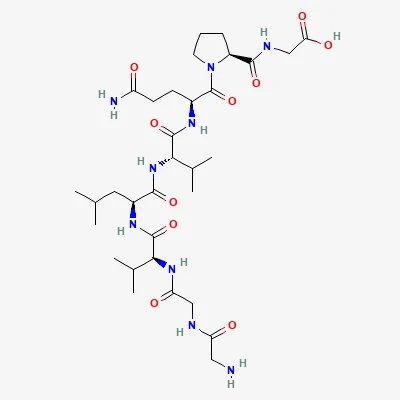
Sequence: GGVLVQPG
No modifications; free N-terminal amine and C-terminal carboxylic acid. Commonly supplied and studied as the acetate salt (larazotide acetate).
What Is Larazotide?
Larazotide is a synthetic octapeptide studied as an antagonist of zonulin, a regulator of the tight junctions that seal the spaces between intestinal epithelial cells [1]. It is described as a gut permeability regulator and is most often tested as larazotide acetate under the development code AT-1001 [2].
The interest in larazotide follows from research linking zonulin-driven increases in epithelial and endothelial permeability to several acute and chronic inflammatory diseases [1]. Celiac disease has been the main clinical target, because increased intestinal permeability is considered a central part of its pathophysiology [3].
Beyond celiac disease, larazotide has been examined in research on type 1 diabetes, other autoimmune diseases, inflammatory bowel disease, Kawasaki disease, and respiratory diseases [1], and in a pediatric trial in post-COVID multisystem inflammatory syndrome [4].
Chemical Structure and Molecular Identity
Larazotide is a linear peptide of eight standard amino acids, Gly-Gly-Val-Leu-Val-Gln-Pro-Gly, with a free N-terminal amine and a free C-terminal carboxylic acid. PubChem (CID 9810532) lists its molecular formula as C32H55N9O10, its molecular weight as 725.8 g/mol, and its CAS number as 258818-34-7 for the free base.
| Feature | Detail |
|---|---|
| Length | 8 amino acids |
| Sequence | GGVLVQPG |
| Termini | Free amine (Gly-1) and free acid (Gly-8) |
| Composition | Three glycines, two valines, one leucine, one glutamine, one proline |
| Charged side chains | None; only the termini are ionizable |
| Common salt form | Larazotide acetate |
The peptide is small and largely hydrophobic in its central Val-Leu-Val segment, with no aromatic, acidic, or basic side chains. The acetate salt form used in most studies has a different total mass than the free peptide, so analytical values should be compared with the matching form.
A systematic review of the literature searched under the names larazotide, larazotide acetate, AT-1001, FZI/0, and INN-202, reflecting the several designations used across studies [1].
Research History and Development
Larazotide’s clinical development centered on celiac disease, and research later extended to other conditions linked to zonulin and barrier dysfunction [1]. By 2020, four randomized controlled trials had studied it in patients with celiac disease [2].
Those trials enrolled a combined 626 patients, 465 receiving larazotide acetate and 161 receiving placebo, and tested it both during gluten challenge and in patients following a gluten-free diet [2]. Recent reviews of celiac therapeutics still group larazotide acetate with experimental permeability-modulating medications such as IMU-856 [3][5].
Preclinical research has broadened to autoimmune arthritis [6], vascular disease [7], and colitis, including a hydrogel built for sustained local release of larazotide acetate [8]. In 2025, a phase 2a randomized, double-blind, placebo-controlled trial reported results in children with multisystem inflammatory syndrome after SARS-CoV-2 infection [4].
Mechanisms Studied in Research
Larazotide is studied as a zonulin antagonist that limits tight-junction disruption and so reduces paracellular permeability across epithelial and endothelial barriers [1].
Zonulin and tight junctions
Zonulin is a regulator of intestinal tight junctions, and its modulation of junction competency has been described in many inflammatory diseases [1]. In coeliac disease, mechanisms of barrier disruption include zonulin, inflammatory cytokines, microbial changes, and immune responses to gliadin peptides [3].
Cellular signaling
In LPS-injured Caco-2 intestinal cells, sustained-release larazotide acetate inhibited zonulin-mediated tight-junction disruption by acting against MLCK and phosphorylated myosin light chain signaling, restoring epithelial integrity [8]. In a mouse aortic disease model, the authors described AT-1001 as a protease-activated receptor 2 inhibitor that seals tight junctions in vascular endothelium [7].
Gut barrier and systemic inflammation
In mouse autoimmune arthritis, rising serum zonulin accompanied a leaky intestinal barrier, dysbiosis, and inflammation, and predicted the transition from autoimmunity to arthritis [6]. In children with MIS-C, investigators tested larazotide because of a suggested route in which SARS-CoV-2 spike protein moves from gastrointestinal reservoirs into the blood through zonulin-mediated trafficking [4].
Key Findings From Published Studies
Human data show mixed results in celiac disease and early signals in a small pediatric MIS-C trial, while animal studies report reduced barrier damage and inflammation across several models.
Celiac disease meta-analysis
A 2022 meta-analysis of four randomized trials found that the change in lactulose-to-mannitol ratio, a measure of intestinal permeability, did not differ significantly between larazotide acetate and placebo, regardless of gluten status [2]. In patients undergoing gluten challenge, larazotide acetate was associated with greater improvement in total and celiac-specific gastrointestinal symptom rating scale scores and with less gluten-related diarrhea; no significant difference was seen in patients on a gluten-free diet [2]. Other adverse events were comparable to placebo [2].
Phase 2a trial in MIS-C
In a randomized, double-blind, placebo-controlled trial in 12 children with MIS-C (median age 5.7 years), larazotide was tested as an adjunctive therapy, and no larazotide-related adverse events were reported over 24 weeks of follow-up [4]. Across participants, blood spike antigen levels correlated with interferon-gamma, interleukin-6, and gastrointestinal symptom scores [4]. Treated children showed faster resolution of gastrointestinal symptoms, faster clearance of spike antigen from blood, and a faster return to usual activities [4].
Animal studies
- Arthritis (mouse): treatment with larazotide acetate in the pre-phase of disease reduced the onset of arthritis, supporting impaired gut barrier function as a checkpoint between autoimmunity and inflammation [6].
- Thoracic aortic aneurysm and dissection (mouse): in a beta-aminopropionitrile model, AT-1001 alleviated endothelial tight-junction impairment, attenuated vascular inflammation and edema, and reduced disease incidence; endothelial-specific ZO-1 knockout had the opposite effect, increasing incidence [7].
- Colitis (mouse): in dextran sulfate sodium colitis, a hyaluronic acid hydrogel releasing larazotide acetate and an antimicrobial reduced disease activity, suppressed pro-inflammatory cytokines while raising IL-10, repaired the tight-junction proteins ZO-1, occludin, and claudin-5, restored MUC2 mucus production, and rebalanced gut microbiota [8]. Because the hydrogel also carried an antimicrobial, this result does not isolate larazotide’s own contribution.
Limits of the evidence
The celiac meta-analysis pooled only four trials, and its main permeability endpoint was negative [2]. The MIS-C trial enrolled 12 children, so its findings are preliminary and were framed by the authors as suggesting that larazotide may be safe and may speed symptom resolution [4].
Because larazotide is usually supplied as an acetate salt whose mass differs from the free peptide, HPLC and mass-spectrometry certificates of analysis help confirm identity.
Regulatory and Research Status
Larazotide is an investigational peptide and is not approved by the US Food and Drug Administration for any indication. Reviews of celiac disease therapies note that, despite encouraging preclinical and clinical results, no treatment has yet been conclusively proven as an effective alternative to the gluten-free diet [5].
Most of the human evidence concerns celiac disease, where the four randomized trials studied patients both under gluten challenge and on a gluten-free diet, with different results in each setting [2]. Outside celiac disease, randomized human data include the small pediatric MIS-C trial [4].
The authors of the celiac meta-analysis described larazotide acetate as largely well tolerated and somewhat superior to placebo for symptoms during gluten challenge [2]. Researchers in the field continue to call for reliable biomarkers of intestinal permeability and for further study of barrier-restoring therapies [3].
In the laboratory, larazotide is used as a tool to test whether restoring tight-junction function changes the course of inflammatory, autoimmune, and vascular disease models [6][7].
Commonly Supplied Research Formats
Larazotide is listed by 1 of the 11 major U.S. research-peptide suppliers we track. The most commonly listed formats are:
- 5mg
Supplier catalog survey, October 2026. Quantities refer to net peptide per vial as labeled.
Frequently Asked Questions
Is larazotide the same as AT-1001?
Yes, in the celiac and tight-junction literature AT-1001 is the development code for larazotide, usually tested as larazotide acetate. Other designations include INN-202 and FZI/0. Be aware that the code AT-1001 has also appeared in unrelated pharmacology papers on a nicotinic receptor ligand, so check the structure or sequence, GGVLVQPG, when reading a paper that uses only the code.
What is the molecular weight of larazotide?
Larazotide has a molecular weight of 725.8 g/mol and the molecular formula C32H55N9O10, according to PubChem (CID 9810532). Its CAS number for the free base is 258818-34-7. These values describe the free peptide. Larazotide acetate, the salt form used in most studies, has a higher total mass because it includes the acetate counterion.
Is larazotide FDA approved?
No. Larazotide is not approved by the FDA for celiac disease or any other condition. It remains investigational. Randomized trials in celiac disease produced mixed results, with symptom improvement during gluten challenge but no significant change in a standard permeability measure. Reviews state that no therapy has yet been proven as an effective alternative to the gluten-free diet.
How does larazotide work?
Larazotide is studied as a zonulin antagonist. Zonulin loosens the tight junctions between intestinal cells, increasing permeability. In cell studies, larazotide acetate blocked zonulin-mediated tight-junction disruption by counteracting MLCK and phosphorylated myosin light chain signaling. Animal studies report restored tight-junction proteins and reduced inflammation in colitis, arthritis, and aortic disease models.
What does the research on larazotide in celiac disease show?
A meta-analysis of four randomized trials with 626 patients found no significant difference from placebo in the lactulose-to-mannitol permeability ratio. Among patients undergoing gluten challenge, larazotide acetate was linked to better gastrointestinal symptom scores and less gluten-related diarrhea, but no symptom difference appeared in patients following a gluten-free diet. Adverse events were otherwise similar to placebo.
References
- Troisi J, Venutolo G, Terracciano C, et al. The Therapeutic use of the Zonulin Inhibitor AT-1001 (Larazotide) for a Variety of Acute and Chronic Inflammatory Diseases. Current medicinal chemistry 2021. PMID 33397225 · DOI
- Hoilat GJ, Altowairqi AK, Ayas MF, et al. Larazotide acetate for treatment of celiac disease: A systematic review and meta-analysis of randomized controlled trials. Clinics and research in hepatology and gastroenterology 2022. PMID 34339872 · DOI
- Damianos JA, Bledsoe A, Camilleri M, et al. Coeliac disease and the intestinal barrier: mechanisms of disruption and strategies for restoration. Gut 2026. PMID 40579122 · DOI
- Yonker LM, Kane AS, Swank Z, et al. Viral spike antigen clearance and augmented recovery in children with post-COVID multisystem inflammatory syndrome treated with larazotide. Science translational medicine 2025. PMID 40737433 · DOI
- Girbal-González M, Pérez-Cano FJ. Is There a Future Without Gluten Restrictions for Celiac Patients? Update on Current Treatments. Nutrients 2025. PMID 41010485 · DOI
- Tajik N, Frech M, Schulz O, et al. Targeting zonulin and intestinal epithelial barrier function to prevent onset of arthritis. Nature communications 2020. PMID 32332732 · DOI
- Yang X, Xu C, Yao F, et al. Targeting endothelial tight junctions to predict and protect thoracic aortic aneurysm and dissection. European heart journal 2023. PMID 36638776 · DOI
- Yu F, Chen Y, Ouyang S, et al. Antibacterial hyaluronic acid hydrogel with sustained release of larazotide as effective colitis treatment. Journal of controlled release : official journal of the Controlled Release Society 2025. PMID 40915363 · DOI
Related Compounds
This profile summarizes chemical data and peer-reviewed literature for educational and laboratory-research reference. It is not medical advice, and nothing here describes or recommends use in humans or animals. How we source and verify data.