AHK-Cu (Copper Tripeptide-3)
Also known as: Copper Tripeptide-3 · Ala-His-Lys copper
AHK-Cu is a copper(II) complex of the tripeptide L-alanyl-L-histidyl-L-lysine (AHK), also referred to as copper tripeptide-3. It is a close structural analog of GHK-Cu, with alanine in place of glycine. Peer-reviewed data are limited: the main study found in PubMed examined its effects on human hair follicles and dermal papilla cells in vitro. It is not an FDA-approved drug.
Last reviewed · Identity data matched to PubChem · 1 peer-reviewed sources
Key facts
- Class: copper-binding tripeptide complex; analog of GHK-Cu
- Sequence: alanine-histidine-lysine (AHK) bound to copper(II)
- PubChem CID 168431292 (monohydrochloride); molecular weight 451.39 g/mol
- CAS 682809-81-0
- Evidence base: one in-vitro and ex-vivo hair follicle study found in PubMed
- Regulatory status: not FDA approved as a drug
Chemical Identity
| Molecular formula | C15H24ClCuN6O4- |
|---|---|
| Molecular weight | 451.39 g/mol |
| Monoisotopic mass | 450.0844 Da |
| CAS number | 682809-81-0 |
| PubChem CID | 168431292 |
| InChIKey | DTNUNAICWDULHO-UVEFGIHYSA-L |
| Length | 3 amino acids |
| Compound type | Peptide |
| H-bond donors / acceptors | 5 / 8 |
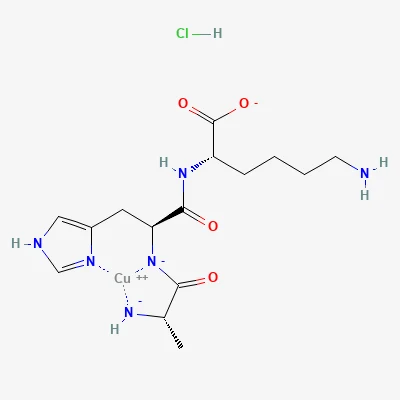
Sequence: AHK
Copper(II) complex. Free N-terminal amine and free C-terminal carboxylate; no amidation or acylation. The PubChem record describes the monohydrochloride.
What Is AHK-Cu?
AHK-Cu is the copper(II) complex of L-alanyl-L-histidyl-L-lysine, a tripeptide that differs from the better-known GHK only in its first amino acid. In GHK the N-terminal residue is glycine; in AHK it is alanine, which adds a single methyl group. The complex is also referred to as copper tripeptide-3.
Researchers have studied AHK-Cu as a tripeptide-copper complex in the context of hair growth.[1] It belongs to the same family of small copper-binding peptides as GHK-Cu, but it has a much smaller research record.
Peer-reviewed data on AHK-Cu are limited. Only one study found in PubMed as of October 2026 examined AHK-Cu directly, and no animal or human studies of it were identified. Findings on GHK-Cu should not be assumed to apply to AHK-Cu.
Chemical Structure and Molecular Identity
AHK-Cu consists of the three standard L-amino acids alanine, histidine and lysine, coordinated to one copper(II) ion. PubChem (CID 168431292) describes the complex as a monohydrochloride, [L-alanyl-N-L-histidyl-N,N3-L-lysinato(2-)]copper monohydrochloride, with the molecular formula C15H24ClCuN6O4- and a molecular weight of 451.39 g/mol.
The systematic name indicates that copper is bound by nitrogen atoms from the peptide backbone and from the histidine imidazole ring. The peptide keeps a free N-terminal amine on alanine and a free C-terminal carboxylate on lysine.
Key identifiers
- PubChem CID: 168431292
- CAS number: 682809-81-0
- InChIKey: DTNUNAICWDULHO-UVEFGIHYSA-L
- Synonyms: AHK-Cu, copper tripeptide-3, Ala-His-Lys copper
What the Published Literature Covers
The published literature on AHK-Cu consists of a single 2007 laboratory study on human hair follicles and dermal papilla cells.[1] Dermal papilla cells are specialized fibroblasts that are important in the formation and growth of hair follicles.[1]
Hair follicle and cell findings
- Ex vivo: AHK-Cu stimulated the elongation of isolated human hair follicles.[1]
- In vitro: AHK-Cu stimulated the proliferation of cultured human dermal papilla cells.[1]
- Apoptosis markers: at the highest concentration tested, AHK-Cu raised the Bcl-2/Bax ratio and reduced cleaved caspase-3 and PARP. The number of apoptotic cells fell, but the decrease was not statistically significant.[1]
The authors proposed that AHK-Cu promotes hair follicle growth by stimulating dermal papilla cell proliferation and preventing their apoptosis.[1] In their background, they described tripeptide-copper complexes as growth factors for differentiated cells that stimulate dermal fibroblast proliferation and VEGF production.[1]
No in-vivo animal studies, controlled human trials or safety studies of AHK-Cu were found. Its pharmacology, stability and skin penetration have not been characterized in peer-reviewed work.
With so little published data, researchers typically confirm AHK-Cu identity and copper content using HPLC and mass spectrometry certificates of analysis.
With so little published data, researchers typically confirm AHK-Cu identity and copper content using HPLC and mass spectrometry certificates of analysis.
Regulatory and Research Status
AHK-Cu is not approved by the FDA as a drug for any indication. With one ex-vivo and in-vitro study in the peer-reviewed record, it remains an early-stage research compound.
AHK-Cu is supplied as a research chemical for laboratory use. Because it is closely related to GHK-Cu, it is sometimes discussed alongside that compound, but the two are distinct molecules with separate identifiers and evidence bases.
Commonly Supplied Research Formats
AHK-Cu is listed by 4 of the 11 major U.S. research-peptide suppliers we track. The most commonly listed formats are:
- 100mg
- 200mg
- 50mg
Supplier catalog survey, October 2026. Quantities refer to net peptide per vial as labeled.
Frequently Asked Questions
Is AHK-Cu the same as GHK-Cu?
No. Both are copper(II) complexes of tripeptides ending in histidine and lysine, but AHK-Cu begins with alanine while GHK-Cu begins with glycine. They have different molecular weights, CAS numbers and PubChem records. GHK-Cu has a much larger research literature, and its findings should not be assumed to apply to AHK-Cu.
What is the molecular weight of AHK-Cu?
PubChem (CID 168431292) lists AHK-Cu as a monohydrochloride with a molecular weight of 451.39 g/mol. The CAS number is 682809-81-0. Because a salt or counterion changes the total mass, researchers should check which form a certificate of analysis reports when comparing mass spectrometry results.
What does the research on AHK-Cu show?
Published research is limited to one 2007 laboratory study. In it, AHK-Cu stimulated elongation of isolated human hair follicles and proliferation of cultured dermal papilla cells, and shifted apoptosis-related proteins in a protective direction. No animal studies, human trials or safety studies of AHK-Cu were found in PubMed as of October 2026.
Is AHK-Cu FDA approved?
No. AHK-Cu is not approved by the FDA as a drug for any indication. Its peer-reviewed record consists of a single ex-vivo and in-vitro study on human hair follicle cells, and no controlled human trials were found. It is supplied as a research chemical for laboratory use.
References
- Pyo HK, Yoo HG, Won CH, et al. The effect of tripeptide-copper complex on human hair growth in vitro. Archives of pharmacal research 2007. PMID 17703734 · DOI
Related Compounds
This profile summarizes chemical data and peer-reviewed literature for educational and laboratory-research reference. It is not medical advice, and nothing here describes or recommends use in humans or animals. How we source and verify data.