Nonapeptide-1
Nonapeptide-1 is a synthetic nine-residue peptide, Met-Pro-D-Phe-Arg-D-Trp-Phe-Lys-Pro-Val-NH2, designed as a modified analog of residues 5 to 13 of alpha-melanocyte-stimulating hormone (alpha-MSH). It has the formula C61H87N15O9S and a molecular weight of 1206.5 g/mol. No peer-reviewed studies specifically on nonapeptide-1 were found in PubMed as of October 2026.
Last reviewed · Identity data matched to PubChem
Key facts
- Class: synthetic cosmetic peptide; modified alpha-MSH (5-13) fragment analog
- Sequence: Met-Pro-D-Phe-Arg-D-Trp-Phe-Lys-Pro-Val-NH2, nine residues including two D-amino acids
- Formula C61H87N15O9S; molecular weight 1206.5 g/mol (PubChem CID 10418849)
- CAS 158563-45-2; UNII 64W45420K5
- Peer-reviewed literature: no PubMed studies on this molecule found as of October 2026
- Regulatory status: not an FDA-approved drug; used as a cosmetic ingredient
Chemical Identity
| Molecular formula | C61H87N15O9S |
|---|---|
| Molecular weight | 1206.5 g/mol |
| Monoisotopic mass | 1205.6532 Da |
| CAS number | 158563-45-2 |
| PubChem CID | 10418849 |
| UNII | 64W45420K5 |
| InChIKey | KNFLNGRLKALWRF-LDXSYGEZSA-N |
| Compound type | Peptide |
| H-bond donors / acceptors | 12 / 13 |
| XLogP3 | 2.3 |
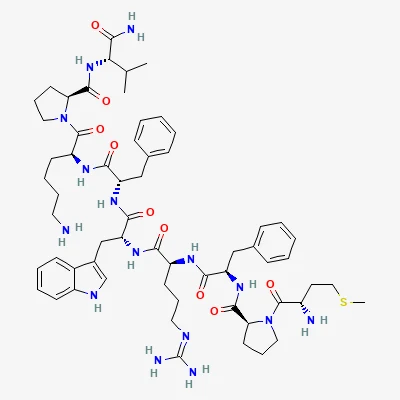
Structure notes: Met-Pro-D-Phe-Arg-D-Trp-Phe-Lys-Pro-Val with a C-terminal amide; D-phenylalanine at position 3 and D-tryptophan at position 5, all other chiral residues L; free N-terminal amine. Corresponds to alpha-MSH residues 5-13 with substitutions Met5, Pro6, D-Phe7, D-Trp9 and Phe10.
What Is Nonapeptide-1?
Nonapeptide-1 is a synthetic peptide of nine amino acids built as a modified fragment of alpha-melanocyte-stimulating hormone (alpha-MSH), a hormone involved in skin pigmentation. It is a cosmetic ingredient listed under the INCI name nonapeptide-1 and is marketed for skin-tone and brightening formulations.
Peer-reviewed data on nonapeptide-1 are essentially absent. A PubMed search for this page found no studies that specifically examine this molecule as of October 2026. Claims about how it affects pigmentation therefore come from manufacturer materials rather than from independent published research, and they are not repeated here as findings.
Chemical Structure and Molecular Identity
Nonapeptide-1 is L-methionyl-L-prolyl-D-phenylalanyl-L-arginyl-D-tryptophyl-L-phenylalanyl-L-lysyl-L-prolyl-L-valinamide (Met-Pro-D-Phe-Arg-D-Trp-Phe-Lys-Pro-Val-NH2). PubChem (CID 10418849) lists the molecular formula C61H87N15O9S and a molecular weight of 1206.5 g/mol. The single sulfur atom comes from the N-terminal methionine.
The peptide contains two D-amino acids, D-phenylalanine at position 3 and D-tryptophan at position 5, and its C-terminal valine is amidated. Because of these modifications, it cannot be written as a standard one-letter sequence.
Three aromatic residues (D-phenylalanine, D-tryptophan and phenylalanine) sit beside two basic residues (arginine and lysine), giving the molecule both hydrophobic and positively charged regions. PubChem gives a computed XLogP of 2.3.
Relationship to alpha-MSH
PubChem lists nonapeptide-1 under the synonym (Met5, Pro6, D-Phe7, D-Trp9, Phe10)-alpha-MSH (5-13). In other words, it spans positions 5 through 13 of the 13-residue alpha-MSH sequence, keeps the native arginine, lysine, proline and C-terminal valinamide at positions 8, 11, 12 and 13, and replaces the other five positions as shown below.
| alpha-MSH position | Native residue | Nonapeptide-1 residue |
|---|---|---|
| 5 | Glu | Met |
| 6 | His | Pro |
| 7 | Phe | D-Phe |
| 8 | Arg | Arg |
| 9 | Trp | D-Trp |
| 10 | Gly | Phe |
| 11 to 13 | Lys-Pro-Val-NH2 | Lys-Pro-Val-NH2 |
Key identifiers
- CAS number: 158563-45-2
- InChIKey: KNFLNGRLKALWRF-LDXSYGEZSA-N
- UNII: 64W45420K5
What the Published Literature Covers
No peer-reviewed studies on nonapeptide-1 itself were found in PubMed as of October 2026. There are no indexed cell, animal or human studies of this sequence to summarize.
The PubMed search for this page returned only general papers on melanogenesis, tyrosinase inhibitors and the melanocortin system. None of them names or tests nonapeptide-1, so they were excluded rather than used to infer its activity.
Its design as an alpha-MSH fragment analog indicates the biological system it was intended to address, but structural resemblance alone does not establish whether the peptide activates, blocks or ignores melanocortin receptors. Those properties have not been reported in the indexed literature.
With two D-amino acids and no published reference data, researchers typically confirm nonapeptide-1 identity and purity with HPLC and mass spectrometry certificates of analysis.
Regulatory and Research Status
Nonapeptide-1 is not an FDA-approved drug. It is used as a cosmetic ingredient and has not been studied in drug-development clinical trials.
With no peer-reviewed literature, its receptor activity, effect on pigmentation, skin penetration and safety profile have not been independently characterized. It should not be confused with alpha-MSH analogs that have been studied clinically, such as afamelanotide, which is a full-length 13-residue analog with a different structure.
Basic characterization, such as receptor-binding assays, stability in formulations and activity in standardized pigment-cell or skin models, would need to be published before its effects could be assessed.
Commonly Supplied Research Formats
Nonapeptide-1 is listed by 2 of the 11 major U.S. research-peptide suppliers we track. The most commonly listed formats are:
- 200mg
Supplier catalog survey, October 2026. Quantities refer to net peptide per vial as labeled.
Frequently Asked Questions
What is the molecular weight of nonapeptide-1?
PubChem lists nonapeptide-1 (CID 10418849) with a molecular weight of 1206.5 g/mol and the molecular formula C61H87N15O9S. Its sequence is Met-Pro-D-Phe-Arg-D-Trp-Phe-Lys-Pro-Val-NH2, with two D-amino acids and an amidated C-terminus. The CAS number is 158563-45-2 and the InChIKey is KNFLNGRLKALWRF-LDXSYGEZSA-N. PubChem also records it with UNII 64W45420K5.
Is nonapeptide-1 the same as alpha-MSH?
No. Alpha-MSH is a 13-residue hormone, while nonapeptide-1 is a nine-residue synthetic analog covering positions 5 to 13 of that sequence. It replaces five of those positions, including two with D-amino acids, so its structure differs substantially from the natural hormone. Its receptor activity has not been reported in peer-reviewed studies.
Is nonapeptide-1 the same as afamelanotide or melanotan?
No. Afamelanotide is a full-length 13-residue alpha-MSH analog, [Nle4, D-Phe7]-alpha-MSH, that has been studied clinically. Nonapeptide-1 is a shorter nine-residue fragment analog with a different set of substitutions, including D-tryptophan. Although both relate structurally to alpha-MSH, findings for afamelanotide or related melanotan peptides do not apply to nonapeptide-1.
Is nonapeptide-1 FDA approved?
No. Nonapeptide-1 is not an FDA-approved drug and has not been tested in drug-development clinical trials. It is used as a cosmetic ingredient. No peer-reviewed studies specifically on nonapeptide-1 were found in PubMed as of October 2026, so its activity and safety have not been independently characterized in published research.
What does the research on nonapeptide-1 show?
There is no peer-reviewed research to summarize. A PubMed search found no studies on nonapeptide-1 as of October 2026; results were limited to general melanogenesis and melanocortin papers that do not mention it. Descriptions of its effects on pigmentation come from manufacturer materials rather than from independent publications.
Related Compounds
This profile summarizes chemical data and peer-reviewed literature for educational and laboratory-research reference. It is not medical advice, and nothing here describes or recommends use in humans or animals. How we source and verify data.