Acetyl Hexapeptide-3
Also known as: Acetyl Hexapeptide-8
Acetyl hexapeptide-3 is a synthetic six-residue peptide, Ac-Glu-Glu-Met-Gln-Arg-Arg-NH2, designed as a non-toxic mimic of botulinum neurotoxin activity that interferes with the SNARE complex driving neurotransmitter release. Now listed under the INCI name acetyl hexapeptide-8, it is a cosmetic anti-wrinkle ingredient studied in neuronal, skin-penetration and small human studies. It is not an FDA-approved drug.
Last reviewed · Identity data matched to PubChem · 10 peer-reviewed sources
Key facts
- Class: synthetic SNARE-modulating cosmetic hexapeptide
- Sequence: Glu-Glu-Met-Gln-Arg-Arg; N-terminal acetyl group, C-terminal amide
- INCI name: acetyl hexapeptide-8; acetyl hexapeptide-3 is the earlier name
- PubChem CID 71587772; CAS 616204-22-9; FDA UNII L4EL31FWIL
- Origin: rational design program seeking non-toxic mimics of botulinum neurotoxin activity
- Evidence base: in-vitro, ex-vivo skin penetration and small human cosmetic studies
- Regulatory status: cosmetic ingredient reviewed by the CIR Expert Panel; not FDA approved as a drug
Chemical Identity
| Molecular formula | C34H60N14O12S |
|---|---|
| Molecular weight | 889.0 g/mol |
| CAS number | 616204-22-9 |
| Length | 6 amino acids |
| Compound type | Peptide |
| Data note | Formula and molecular weight calculated from the sequence Ac-EEMQRR-NH2; the PubChem record (CID 71587772) depicts a structure that does not match this sequence. |
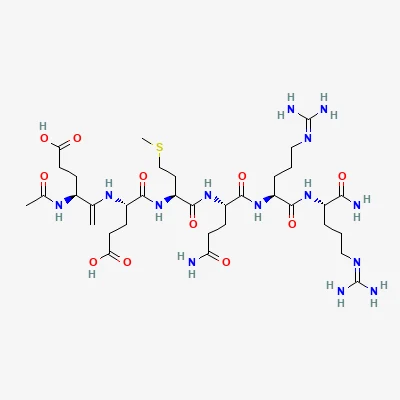
Sequence: EEMQRR
N-terminal acetyl group; C-terminal amide (Ac-EEMQRR-NH2).
What Is Acetyl Hexapeptide-3?
Acetyl hexapeptide-3 is a synthetic hexapeptide, Ac-EEMQRR-NH2, created through a rational design program to mimic, at much lower potency and without the toxicity, the anti-wrinkle action of botulinum neurotoxins. Its designers showed that it inhibits neurotransmitter release by interfering with the SNARE protein complex required for calcium-dependent exocytosis.[1]
The same molecule is listed under the INCI name acetyl hexapeptide-8, sometimes abbreviated AH-8. A 2025 review describes it as one of the most widely discussed biomimetic peptides in cosmeceuticals, used in topical products aimed at anti-aging, scar treatment and skin rejuvenation.[2]
The central research question about acetyl hexapeptide-3 is delivery. It is hydrophilic and relatively large, which limits its passage through the stratum corneum, and reviewers note that its ability to reach neuromuscular junctions after topical application remains uncertain.[2]
Chemical Structure and Molecular Identity
Acetyl hexapeptide-3 consists of six standard L-amino acids, glutamate, glutamate, methionine, glutamine, arginine and arginine, with an acetylated N-terminus and an amidated C-terminus. PubChem indexes it under CID 71587772, and its CAS number is 616204-22-9.
The sequence combines two acidic glutamate residues near the N-terminus with two basic arginine residues at the C-terminus, giving a highly polar, water-soluble peptide. This hydrophilicity is the main reason for its poor permeation through the lipid-rich outer layer of skin.[2]
The peptide can be quantified in skin layers and formulation matrices by hydrophilic interaction liquid chromatography with tandem mass spectrometry (HILIC-MS/MS), using stable isotope-labeled analogues as internal standards.[3][4] It also binds copper(II) ions, a property that has been used as a starting point for designing new copper-chelating derivatives.[5]
Names and synonyms
- INCI name: acetyl hexapeptide-8 (also acetyl hexapeptide-8 amide)
- Earlier name: acetyl hexapeptide-3
- Abbreviations: AH-8, Ac-EEMQRR-NH2
Research History and Development
Acetyl hexapeptide-3 was reported in 2002 as the product of a program to design non-toxic molecules that reproduce the anti-wrinkle action of botulinum neurotoxins. The original report described inhibition of neurotransmitter release, a skin topography study in healthy women, and an absence of oral toxicity or primary irritation in safety testing.[1]
Over the following decade, attention shifted to whether the peptide penetrates skin. Analytical chemists developed HILIC-MS/MS methods to measure it in tape strips, epidermis, dermis and receptor fluid, and these methods were used in diffusion-cell studies on animal and human skin.[4][3] Formulation scientists compared emulsion types to improve its delivery, noting that it had also been explored as a topical treatment for blepharospasm.[6]
Later work extended the sequence in new directions. Researchers studying the analgesic peptide DD04107, the palmitoylated version of the same hexapeptide, also tested its acetylated analogue on neuronal exocytosis, and chemists designed copper-binding variants of the sequence.[7][5] Public interest in the ingredient has also grown: a Google Trends analysis found that searches for it rose sharply in 2022, although they remained well below searches for botulinum neurotoxin. The authors linked the rise to the ingredient’s affordability, over-the-counter availability and ease of self-application.[8]
Mechanisms Studied in Research
Acetyl hexapeptide-3 is studied as an inhibitor of neuronal exocytosis: it interferes with the SNARE complex, and related work points to synaptotagmin-1 as a possible additional target.
SNARE complex interference
In the original mechanistic work, the hexapeptide inhibited neurotransmitter release with a potency similar to that of botulinum neurotoxin type A but with much lower efficacy. The inhibition was attributed to interference with the formation or stability of the vesicular fusion (SNARE) complex that drives calcium-dependent exocytosis.[1]
Synaptotagmin-1 binding
In primary sensory neurons, both DD04107 (the palmitoylated hexapeptide) and its acetylated analogue inhibited the exocytotic release of α-calcitonin gene-related peptide (α-CGRP). Side-chain scanning identified the first glutamate, methionine, glutamine and the final arginine as crucial for activity, and isothermal titration calorimetry showed that some peptides in the series bound directly to the C2B domain of synaptotagmin-1 but not synaptotagmin-7.[7]
Copper binding
The hexapeptide has a measurable affinity for copper(II) ions. Researchers characterized new derivatives by potentiometric titration and calorimetry and compared their cytotoxicity in human skin cells with that of the parent peptide and its copper complexes.[5]
How these mechanisms operate after topical application is not established. Reviewers describe the biological basis of reported skin effects, and particularly the peptide’s ability to inhibit muscle contraction through intact skin, as incompletely understood.[2]
Key Findings From Published Studies
Most published data on acetyl hexapeptide-3 concern its mechanism in neurons and its limited penetration into skin; human efficacy data are small-scale. Key results by model:
Skin penetration
- In diffusion cells with hairless guinea pig and human cadaver skin, most of the applied peptide was washed from the surface after 24 hours. What penetrated stayed mainly in the stratum corneum (0.54% of the applied amount in guinea pig and 0.22% in human skin), and about 0.01% reached the epidermis in both.[3]
- On porcine ear skin, a water-in-oil-in-water multiple emulsion significantly increased penetration compared with simple oil-in-water and water-in-oil emulsions, and water-rich vehicles outperformed the oil-rich one.[6]
Human studies
- In the 2002 report, skin topography analysis in healthy women showed wrinkle depth reductions of up to 30% after 30 days of use of an emulsion containing the peptide.[1]
- A 2025 review concluded that preclinical and clinical studies indicate the peptide may reduce wrinkle depth and improve elasticity and hydration, with some studies also reporting effects on scar remodeling and sebum regulation, while emphasizing that low skin penetration limits its bioavailability.[2]
- A 2014 dermatology review described it as an effective topical anti-wrinkle agent and suggested it could serve as an adjunct to intramuscular botulinum neurotoxin treatment.[9]
Neuronal and animal studies
- The acetylated hexapeptide inhibited α-CGRP release from primary sensory neurons; a cyclic palmitoylated derivative from the same series showed potent analgesic activity in an inflammatory pain model.[7]
Because published results hinge on the exact acetylated, amidated hexapeptide, researchers typically confirm identity and purity with HPLC and mass spectrometry certificates of analysis.
Because published results hinge on the exact acetylated, amidated hexapeptide, researchers typically confirm identity and purity with HPLC and mass spectrometry certificates of analysis.
Regulatory and Research Status
Acetyl hexapeptide-3 is a cosmetic ingredient and is not approved by the US Food and Drug Administration as a drug for any indication. It is reported to function in cosmetics as a skin conditioning agent.[10] The FDA has assigned it a Unique Ingredient Identifier (UNII L4EL31FWIL), which is a substance registration code and does not indicate approval.
The Expert Panel for Cosmetic Ingredient Safety (the Cosmetic Ingredient Review panel) assessed it under the name acetyl hexapeptide-8 amide. The panel concluded that it is safe in cosmetics in present practices of use at the low concentrations currently reported, and that the available data are insufficient to determine safety at higher concentrations.[10]
As a research compound, acetyl hexapeptide-3 is used to study SNARE-dependent exocytosis, peptide skin penetration and formulation design. Reviewers identify improved delivery systems as the main open problem, since the extent to which the peptide reaches its proposed neuromuscular target through intact skin has not been established.[2]
Commonly Supplied Research Formats
Acetyl Hexapeptide-3 is listed by 2 of the 11 major U.S. research-peptide suppliers we track. The most commonly listed formats are:
- 200mg
Supplier catalog survey, October 2026. Quantities refer to net peptide per vial as labeled.
Frequently Asked Questions
Is acetyl hexapeptide-3 the same as acetyl hexapeptide-8?
Yes. Acetyl hexapeptide-3 and acetyl hexapeptide-8 are two names for the same peptide, Ac-Glu-Glu-Met-Gln-Arg-Arg-NH2. Acetyl hexapeptide-8 is the current INCI name, and the Cosmetic Ingredient Review panel treats acetyl hexapeptide-8 amide as a synonym. PubChem lists both names under CID 71587772 with CAS number 616204-22-9.
How does acetyl hexapeptide-3 work?
In laboratory studies, acetyl hexapeptide-3 inhibits neurotransmitter release by interfering with the SNARE complex, the protein assembly that drives calcium-dependent vesicle fusion. Its potency was similar to botulinum neurotoxin type A but its efficacy much lower. Related work suggests synaptotagmin-1 may be an additional target. Whether these effects occur after topical application is not established.
Does acetyl hexapeptide-3 penetrate the skin?
Only to a small extent in published studies. In diffusion cells with human cadaver skin, most applied peptide was washed off the surface, about 0.22% remained in the stratum corneum and about 0.01% reached the epidermis. On porcine skin, water-in-oil-in-water emulsions increased penetration compared with simpler emulsions. Reviewers call low penetration its main limitation.
Is acetyl hexapeptide-3 FDA approved?
No. Acetyl hexapeptide-3 is not approved by the FDA as a drug for any condition. It is a cosmetic ingredient, and the Cosmetic Ingredient Review panel concluded it is safe in cosmetics at the low concentrations currently used, while finding data insufficient to assess higher concentrations. Cosmetic ingredients are not subject to FDA premarket approval.
How is acetyl hexapeptide-3 different from botulinum toxin?
Acetyl hexapeptide-3 is a six-residue synthetic peptide, while botulinum neurotoxins are large bacterial proteins. Both target SNARE-dependent neurotransmitter release, but in the original study the peptide had much lower efficacy than botulinum neurotoxin type A and showed no oral toxicity or primary irritation. Its ability to reach nerve endings through intact skin remains uncertain.
How is acetyl hexapeptide-3 related to acetyl octapeptide-3?
Acetyl octapeptide-3 extends the acetyl hexapeptide-3 sequence by two residues. Acetyl hexapeptide-3 is Ac-EEMQRR-NH2, while acetyl octapeptide-3 is Ac-EEMQRRAD-NH2, with alanine and aspartate added before the C-terminal amide. Both are acetylated, amidated cosmetic peptides, but acetyl hexapeptide-3 has a considerably larger published literature.
References
- Blanes-Mira C, Clemente J, Jodas G, et al. A synthetic hexapeptide ([acetyl hexapeptide-3]) with antiwrinkle activity. International journal of cosmetic science 2002. PMID 18498523 · DOI
- Zdrada-Nowak J, Surgiel-Gemza A, Szatkowska M. Acetyl Hexapeptide-8 in Cosmeceuticals-A Review of Skin Permeability and Efficacy. International journal of molecular sciences 2025. PMID 40565185 · DOI
- Kraeling ME, Zhou W, Wang P, et al. In vitro skin penetration of acetyl hexapeptide-8 from a cosmetic formulation. Cutaneous and ocular toxicology 2015. PMID 24754410 · DOI
- Zhou W, Wang PG, Ogunsola OA, et al. Rapid determination of hexapeptides by hydrophilic interaction LC-MS/MS for in vitro skin-penetration studies. Bioanalysis 2013. PMID 23742305 · DOI
- Wyrzykowski D, Wieczorek R, Kloska A, et al. Influence of the modification of the cosmetic peptide [acetyl hexapeptide-3] on the affinity toward copper(II) ions. Journal of peptide science : an official publication of the European Peptide Society 2024. PMID 37752675 · DOI
- Hoppel M, Reznicek G, Kählig H, et al. Topical delivery of acetyl hexapeptide-8 from different emulsions: influence of emulsion composition and internal structure. European journal of pharmaceutical sciences : official journal of the European Federation for Pharmaceutical Sciences 2015. PMID 25497319 · DOI
- Butrón D, Zamora-Carreras H, Devesa I, et al. DD04107-Derived neuronal exocytosis inhibitor peptides: Evidences for synaptotagmin-1 as a putative target. Bioorganic chemistry 2021. PMID 34388485 · DOI
- Olsson SE, Sreepad B, Lee T, et al. Public Interest in Acetyl Hexapeptide-8: Longitudinal Analysis. JMIR dermatology 2024. PMID 38376906 · DOI
- Wisniewski JD, Ellis DL, Lupo MP. Facial rejuvenation: combining cosmeceuticals with cosmetic procedures. Cutis 2014. PMID 25279473
- Johnson W, Bergfeld WF, Belsito DV, et al. Safety Assessment of Acetyl Hexapeptide-8 Amide as Used in Cosmetics. International journal of toxicology 2025. PMID 40673537 · DOI
Related Compounds
This profile summarizes chemical data and peer-reviewed literature for educational and laboratory-research reference. It is not medical advice, and nothing here describes or recommends use in humans or animals. How we source and verify data.