Dipeptide Diaminobutyroyl Benzylamide Diacetate
Also known as: Syn-AKE
Dipeptide diaminobutyroyl benzylamide diacetate is a synthetic small peptide used as a cosmetic ingredient under this INCI name. It is built from beta-alanine, L-proline and L-2,4-diaminobutyric acid capped with a benzylamide, supplied as a diacetate salt (C23H37N5O7, 495.6 g/mol). Peer-reviewed data are limited to one in-silico and in-vitro study and one study of a multi-ingredient serum.
Last reviewed · Identity data matched to PubChem · 2 peer-reviewed sources
Key facts
- Class: synthetic cosmetic peptide; INCI name dipeptide diaminobutyroyl benzylamide diacetate
- Structure: beta-alanyl-L-prolyl-L-2,4-diaminobutyric acid benzylamide, as a diacetate salt
- Formula C23H37N5O7 (salt); molecular weight 495.6 g/mol (PubChem CID 71465152)
- CAS 823202-99-9; UNII 38H206R00R
- Evidence base: one in-silico/in-vitro study and one ex-vivo and clinical study of a combination serum
- Regulatory status: not an FDA-approved drug; used as a cosmetic ingredient
Chemical Identity
| Molecular formula | C23H37N5O7 |
|---|---|
| Molecular weight | 495.6 g/mol |
| Monoisotopic mass | 495.2693 Da |
| CAS number | 823202-99-9 |
| PubChem CID | 71465152 |
| UNII | 38H206R00R |
| InChIKey | HSUGRPOJOBRRBK-SXBSVMRRSA-N |
| Compound type | Peptide |
| H-bond donors / acceptors | 6 / 9 |
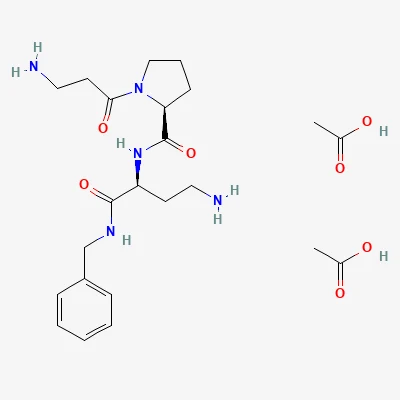
Structure notes: Contains non-standard units: N-terminal beta-alanine, L-proline and L-2,4-diaminobutyric acid (Dab), with the C-terminus capped as an N-benzylamide; supplied as a diacetate salt (H-beta-Ala-Pro-Dab-NH-Bzl x 2 AcOH).
What Is Dipeptide Diaminobutyroyl Benzylamide Diacetate?
Dipeptide diaminobutyroyl benzylamide diacetate is a synthetic small peptide used as an ingredient in anti-aging cosmetic formulations. It is identified by its INCI (International Nomenclature of Cosmetic Ingredients) name and is not a naturally occurring molecule.
Peer-reviewed data on this compound are limited. A PubMed search for this page found two studies that clearly address it: a 2024 in-silico and in-vitro study of the peptide on its own[1] and a 2026 ex-vivo and clinical study of a serum that contains it alongside several other active ingredients.[2]
Chemical Structure and Molecular Identity
The molecule is a short chain of three amino-acid units, beta-alanine, L-proline and L-2,4-diaminobutyric acid, with the C-terminus converted to a benzylamide. Because two of these units are non-standard amino acids and the C-terminus is capped, it cannot be written as a standard one-letter sequence. It is commonly abbreviated H-beta-Ala-Pro-Dab-NH-Bzl.
PubChem (CID 71465152) lists the diacetate salt with the molecular formula C23H37N5O7 and a molecular weight of 495.6 g/mol. The formula includes two molecules of acetic acid; the peptide portion itself corresponds to C19H29N5O3. The molecule carries two free primary amines, one on the beta-alanine and one on the diaminobutyric acid side chain, and the salt contains two acetate counterions per peptide molecule.
Key identifiers
- CAS number: 823202-99-9
- InChIKey: HSUGRPOJOBRRBK-SXBSVMRRSA-N
- UNII: 38H206R00R
- Systematic name: (2S)-beta-alanyl-L-prolyl-2,4-diamino-N-(phenylmethyl)butanamide diacetate
What the Published Literature Covers
The published literature consists of one computational and cell-free study of the isolated peptide and one study in which it was a single component of a multi-ingredient serum. No controlled study testing the peptide alone in human skin was found.
In-silico and in-vitro study (2024)
Researchers used molecular docking to model interactions between the peptide and matrix metalloproteinases (MMP-1, MMP-8 and MMP-13) and sirtuin 1 (SIRT1). Docking scores ranked the MMPs in the order MMP-13 < MMP-8 < MMP-1, and the most stable predicted binding was to SIRT1, at -9.32 kcal/mol. In 50 ns molecular dynamics simulations, the peptide remained stable in the active sites of MMP-13 and SIRT1.[1]
The same study reported concentration-dependent radical scavenging in the DPPH antioxidant assay and assessed safety with an MTT cytotoxicity test and an Ames genotoxicity test. The authors concluded that the peptide may hold promise for anti-aging formulations.[1] These are computational predictions and laboratory assays, not measurements in living skin.
Combination serum study (2026)
A serum containing acetyl hexapeptide-8, dipeptide diaminobutyroyl benzylamide diacetate, gluconolactone, niacinamide and laminaria extract was tested ex vivo on skin samples and in two clinical studies. Ex vivo, the serum increased biomarkers including elastic fibers and collagen fibers. In a 50-participant study of static wrinkles, mean clinical scores for various wrinkle types improved by 35% to 69% after 12 weeks; in a 42-participant study of dynamic wrinkles, scores improved by 10% to 13% (all p < 0.001).[2]
Because the serum combined several actives, these results cannot be attributed to dipeptide diaminobutyroyl benzylamide diacetate alone, and the abstract does not describe a placebo comparison.[2]
Because it contains non-standard amino acids and a diacetate salt form, researchers typically confirm identity with HPLC and mass spectrometry certificates of analysis.
Regulatory and Research Status
Dipeptide diaminobutyroyl benzylamide diacetate is not an FDA-approved drug. It is used as a cosmetic ingredient under its INCI name, and it has not been evaluated in drug-development clinical trials.
The research base is small and recent. Its proposed activity rests on docking simulations and in-vitro assays, and the only human data come from a combination product.[1][2] Independent studies of the isolated peptide in skin models or controlled human trials have not been published in PubMed as of October 2026.
Commonly Supplied Research Formats
Dipeptide Diaminobutyroyl Benzylamide Diacetate is listed by 2 of the 11 major U.S. research-peptide suppliers we track. The most commonly listed formats are:
- 200mg
Supplier catalog survey, October 2026. Quantities refer to net peptide per vial as labeled.
Frequently Asked Questions
What is the molecular weight of dipeptide diaminobutyroyl benzylamide diacetate?
PubChem lists dipeptide diaminobutyroyl benzylamide diacetate with a molecular weight of 495.6 g/mol and the formula C23H37N5O7. That value is for the diacetate salt, which includes two acetic acid molecules. The peptide portion alone corresponds to C19H29N5O3. Its CAS number is 823202-99-9 and its PubChem CID is 71465152.
Is dipeptide diaminobutyroyl benzylamide diacetate FDA approved?
No. Dipeptide diaminobutyroyl benzylamide diacetate is not an FDA-approved drug and has not been studied in drug-development clinical trials. It is used as a cosmetic ingredient under its INCI name. Published research consists of one in-silico and in-vitro study and one study of a multi-ingredient serum, so its evidence base remains limited.
What does the research on dipeptide diaminobutyroyl benzylamide diacetate show?
A 2024 study predicted by docking that the peptide binds sirtuin 1 and several matrix metalloproteinases, and reported concentration-dependent antioxidant activity in a DPPH assay along with cytotoxicity and Ames testing. A 2026 study found wrinkle and skin-quality improvements with a serum containing it plus other actives, so effects of the peptide alone remain unmeasured.
Is dipeptide diaminobutyroyl benzylamide diacetate the same as acetyl hexapeptide-8?
No. Acetyl hexapeptide-8 is an acetylated six-residue peptide, while dipeptide diaminobutyroyl benzylamide diacetate is a much smaller molecule built from beta-alanine, proline and diaminobutyric acid with a benzylamide cap. The two were combined in one serum in a 2026 ex-vivo and clinical study, but they are distinct ingredients with different structures.
Is dipeptide diaminobutyroyl benzylamide diacetate made from snake venom?
No. It is a fully synthetic small peptide made from beta-alanine, L-proline and L-2,4-diaminobutyric acid with a benzylamide cap, and it contains no venom-derived material. It is sometimes marketed as venom-inspired, but that design rationale is not documented in the peer-reviewed abstracts available in PubMed, which simply describe it as a synthetic peptide.
References
- Gok B, Budama-Kilinc Y, Kecel-Gunduz S. Anti-aging activity of [dipeptide diaminobutyroyl benzylamide diacetate] peptide by in silico approaches and in vitro tests. Journal of biomolecular structure & dynamics 2024. PMID 37349941 · DOI
- Zhu M, He X, Zhu Z, et al. The effect of a serum containing acetyl hexapeptide-8, dipeptide diaminobutyroyl benzylamide diacetate and gluconolactone on skin biomarkers, wrinkles and skin texture: Ex vivo and clinical studies. International journal of cosmetic science 2026. PMID 41668671 · DOI
Related Compounds
This profile summarizes chemical data and peer-reviewed literature for educational and laboratory-research reference. It is not medical advice, and nothing here describes or recommends use in humans or animals. How we source and verify data.