AOD-9604
Also known as: Tyr-hGH(177-191) · Anti-Obesity Drug 9604
AOD-9604 is a synthetic 16-amino-acid peptide modeled on the C-terminal region of human growth hormone, consisting of residues 177-191 with an added N-terminal tyrosine and an internal disulfide bond. Its code stands for Anti-Obesity Drug 9604. It reached phase IIa obesity trials in the early 2000s but is not FDA approved, and peer-reviewed data indexed for it are limited.
Last reviewed · Identity data matched to PubChem · 3 peer-reviewed sources
Key facts
- Class: synthetic peptide analog of the human growth hormone C-terminus
- Length: 16 amino acids, Tyr followed by hGH residues 177-191
- One disulfide bond between the two cysteines (positions 7 and 14)
- Formula C78H123N23O23S2; molecular weight 1815.1 g/mol; CAS 221231-10-3
- Name stands for Anti-Obesity Drug 9604
- Reached phase IIa obesity trials by February 2002
- Regulatory status: not FDA approved; prohibited in sport by WADA
Chemical Identity
| Molecular formula | C78H123N23O23S2 |
|---|---|
| Molecular weight | 1815.1 g/mol |
| Monoisotopic mass | 1813.8604 Da |
| CAS number | 221231-10-3 |
| PubChem CID | 71300630 |
| UNII | 7UP768IP4M |
| InChIKey | GVIYUKXRXPXMQM-BPXGDYAESA-N |
| Length | 16 amino acids |
| Compound type | Peptide |
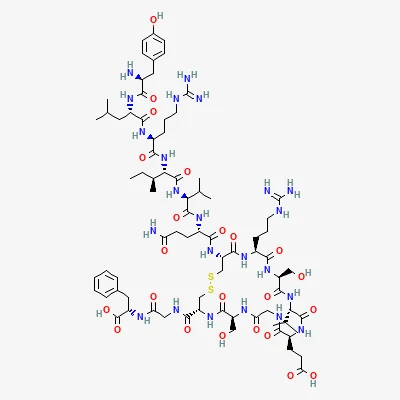
Sequence: YLRIVQCRSV EGSCGF
Intramolecular disulfide bond between Cys7 and Cys14 (cyclic 7-14 disulfide); free N-terminal amine and free C-terminal carboxylic acid. Residues 2-16 correspond to hGH 177-191, with tyrosine in place of the native phenylalanine at position 176.
What Is AOD-9604?
AOD-9604 is a synthetic peptide derived from the far C-terminal end of human growth hormone (hGH), developed as a candidate anti-obesity drug. Its name is short for anti-obesity drug 9604[1]. The sequence copies hGH residues 177-191 and adds a tyrosine at the N-terminus, which is why it is also written Tyr-hGH(177-191).
It is closely related to HGH Fragment 176-191, which carries the native phenylalanine at the first position. The two are easily confused, but they are distinct molecules with different formulas. Peer-reviewed data indexed specifically under the AOD-9604 name are limited, and much of what is available comes from drug-development summaries and narrative reviews.
Chemical Structure and Molecular Identity
AOD-9604 is a 16-residue peptide, YLRIVQCRSVEGSCGF, with one intramolecular disulfide bond and the molecular formula C78H123N23O23S2. PubChem lists a molecular weight of 1815.1 g/mol under CID 71300630, CAS number 221231-10-3 and InChIKey GVIYUKXRXPXMQM-BPXGDYAESA-N.
The PubChem structure shows a disulfide bridge linking the cysteines at positions 7 and 14, which closes an eight-residue ring, with a free N-terminal amine and a free C-terminal carboxylic acid. The formula matches this sequence exactly when the disulfide is formed. The two sulfur atoms in the formula come from those cysteines.
- Length: 16 amino acids, all standard L-residues
- Disulfide: Cys7-Cys14
- Basic residues: Arg3 and Arg8
- Acidic residue: Glu12
- Difference from HGH Fragment 176-191: Tyr instead of Phe at position 1, adding one oxygen atom (C78H123N23O23S2 versus C78H123N23O22S2)
What the Published Literature Covers
Indexed literature on AOD-9604 by name is sparse and consists mainly of a drug-development summary and recent narrative reviews. No primary trial report or detailed preclinical study under the AOD-9604 name was among the PubMed records available for this page.
Clinical development
A 2004 drug-development profile reported that the company Metabolic was developing AOD-9604 for the potential treatment of obesity and that phase IIa trials were under way by February 2002[2]. The profile’s abstract does not report trial outcomes, and no approved product followed.
Reviews
A 2026 narrative review in Sports Medicine listed AOD-9604 among prominent unapproved peptides marketed directly to patients through a gray market operating largely outside regulatory oversight. It concluded that many such peptides show favorable outcomes in animal models but that rigorous human safety data are scarce, with potential for serious harm[1].
A 2026 orthopaedic review grouped AOD-9604 with peptides acting on growth hormone and IGF-1 signaling and stated that, although preclinical studies are promising, clinical trials are currently lacking[3]. Neither review reports new experimental data on AOD-9604.
Because AOD-9604 and HGH Fragment 176-191 differ by a single residue, researchers typically confirm identity by mass spectrometry and purity by HPLC.
Because AOD-9604 and HGH Fragment 176-191 differ by a single residue, researchers typically confirm identity by mass spectrometry and purity by HPLC.
Regulatory and Research Status
AOD-9604 is not an FDA-approved drug. Its clinical program reached phase IIa for obesity[2], and recent reviews classify it as an unapproved peptide[1].
In sport, the World Anti-Doping Agency Prohibited List names AOD-9604 and hGH 176-191 as examples of prohibited growth hormone fragments. The current edition of that list is the authoritative reference.
For researchers, the main limitation is the small body of indexed, peer-reviewed data under this name. Studies should state whether they used AOD-9604 or the native-sequence HGH Fragment 176-191, since the literature does not always distinguish them.
Commonly Supplied Research Formats
AOD-9604 is listed by 8 of the 11 major U.S. research-peptide suppliers we track. The most commonly listed formats are:
- 5mg
- 10mg
- 4mg + BAC WATER
- 2mg
Supplier catalog survey, October 2026. Quantities refer to net peptide per vial as labeled.
Frequently Asked Questions
Is AOD-9604 the same as HGH Fragment 176-191?
No, but they are closely related. Both are 16-residue peptides from the C-terminus of human growth hormone with a Cys7-Cys14 disulfide. AOD-9604 has tyrosine at position 1, while HGH Fragment 176-191 has the native phenylalanine. Their formulas differ by one oxygen atom: C78H123N23O23S2 for AOD-9604 and C78H123N23O22S2 for the fragment.
What is the molecular weight of AOD-9604?
AOD-9604 has a molecular weight of 1815.1 g/mol according to PubChem (CID 71300630). Its molecular formula is C78H123N23O23S2 and its CAS number is 221231-10-3. The formula corresponds to the sequence YLRIVQCRSVEGSCGF with one internal disulfide bond, a free N-terminal amine and a free C-terminal acid.
Is AOD-9604 FDA approved?
No. AOD-9604 has not been approved by the FDA for any use. A drug-development profile reported phase IIa obesity trials under way by February 2002, but no approved product followed. A 2026 review in Sports Medicine lists it among unapproved peptides marketed directly to patients, and WADA prohibits it in sport.
What does the research on AOD-9604 show?
Peer-reviewed literature indexed under the AOD-9604 name is limited. Available records include a 2004 development profile noting phase IIa obesity trials and recent narrative reviews. These reviews state that animal data for peptides of this kind are favorable but that rigorous human safety data and clinical trials are lacking.
References
- Mendias CL, Awan TM. Safety and Efficacy of Approved and Unapproved Peptide Therapies for Musculoskeletal Injuries and Athletic Performance. Sports medicine (Auckland, N.Z.) 2026. PMID 41966639 · DOI
- Wilding J. AOD-9604 Metabolic. Current opinion in investigational drugs (London, England : 2000) 2004. PMID 15134286
- Rahman OF, Lee SJ, Seeds WA. Therapeutic Peptides in Orthopaedics: Applications, Challenges, and Future Directions. Journal of the American Academy of Orthopaedic Surgeons. Global research & reviews 2026. PMID 41490200 · DOI
Related Compounds
This profile summarizes chemical data and peer-reviewed literature for educational and laboratory-research reference. It is not medical advice, and nothing here describes or recommends use in humans or animals. How we source and verify data.