SLU-PP-332
SLU-PP-332 is a synthetic small-molecule agonist of the estrogen-related receptors ERRα, ERRβ and ERRγ, with highest potency at ERRα. Described in 2023, it is studied as an exercise mimetic: in mice it increased oxidative muscle fibers, endurance, energy expenditure and fatty acid oxidation. It is not a peptide, is not FDA approved, and has no published human clinical trials.
Last reviewed · Identity data matched to PubChem · 9 peer-reviewed sources
Key facts
- Class: synthetic small-molecule pan-agonist of estrogen-related receptors (ERRα/β/γ)
- Not a peptide: an aryl acyl hydrazone with naphthalene and phenol groups
- Formula C18H14N2O2; molecular weight 290.3 g/mol; CAS 303760-60-3
- First reported in 2023 as an ERRα-dependent exercise mimetic in mice
- Related compound: SLU-PP-915, a structurally distinct, orally bioavailable pan-ERR agonist
- Exercise mimetics fall within a WADA-prohibited category in sport
- Regulatory status: not FDA approved; preclinical evidence only
Chemical Identity
| Molecular formula | C18H14N2O2 |
|---|---|
| Molecular weight | 290.3 g/mol |
| Monoisotopic mass | 290.1055 Da |
| CAS number | 303760-60-3 |
| PubChem CID | 5338394 |
| InChIKey | RNZIMBFHRXYRLL-XDHOZWIPSA-N |
| Compound type | Small molecule |
| H-bond donors / acceptors | 2 / 3 |
| XLogP3 | 3.7 |
What Is SLU-PP-332?
SLU-PP-332 is a synthetic small-molecule agonist that activates all three estrogen-related receptors (ERRα, ERRβ and ERRγ), with the highest potency for ERRα. Its 2023 discovery paper reported that it had pharmacokinetic properties sufficient for use as an in-vivo chemical tool[1].
The ERRs are orphan nuclear receptors that regulate genes involved in mitochondrial biogenesis, oxidative phosphorylation, fatty acid oxidation and the Krebs cycle, and they are essential for skeletal muscle adaptation to aerobic exercise[2]. Because SLU-PP-332 switches on an acute aerobic exercise gene program, it is studied as an exercise mimetic[1].
Despite being discussed alongside research peptides, SLU-PP-332 is not a peptide. A 2026 study describes it as a well-established exercise mimetic and widely used chemical probe for ERR activation[3]. All published efficacy data come from cell and animal models.
Chemical Structure and Molecular Identity
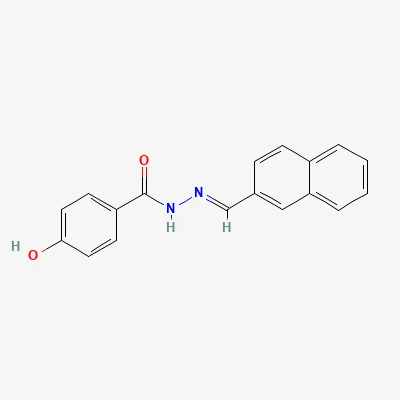
SLU-PP-332 is an aryl acyl hydrazone with the molecular formula C18H14N2O2 and a molecular weight of 290.3 g/mol. PubChem lists it under CID 5338394 with CAS number 303760-60-3 and InChIKey RNZIMBFHRXYRLL-XDHOZWIPSA-N.
Structurally, it links a 4-hydroxybenzoyl group through a hydrazone (C=N-NH-C=O) bridge to a 2-naphthyl group, with the E configuration at the C=N double bond. Its chemical name is (E)-4-hydroxy-N’-(naphthalen-2-ylmethylene)benzohydrazide, and PubChem also lists the synonym ERR pan-agonist 332.
- Ring systems: a phenol ring and a naphthalene ring
- Hydrogen-bond donors / acceptors: 2 / 3 (PubChem computed)
- Computed XLogP: 3.7, indicating a fairly lipophilic molecule
- Rotatable bonds: 3
In human liver S9 incubations, metabolism occurred mainly on these two ring systems: hydroxylation of the naphthalene or phenolic rings, plus direct glucuronidation and sulfation of the parent compound[4]. A 2026 structure-activity study was the first to systematically map which parts of the scaffold control ERRα and ERRγ agonism, ligand efficiency and physicochemical properties[3].
Research History and Development
SLU-PP-332 was first reported in 2023 and was followed by mouse studies in obesity and heart failure, a second-generation analog, and doping-control analytics. The 2023 ACS Chemical Biology paper noted that designing compounds with ERRα agonist activity had been difficult and that few synthetic agonists could target ERRs in vivo[1].
A 2024 study in Circulation described SLU-PP-332 and SLU-PP-915 as two structurally distinct pan-ERR agonists designed by a structure-based approach and tested them in a pressure-overload heart failure model[5]. The same year, a study in obese mice examined its effects on metabolic syndrome[6]. A 2026 paper reported that SLU-PP-332 lacks oral bioavailability, motivating characterization of the orally bioavailable SLU-PP-915[2].
As interest grew, anti-doping laboratories began characterizing its metabolites[7][4], and a 2026 systematic review covering 2020 to 2024 assessed pan-ERR agonists as exercise mimetics[8]. That same year, the first comprehensive structure-activity analysis of the SLU-PP-332 scaffold combined chemical synthesis, cell-based assays, gene-expression profiling, docking and molecular dynamics simulations[3].
Mechanisms Studied in Research
SLU-PP-332 acts by binding and activating ERR nuclear receptors, which switch on metabolic genes tied to mitochondrial function and fatty acid use. In a skeletal muscle cell line it increased mitochondrial function and cellular respiration, and in mice it induced an ERRα-specific acute aerobic exercise gene program[1].
Isoform dependence differs by tissue
| Tissue or model | Main ERR isoform | Reported effect |
|---|---|---|
| Mouse skeletal muscle | ERRα | ERRα activation was critical for enhanced exercise endurance[1] |
| Mouse heart (pressure overload) | ERRγ | Main mediator of transcriptional regulation and cardioprotection[5] |
| Mouse muscle gene expression | Pan-ERR | Induction of Ddit4, an acute-exercise gene, at or above treadmill-running levels depending on muscle[2] |
Downstream metabolic programs
In the heart, ERR agonists transcriptionally activated a broad set of metabolic genes, especially those for fatty acid metabolism and mitochondrial function, and increased mitochondrial oxidative capacity and fatty acid use in vitro and in vivo[5]. The 2026 systematic review summarized the gene program as ERRα-dependent and including Ddit4 and Slc25a25[8].
At the whole-body level, SLU-PP-332 mimicked exercise-induced benefits on metabolism in mice, including higher energy expenditure and fatty acid oxidation[6]. The review also notes the shift toward type IIa fibers, which are oxidative-glycolytic and use a mix of fatty acids and glucose[8].
Key Findings From Published Studies
Published findings on SLU-PP-332 are limited to mouse studies, cell culture and in-vitro metabolism work; no human trial has been reported. The main themes are endurance, obesity and metabolic syndrome, and heart failure.
Exercise capacity (mouse)
SLU-PP-332 increased type IIa oxidative skeletal muscle fibers and enhanced exercise endurance in mice[1]. A 2026 study found SLU-PP-915 enhanced running distance and duration to a similar extent as SLU-PP-332 under matched experimental conditions[2].
Obesity and metabolic syndrome (mouse)
In diet-induced obese and ob/ob mice, SLU-PP-332 increased energy expenditure and fatty acid oxidation, decreased fat mass accumulation, reduced obesity and improved insulin sensitivity[6]. The 2026 systematic review reported reduced adiposity, improved glycemic control and higher basal energy expenditure in obesity models without evident toxicity, plus restored mitochondrial function and reduced inflammation in aging kidneys[8].
Heart failure (mouse)
In a pressure overload-induced heart failure model, both SLU-PP-332 and SLU-PP-915 significantly improved ejection fraction, ameliorated fibrosis and increased survival without affecting cardiac hypertrophy. Metabolomics showed substantial normalization of fatty acid, lipid, TCA cycle and oxidative phosphorylation metabolites after six weeks of pressure overload[5].
Human cells and metabolism (in vitro)
- A 2025 pilot study treated primary myoblasts from the muscle of physically inactive women with SLU-PP-332 to assess metabolic and expression changes linked to ERR activation. At baseline, muscle from inactive women showed higher NOX4 and lower SIRT1, PGC-1α, ERRα and FNDC5 expression than muscle from active women[9].
- With human liver S9 fractions and microsomes, one laboratory identified nine metabolites (six phase I, three phase II)[7], while another, using S9 fractions, identified 22 hydroxylated, glucuronidated and sulfated metabolites[4].
Because hydrazones like SLU-PP-332 can isomerize or hydrolyze, researchers confirm identity and purity with HPLC and mass-spectrometry certificates of analysis.
Because hydrazones like SLU-PP-332 can isomerize or hydrolyze, researchers confirm identity and purity with HPLC and mass-spectrometry certificates of analysis.
Regulatory and Research Status
SLU-PP-332 is not an FDA-approved drug and has not been tested in published human clinical trials. The 2026 systematic review of pan-ERR agonists concluded that clinical trials are needed to confirm efficacy and safety in humans[8].
In sport, the World Anti-Doping Agency prohibits exercise mimetics and metabolic modulators, and doping-control laboratories have published in-vitro metabolite profiles of SLU-PP-332 to detect misuse[4]. A separate 2026 analytical study described the compound as having doping potential and characterized it by high-resolution mass spectrometry[7].
Development work has shifted partly toward analogs. The 2026 structure-activity study reported analogs with comparable or context-dependent transcriptional activity and improved ligand efficiency, solubility or metabolic stability, while describing SLU-PP-332 as a benchmark for ERR activation[3]. Open questions include long-term safety, the balance of isoform effects across tissues, and whether mouse findings translate to other species.
Commonly Supplied Research Formats
SLU-PP-332 is listed by 4 of the 11 major U.S. research-peptide suppliers we track. The most commonly listed formats are:
- 5mg
- 1000mcg x 60 (capsules)
- 250mcg x 100 (capsules)
- 500mcg x 100 (capsules)
- 250mcg (capsules)
Supplier catalog survey, October 2026. Quantities refer to net peptide per vial as labeled.
Frequently Asked Questions
What is SLU-PP-332?
SLU-PP-332 is a synthetic small molecule that activates the estrogen-related receptors ERRα, ERRβ and ERRγ, with the highest potency at ERRα. First reported in 2023, it is studied as an exercise mimetic because it switches on an acute aerobic exercise gene program in mouse muscle. It is not a peptide and has no published human trials.
Is SLU-PP-332 a peptide?
No. SLU-PP-332 is a small organic molecule, an acyl hydrazone with the formula C18H14N2O2 and a molecular weight of 290.3 g/mol. It contains a phenol ring and a naphthalene ring joined by a hydrazone linker. It is often discussed alongside research peptides because of shared interest in mitochondrial and metabolic research.
What is the molecular weight of SLU-PP-332?
SLU-PP-332 has a molecular weight of 290.3 g/mol according to PubChem (CID 5338394). Its molecular formula is C18H14N2O2, its CAS number is 303760-60-3, and its chemical name is (E)-4-hydroxy-N'-(naphthalen-2-ylmethylene)benzohydrazide. PubChem also lists the synonym ERR pan-agonist 332, which reflects its activity across all three ERR isoforms.
Is SLU-PP-332 FDA approved?
No. SLU-PP-332 is not FDA approved and has not been tested in published human clinical trials. Evidence comes from mouse studies, cell culture and in-vitro metabolism work. A 2026 systematic review concluded that clinical trials are needed to confirm efficacy and safety in humans. The World Anti-Doping Agency prohibits exercise mimetics in sport.
How is SLU-PP-332 different from SLU-PP-915?
Both are pan-ERR agonists, but they are structurally distinct. SLU-PP-915 is a chemically different, orally bioavailable compound, characterized partly because SLU-PP-332 lacks oral bioavailability. In mice, the two compounds produced similar gains in running distance and duration and similar heart failure benefits in a pressure overload model.
Why is SLU-PP-332 called an exercise mimetic?
SLU-PP-332 is called an exercise mimetic because, in mice, it induced an ERRα-dependent gene program similar to acute aerobic exercise, including the gene Ddit4. It also increased oxidative type IIa muscle fibers, endurance, energy expenditure and fatty acid oxidation. These effects have been shown in animals and cells, not in people.
What does the research on SLU-PP-332 show?
In mice, SLU-PP-332 enhanced exercise endurance, reduced fat mass and obesity, improved insulin sensitivity, and in a heart failure model improved ejection fraction, reduced fibrosis and increased survival. In-vitro studies with human liver fractions identified multiple metabolites for doping control. No human efficacy or safety data have been published.
References
- Billon C, Sitaula S, Banerjee S, et al. Synthetic ERRα/β/γ Agonist Induces an ERRα-Dependent Acute Aerobic Exercise Response and Enhances Exercise Capacity. ACS chemical biology 2023. PMID 36988910 · DOI
- Billon C, Appourchaux K, Côté I, et al. An orally active estrogen receptor-related receptor agonist, SLU-PP-915, enhances aerobic exercise capacity. The Journal of pharmacology and experimental therapeutics 2026. PMID 41421047 · DOI
- Okda HE, Zhao P, Hayes M, et al. Chemical optimization of the exercise mimetic SLU-PP-332 enables insight into estrogen-related receptor signaling. International journal of biological macromolecules 2026. PMID 41850449 · DOI
- Avliyakulov NK, Sobolevsky T, Ahrens E. Analysis and Identification of In Vitro Metabolites of Exercise Mimetic SLU-PP-332 ERRα/β/γ Agonist for Doping-Control Purposes. Drug testing and analysis 2026. PMID 41688415 · DOI
- Xu W, Billon C, Li H, et al. Novel Pan-ERR Agonists Ameliorate Heart Failure Through Enhancing Cardiac Fatty Acid Metabolism and Mitochondrial Function. Circulation 2024. PMID 37961903 · DOI
- Billon C, Schoepke E, Avdagic A, et al. A Synthetic ERR Agonist Alleviates Metabolic Syndrome. The Journal of pharmacology and experimental therapeutics 2024. PMID 37739806 · DOI
- Möller T, Krug O, Thevis M. In Vitro Metabolism and Analytical Characterization of SLU-PP-332 and SLU-PP-915: Novel Pan-ERR Agonists With Doping Potential. Rapid communications in mass spectrometry : RCM 2026. PMID 41588687 · DOI
- de Souza-Lima J, Astrosa-Martin BD, Galaz-Rodríguez CA, et al. [Pharmacological Activation of ERRα/β/γ as an Exercise Mimetic: Potential Therapeutic Applications]. Revista medica de Chile 2026. PMID 42024694 · DOI
- Bonanni R, Falvino A, Matticari A, et al. Targeting ERRs to counteract age-related muscle atrophy associated with physical inactivity: a pilot study. Frontiers in physiology 2025. PMID 40692696 · DOI
Related Compounds
This profile summarizes chemical data and peer-reviewed literature for educational and laboratory-research reference. It is not medical advice, and nothing here describes or recommends use in humans or animals. How we source and verify data.