Adipotide (FTPP)
Also known as: FTPP · Prohibitin-targeting peptide 1
Adipotide, also called FTPP or prohibitin-targeting peptide 1, is a synthetic peptidomimetic that joins a fat-vasculature homing sequence to a proapoptotic peptide. In obese rodents and monkeys it caused targeted destruction of white fat blood vessels and weight loss. It is an experimental research compound, not an approved drug, and has not advanced to published human trials.
Last reviewed · Identity data matched to PubChem · 4 peer-reviewed sources
Key facts
- Class: ligand-directed proapoptotic peptidomimetic (chimeric peptide)
- Structure: CKGGRAKDC homing motif linked to a D(KLAKLAK)2 proapoptotic domain
- Targets prohibitin, a vascular marker of white adipose tissue
- Formula C111H206N36O28S2; molecular weight 2557.2 g/mol; CAS 859216-15-2
- Mechanism: apoptosis of white-fat blood vessels, not of fat cells directly
- Studied in obese mice (2004) and obese monkeys (2011)
- Regulatory status: experimental; not FDA approved
Chemical Identity
| Molecular formula | C111H206N36O28S2 |
|---|---|
| Molecular weight | 2557.2 g/mol |
| Monoisotopic mass | 2556.5277 Da |
| CAS number | 859216-15-2 |
| PubChem CID | 163360068 |
| InChIKey | GZESIPHLGJDZRG-VCWDIOOSSA-N |
| Compound type | Peptide |
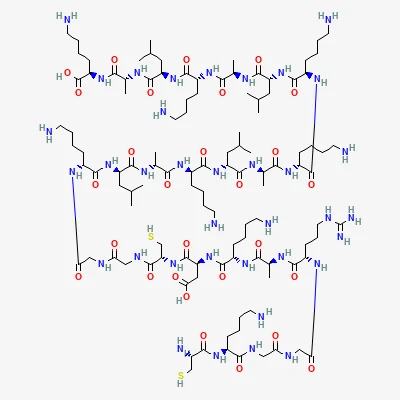
Structure notes: Chimeric peptidomimetic CKGGRAKDC-GG-D(KLAKLAK)2: a cyclic nine-residue homing peptide (CKGGRAKDC) joined by a glycine-glycine linker to a dimeric proapoptotic domain built from D-amino acids. Because it mixes a disulfide-cyclized motif, a linker and D-configuration residues, it is not represented as a single standard one-letter sequence.
What Is Adipotide?
Adipotide is a laboratory-designed peptide that combines two functional parts: a sequence that homes to the blood vessels of white fat and a second sequence that triggers cell death once it arrives. In the 2011 primate study it was defined chemically as CKGGRAKDC-GG-(D)(KLAKLAK)2 and named adipotide[1].
The concept came from a 2004 mouse study that used in vivo phage display to find a peptide motif, CKGGRAKDC, that homes to white-fat vasculature, and then coupled it to a proapoptotic peptide to ablate white fat[2]. Adipotide is the name later given to this homing-plus-killing construct.
It is sometimes abbreviated FTPP and referred to as prohibitin-targeting peptide 1, because its molecular target is prohibitin on fat blood vessels. Unlike metabolic peptides that signal through hormone receptors, adipotide is designed to physically eliminate the vascular support of fat tissue. The homing peptide was first identified by in vivo phage display, a screening method that selects peptides binding to a specific tissue, and it localized to white-fat blood vessels[2].
Chemical Structure and Molecular Identity
Adipotide is a chimeric peptidomimetic with the molecular formula C111H206N36O28S2 and a molecular weight of 2557.2 g/mol. PubChem lists it under CID 163360068, with CAS number 859216-15-2 and InChIKey GZESIPHLGJDZRG-VCWDIOOSSA-N.
The molecule has two domains joined by a glycine-glycine linker:
- Homing domain: CKGGRAKDC, a nine-residue peptide whose two cysteines form a disulfide loop; it binds prohibitin on white-fat blood vessels[2].
- Proapoptotic domain: (D)(KLAKLAK)2, a 14-residue sequence built from D-amino acids that disrupts mitochondrial membranes once inside cells[1].
Because the construct mixes a disulfide-cyclized motif with a dimeric domain made of D-configuration residues, it is not written as a single standard one-letter sequence. The two sulfur atoms in the formula come from the two cysteines of the homing peptide. PubChem’s structure reflects the D-stereochemistry of the killing domain.
Research History and Development
The research line began in 2004 with proof of concept in mice and reached its best-known result in 2011 with a study in obese monkeys. Both came from the same group working on ligand-directed therapy.
In the 2004 Nature Medicine study, the authors isolated the CKGGRAKDC homing motif, showed it associates with prohibitin, and established prohibitin as a vascular marker of adipose tissue. Targeting a proapoptotic peptide to prohibitin caused ablation of white fat and reversal of obesity in mice[2].
In 2011, the construct, now named adipotide, was tested in obese Old World monkeys and reported in Science Translational Medicine[1]. A 2012 comment on that study argued that the weight loss might instead reflect a direct effect of adipotide on food consumption rather than only on fat vasculature[3], illustrating ongoing debate about mechanism.
The homing motif has since been reused in other research tools unrelated to adipotide itself, including nanoparticle and imaging constructs, which shows continued interest in prohibitin as an adipose-vascular target. In one such comparison, a prohibitin-targeted nanoparticle delivering the proapoptotic domain was evaluated against the adipotide bioconjugate in diet-induced obese mice[4].
Mechanisms Studied in Research
Adipotide is designed to kill the blood vessels that supply white fat, so that the fat tissue loses its vascular support and is resorbed. The two domains give it address-and-destroy behavior: the CKGGRAKDC motif binds prohibitin on fat endothelium, and the D(KLAKLAK)2 domain then induces apoptosis[2][1].
Prohibitin targeting
The 2004 study established prohibitin as the vascular receptor for the homing peptide and as a marker of white-fat blood vessels, and noted that prohibitin is also expressed in the vasculature of human white fat[2]. That cross-species expression is the basis for interest in translating the approach beyond rodents, although no human study appears in the records reviewed here.
Proapoptotic domain
The D(KLAKLAK)2 sequence is a membrane-disrupting peptide that is relatively inactive outside cells but triggers mitochondrial-dependent apoptosis once internalized. In adipotide, the homing peptide delivers it selectively to fat vasculature, so cell death is concentrated where the construct accumulates rather than across tissues generally[1]. A separate 2013 study comparing a nanoparticle version with the adipotide bioconjugate confirmed that the proapoptotic KLA domain is the shared effector in these fat-targeting designs[4].
Key Findings From Published Studies
Published findings are from obese mice and obese monkeys; no human trial of adipotide appears in the records reviewed here.
Mice (2004)
Targeting the proapoptotic peptide to prohibitin in the adipose vasculature caused ablation of white fat, and resorption of established white fat was accompanied by normalization of metabolism and rapid reversal of obesity, which the authors reported without detectable adverse effects in that model[2].
Monkeys (2011)
In obese Old World monkeys, adipotide induced targeted apoptosis within the blood vessels of white adipose tissue and produced rapid weight loss together with improved insulin resistance. Magnetic resonance imaging and dual-energy x-ray absorptiometry confirmed a marked reduction in white adipose tissue. The authors reported that monkeys from three different species showed predictable and reversible changes in kidney proximal-tubule function at the optimal dose levels determined in the study. On that basis the authors described adipotide as a prototype for a new class of candidate obesity drugs[1].
Interpretation and debate
A 2012 published comment proposed that the observed weight loss could stem from reduced food consumption rather than solely from vascular apoptosis, raising a question about the primary mechanism in primates[3]. A 2013 comparative study found that a prohibitin-targeted nanoparticle carrying the KLA domain reduced body weight and serum leptin in diet-induced obese mice, framing adipotide as the bioconjugate comparator. That study described the shared targeting concept as antiangiogenic, acting on the vascular marker of adipose tissue rather than on fat cells directly[4].
Because adipotide is a two-domain peptidomimetic containing D-amino acids, researchers typically verify its identity and purity with HPLC and mass-spectrometry certificates of analysis.
Because adipotide is a two-domain peptidomimetic containing D-amino acids, researchers typically verify its identity and purity with HPLC and mass-spectrometry certificates of analysis.
Regulatory and Research Status
Adipotide is an experimental research compound and is not approved by the FDA for any use. The 2011 primate report described it as a prototype for a new class of candidate obesity drugs, language that reflects early-stage, preclinical status[1].
The published evidence is limited to the original mouse study, the monkey study, a comment on that study, and comparative preclinical work using the same targeting concept. Reported effects on kidney proximal-tubule function in monkeys[1] are among the reasons careful preclinical characterization has continued.
For researchers, open questions include whether the weight loss is driven by vascular apoptosis, by reduced food intake, or by both[3], and whether prohibitin targeting can be made selective enough for study beyond rodent and primate models.
Commonly Supplied Research Formats
Adipotide is listed by 3 of the 11 major U.S. research-peptide suppliers we track. The most commonly listed formats are:
- 10mg
- 5mg
Supplier catalog survey, October 2026. Quantities refer to net peptide per vial as labeled.
Frequently Asked Questions
What is adipotide?
Adipotide, also called FTPP or prohibitin-targeting peptide 1, is a synthetic peptidomimetic made of two parts: the homing peptide CKGGRAKDC, which binds prohibitin on the blood vessels of white fat, and a proapoptotic domain, D(KLAKLAK)2, that triggers cell death. In obese rodents and monkeys it caused targeted loss of white fat and weight reduction.
What is the molecular weight of adipotide?
Adipotide has a molecular weight of 2557.2 g/mol according to PubChem (CID 163360068). Its molecular formula is C111H206N36O28S2 and its CAS number is 859216-15-2. The two sulfur atoms come from the two cysteines of the CKGGRAKDC homing peptide, which form a disulfide loop.
How does adipotide work?
Adipotide uses an address-and-destroy design. The CKGGRAKDC domain binds prohibitin, a marker on the blood vessels that supply white fat. The attached D(KLAKLAK)2 domain then disrupts mitochondrial membranes and triggers apoptosis in those vessels. In studies, the fat tissue lost its blood supply and was resorbed, rather than the fat cells being killed directly.
Is adipotide FDA approved?
No. Adipotide is an experimental compound that has not been approved by the FDA. Published research is limited to mouse and monkey studies. The 2011 primate study described it as a prototype for a possible new class of obesity drugs, which reflects early preclinical status, and no human trial results appear in the indexed literature reviewed here.
What does the research on adipotide show?
In mice, targeting a proapoptotic peptide to prohibitin ablated white fat and reversed obesity. In obese monkeys, adipotide caused targeted apoptosis of white-fat blood vessels, rapid weight loss and improved insulin resistance, confirmed by MRI and DXA, along with reversible changes in kidney proximal-tubule function. A later comment suggested reduced food intake may also contribute.
References
- Barnhart KF, Christianson DR, Hanley PW, et al. A peptidomimetic targeting white fat causes weight loss and improved insulin resistance in obese monkeys. Science translational medicine 2011. PMID 22072637 · DOI
- Kolonin MG, Saha PK, Chan L, et al. Reversal of obesity by targeted ablation of adipose tissue. Nature medicine 2004. PMID 15133506 · DOI
- Criscione L. Comment on "a peptidomimetic targeting white fat causes weight loss and improved insulin resistance in obese monkeys". Science translational medicine 2012. PMID 22539771 · DOI
- Hossen N, Kajimoto K, Akita H, et al. A comparative study between nanoparticle-targeted therapeutics and bioconjugates as obesity medication. Journal of controlled release : official journal of the Controlled Release Society 2013. PMID 23871959 · DOI
Related Compounds
This profile summarizes chemical data and peer-reviewed literature for educational and laboratory-research reference. It is not medical advice, and nothing here describes or recommends use in humans or animals. How we source and verify data.