Enclomiphene
Also known as: trans-Clomiphene · (E)-Clomiphene
Enclomiphene is a nonsteroidal selective estrogen receptor modulator and the trans isomer of clomiphene, with the formula C26H28ClNO. By blocking estrogen feedback at the hypothalamus and pituitary, it raises LH and FSH and, in turn, testicular testosterone. Phase II and III trials in men with secondary hypogonadism compared it with testosterone gel. It is not FDA approved.
Last reviewed · Identity data matched to PubChem · 13 peer-reviewed sources
Key facts
- Class: nonsteroidal selective estrogen receptor modulator (SERM), triphenylethylene derivative
- Identity: the trans (E) isomer of clomiphene; the cis (Z) isomer is zuclomiphene
- Formula C26H28ClNO; molecular weight 406.0 g/mol (free base); CAS 15690-57-0
- Studied mainly as enclomiphene citrate in men with secondary hypogonadism
- Raises LH and FSH rather than supplying testosterone directly
- Evaluated in phase II and phase III trials (ZA-304, ZA-305) against testosterone gel
- Not FDA approved; clomiphene citrate is approved for ovarian dysfunction in women
Chemical Identity
| Molecular formula | C26H28ClNO |
|---|---|
| Molecular weight | 406.0 g/mol |
| Monoisotopic mass | 405.1859 Da |
| CAS number | 15690-57-0 |
| PubChem CID | 1548953 |
| UNII | R6D2UI4FLS |
| InChIKey | GKIRPKYJQBWNGO-OCEACIFDSA-N |
| Compound type | Small molecule |
| H-bond donors / acceptors | 0 / 2 |
| XLogP3 | 7.2 |
What Is Enclomiphene?
Enclomiphene is the trans stereoisomer of clomiphene, a nonsteroidal estrogen receptor antagonist from the selective estrogen receptor modulator (SERM) class. It has been studied mainly as a way to raise testosterone in men with secondary hypogonadism by increasing the body’s own gonadotropin output.[1][2]
Clomiphene citrate, the parent drug, is a mixture of two isomers: the trans isomer enclomiphene and the cis isomer zuclomiphene. Clomiphene citrate is FDA approved for ovarian dysfunction in women and has been used off-label for years in men with secondary hypogonadism.[1][3] Reviews suggest that most of clomiphene’s intended effects in men come from enclomiphene, while zuclomiphene contributes little.[3]
Most published clinical research uses the citrate salt, enclomiphene citrate, and compares it with topical testosterone, placebo or clomiphene.[4][5]
Chemical Structure and Molecular Identity
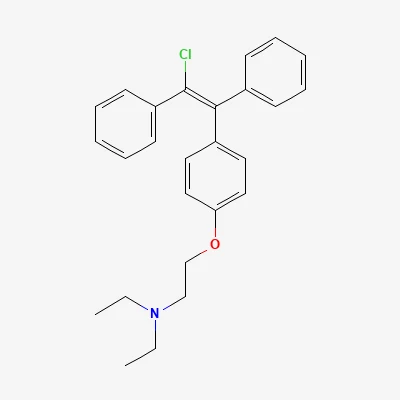
Enclomiphene is a small-molecule triphenylethylene derivative with the molecular formula C26H28ClNO and a molecular weight of 406.0 g/mol (free base). Its PubChem CID is 1548953, its CAS number is 15690-57-0 and its InChIKey is GKIRPKYJQBWNGO-OCEACIFDSA-N.
The IUPAC name is 2-[4-[(E)-2-chloro-1,2-diphenylethenyl]phenoxy]-N,N-diethylethanamine. The (E) descriptor marks the geometry around the central carbon-carbon double bond, which carries a chlorine atom and three aromatic rings; one ring bears a diethylaminoethoxy side chain. The cis, or (Z), isomer of the same structure is zuclomiphene.[3]
- Generic names: enclomiphene (USAN), enclomifene (INN); also called trans-clomiphene or (E)-clomiphene
- Salt forms in research: mostly enclomiphene citrate; one zebrafish study used enclomiphene hydrochloride[6]
- Computed properties (PubChem): XLogP 7.2, topological polar surface area 12.5 Ų, no hydrogen-bond donors, two acceptors
The high XLogP and very small polar surface area describe a highly lipophilic molecule, consistent with its triphenylethylene scaffold.
Research History and Development
Enclomiphene was developed as a single-isomer alternative to clomiphene citrate, a drug prescribed for decades for female ovulatory dysfunction. A 2009 review described it as an investigational nonsteroidal estrogen receptor antagonist intended to restore physiological testosterone secretion while maintaining testicular volume and, potentially, sperm production.[2]
Early animal work used the compound as an antiestrogen tool. A 1991 study in postpartum beef cows tested whether it would shorten the interval to first estrus.[7]
Human development focused on secondary hypogonadism. A small phase IIB proof-of-principle study published in 2013 compared it with testosterone gel, followed by a larger phase II trial in 2014 and two parallel phase III trials, ZA-304 and ZA-305, published in 2016.[8][9][4]
Regulatory progress proved difficult. A 2019 drug profile reviewed the obstacles to FDA approval of enclomiphene as a new molecular entity for hypogonadism.[3] Later research has included retrospective clinical comparisons with clomiphene and meta-analyses pooling SERM trials.[5][10] Interest also extended to men with obesity-related functional androgen deficiency, a group in which SERMs had been proposed but few data existed.[11]
Mechanisms Studied in Research
Enclomiphene blocks estrogen receptors in the hypothalamus and pituitary, reducing estrogen’s negative feedback and increasing secretion of luteinizing hormone (LH) and follicle-stimulating hormone (FSH), which in turn stimulate the testes. Reviews describe it as promoting gonadotropin-dependent testosterone secretion rather than supplying testosterone directly.[2][1]
This distinction matters for spermatogenesis. Exogenous testosterone suppresses LH and FSH and can impair sperm production, whereas enclomiphene raises both gonadotropins, which researchers have proposed as a way to correct low testosterone while preserving fertility.[3][4]
Receptor-level evidence
In postpartum beef cows, enclomiphene reduced the concentrations of total and unoccupied estradiol receptors in the hypothalamus and pituitary. In that model, however, LH concentrations, LH pulse frequency, days to first estrus and days to conception did not change.[7]
Isomer differences
Reviews attribute clomiphene’s undesirable effects largely to zuclomiphene.[3] In a retrospective study of 66 men who used clomiphene and later enclomiphene, estradiol changed less with enclomiphene (-5.92 vs 17.50 pg/mL, P=0.001).[5]
Key Findings From Published Studies
Randomized trials in men with secondary hypogonadism show that enclomiphene citrate raises total testosterone, LH and FSH while maintaining sperm counts, unlike topical testosterone, which raised testosterone but reduced sperm production.
Randomized trials
- Phase IIB (12 men): testosterone rose similarly with enclomiphene and gel at 6 months, but only the enclomiphene group showed increased LH and FSH. Enclomiphene raised sperm counts in seven of seven men at 3 months and six of six at 6 months, while the gel did not raise counts above 20 million/mL in any of five men at 3 months. Testosterone fell back to pretreatment values one month after treatment ended.[8]
- Phase II: enclomiphene increased morning testosterone, estradiol and LH to levels similar to a topical testosterone gel, increased FSH and conserved sperm counts.[9]
- Phase III (ZA-304 and ZA-305): in overweight men aged 18 to 60, two enclomiphene dose levels were compared with testosterone gel and placebo. After 16 weeks, testosterone increased in all active groups; LH and FSH rose with enclomiphene but fell with the gel, and sperm concentration stayed in the normal range with enclomiphene but dropped markedly with the gel.[4]
Meta-analyses
A 2025 meta-analysis of randomized trials pooling clomiphene and enclomiphene found that SERMs raised total testosterone by a mean of 273.76 ng/dL versus placebo (95% CI 191.87 to 355.66), with significant increases in LH and FSH and no significant testosterone difference from testosterone gel.[10] A 2023 meta-analysis in 292 men with obesity-related functional androgen deficiency reported a mean testosterone increase of 7.50 nmol/L with enclomiphene citrate (95% CI 6.52 to 8.48) and no unexpected safety findings.[11]
Comparisons with clomiphene
In a retrospective study of 78 men, both drugs raised total testosterone, but only enclomiphene significantly increased FSH, LH and total motile sperm count.[12] In the 66-man switch study, adverse effects including decreased libido, reduced energy and mood changes were less frequent with enclomiphene (OR for adverse events 0.18, 95% CI 0.07 to 0.44).[5]
Other findings
The 2009 review noted an unanticipated favorable effect on fasting plasma glucose in early trials and short-term safety comparable to testosterone gels and placebo.[2] In zebrafish larvae, exposure to clomiphene citrate or enclomiphene at a specific developmental stage increased fusion of the interfrontal cranial suture compared with controls.[6]
Because enclomiphene and zuclomiphene share one formula and differ only in double-bond geometry, isomeric purity is best confirmed with batch-specific HPLC and mass spectrometry data.
Because enclomiphene and zuclomiphene share one formula and differ only in double-bond geometry, isomeric purity is best confirmed with batch-specific HPLC and mass spectrometry data.
Regulatory and Research Status
Enclomiphene is not FDA approved for any indication; it remains an investigational compound, while its parent mixture, clomiphene citrate, is FDA approved for ovarian dysfunction in women.[1] A 2019 drug profile discussed the difficulties enclomiphene faced in seeking FDA approval as a new molecular entity.[3]
Professional bodies continue to evaluate it. In 2026 the British Society of Sexual Medicine published a position statement on the potential use of enclomiphene in male hypogonadism.[13] In sport, clomifene, of which enclomiphene is an isomer, is listed among anti-estrogenic substances on the World Anti-Doping Agency Prohibited List.
This page summarizes published research for reference purposes and does not provide guidance on human use.
Commonly Supplied Research Formats
Enclomiphene is listed by 2 of the 11 major U.S. research-peptide suppliers we track. The most commonly listed formats are:
- 12.5mg x 60 (capsules)
- 12.5mg x 50 (capsules)
Supplier catalog survey, October 2026. Quantities refer to net peptide per vial as labeled.
Frequently Asked Questions
Is enclomiphene the same as clomiphene?
No. Clomiphene citrate is a mixture of two isomers, enclomiphene (trans) and zuclomiphene (cis). Enclomiphene is the single trans isomer. Reviews suggest most of clomiphene's intended effects in men come from enclomiphene, while zuclomiphene contributes little and may account for some undesirable effects. Both isomers share the formula C26H28ClNO.
What is the molecular weight of enclomiphene?
Enclomiphene has a molecular weight of 406.0 g/mol as the free base, with the molecular formula C26H28ClNO according to PubChem (CID 1548953). Its CAS number is 15690-57-0. Most clinical studies used the citrate salt, which has a higher formula weight because it includes citric acid.
Is enclomiphene FDA approved?
No. Enclomiphene is not FDA approved for any indication and remains investigational. A 2019 drug profile reviewed the difficulties it faced in gaining approval as a new molecular entity for male hypogonadism. Its parent mixture, clomiphene citrate, is FDA approved for ovarian dysfunction in women.
How is enclomiphene different from testosterone?
Enclomiphene does not supply testosterone. It blocks estrogen feedback at the hypothalamus and pituitary, raising LH and FSH so the testes produce more testosterone. In phase III trials, both enclomiphene and testosterone gel raised testosterone, but LH and FSH rose with enclomiphene and fell with the gel, and only enclomiphene maintained sperm concentration in the normal range.
What does the research on enclomiphene show?
Randomized phase II and III trials in men with secondary hypogonadism found that enclomiphene citrate raised total testosterone, LH and FSH while preserving sperm counts. Meta-analyses report significant testosterone increases versus placebo. Retrospective studies comparing it with clomiphene found smaller estradiol changes and fewer reported adverse effects with enclomiphene.
Is enclomiphene a SERM?
Yes. Enclomiphene is a nonsteroidal selective estrogen receptor modulator from the triphenylethylene family, the same structural family as clomiphene. In the hypothalamus and pituitary it acts as an estrogen receptor antagonist, which is the basis for the increased gonadotropin secretion seen in clinical studies.
References
- Rodriguez KM, Pastuszak AW, Lipshultz LI. Enclomiphene citrate for the treatment of secondary male hypogonadism. Expert opinion on pharmacotherapy 2016. PMID 27337642 · DOI
- Hill S, Arutchelvam V, Quinton R. Enclomiphene, an estrogen receptor antagonist for the treatment of testosterone deficiency in men. IDrugs : the investigational drugs journal 2009. PMID 19204885
- Earl JA, Kim ED. Enclomiphene citrate: A treatment that maintains fertility in men with secondary hypogonadism. Expert review of endocrinology & metabolism 2019. PMID 31063005 · DOI
- Kim ED, McCullough A, Kaminetsky J. Oral enclomiphene citrate raises testosterone and preserves sperm counts in obese hypogonadal men, unlike topical testosterone: restoration instead of replacement. BJU international 2016. PMID 26496621 · DOI
- Saffati G, Kassab J, Orozco Rendon D, et al. Safety and efficacy of enclomiphene and clomiphene for hypogonadal men. Translational andrology and urology 2024. PMID 39434750 · DOI
- Franz-Odendaal TA, Bezuhly M. Clomiphene Citrate and Enclomiphene Hydrochloride Exposure Is Associated With Interfrontal Suture Fusion in Zebrafish. Plastic surgery (Oakville, Ont.) 2023. PMID 37915340 · DOI
- Schramm RD, Roberge S, Reeves JJ. Enclomiphene does not alter the postpartum interval of suckled beef cows. Journal of animal science 1991. PMID 1778825 · DOI
- Kaminetsky J, Werner M, Fontenot G, et al. Oral enclomiphene citrate stimulates the endogenous production of testosterone and sperm counts in men with low testosterone: comparison with testosterone gel. The journal of sexual medicine 2013. PMID 23530575 · DOI
- Wiehle RD, Fontenot GK, Wike J, et al. Enclomiphene citrate stimulates testosterone production while preventing oligospermia: a randomized phase II clinical trial comparing topical testosterone. Fertility and sterility 2014. PMID 25044085 · DOI
- Hohl A, Chavez MP, Pasqualotto E, et al. Clomiphene or enclomiphene citrate for the treatment of male hypogonadism: a systematic review and meta-analysis of randomized controlled trials. Archives of endocrinology and metabolism 2025. PMID 41066380 · DOI
- Tienforti D, Castellini C, Di Giulio F, et al. Selective modulation of estrogen receptor in obese men with androgen deficiency: A systematic review and meta-analysis. Andrology 2023. PMID 36604313 · DOI
- Thomas J, Suarez Arbelaez MC, Narasimman M, et al. Efficacy of Clomiphene Citrate Versus Enclomiphene Citrate for Male Infertility Treatment: A Retrospective Study. Cureus 2023. PMID 37546076 · DOI
- Foster J, Choo L, Patel A, et al. British Society of Sexual Medicine: Position Statement for the Potential Use of Enclomiphene in the Treatment of Male Hypogonadism. The world journal of men's health 2026. PMID 41714894 · DOI
Related Compounds
This profile summarizes chemical data and peer-reviewed literature for educational and laboratory-research reference. It is not medical advice, and nothing here describes or recommends use in humans or animals. How we source and verify data.