Gonadorelin
Also known as: GnRH · LHRH
Gonadorelin is the synthetic form of gonadotropin-releasing hormone (GnRH, also called LHRH), a hypothalamic decapeptide that controls release of luteinizing hormone and follicle-stimulating hormone from the pituitary. It carries an N-terminal pyroglutamate and a C-terminal glycinamide, was first used as a diagnostic test of pituitary reserve, and remains a reference compound in reproductive endocrinology and veterinary research.
Last reviewed · Identity data matched to PubChem · 6 peer-reviewed sources
Key facts
- Class: gonadotropin-releasing hormone (GnRH); identical in sequence to native mammalian GnRH
- Length: 10 residues, pGlu-His-Trp-Ser-Tyr-Gly-Leu-Arg-Pro-Gly-NH2
- Formula C55H75N17O13; molecular weight 1182.3 g/mol (PubChem CID 638793)
- CAS number 33515-09-2; synonyms GnRH-I, LHRH, gonadoliberin I
- Target: GnRH receptor, a G-protein-coupled receptor on anterior pituitary gonadotropes
- Human products discontinued in the US; gonadorelin salts remain FDA-approved veterinary drugs
- Included in World Anti-Doping Agency (WADA) doping-control testing
Chemical Identity
| Molecular formula | C55H75N17O13 |
|---|---|
| Molecular weight | 1182.3 g/mol |
| Monoisotopic mass | 1181.5730 Da |
| CAS number | 33515-09-2 |
| PubChem CID | 638793 |
| UNII | 9O7312W37G |
| InChIKey | XLXSAKCOAKORKW-AQJXLSMYSA-N |
| Compound type | Peptide |
| H-bond donors / acceptors | 16 / 15 |
| XLogP3 | -2.4 |
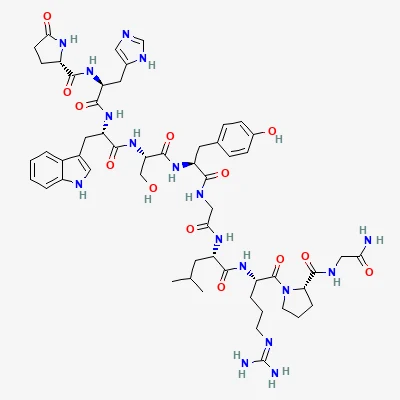
Structure notes: pGlu-His-Trp-Ser-Tyr-Gly-Leu-Arg-Pro-Gly-NH2: N-terminal pyroglutamic acid (5-oxoproline, a cyclized glutamine) and C-terminal glycinamide. The PubChem formula C55H75N17O13 matches QHWSYGLRPG with these two modifications.
What Is Gonadorelin?
Gonadorelin is synthetic gonadotropin-releasing hormone (GnRH), the decapeptide made and released by the hypothalamus that regulates the production and release of luteinizing hormone (LH) and follicle-stimulating hormone (FSH) by the anterior pituitary.[1] Its sequence is identical to native mammalian GnRH, and it is also known as luteinizing hormone-releasing hormone (LHRH) or GnRH-I.
GnRH controls reproductive function by binding high-affinity G-protein-coupled receptors (GnRHR) that are notable for a very short C-terminal tail.[2] Because gonadorelin reproduces this native signal, it has served as a diagnostic agent, a therapeutic hormone in earlier clinical practice, and the parent structure for longer-acting synthetic analogs.[1]
Today, gonadorelin appears most often in veterinary reproduction studies, in reviews of GnRH physiology, and in anti-doping analysis.[3][2][4]
Chemical Structure and Molecular Identity
Gonadorelin is a linear decapeptide, pGlu-His-Trp-Ser-Tyr-Gly-Leu-Arg-Pro-Gly-NH2, with modifications at both ends. PubChem lists it under CID 638793 with the molecular formula C55H75N17O13 and a molecular weight of 1182.3 g/mol.
The N-terminal residue is pyroglutamic acid (5-oxoproline), a cyclized form of glutamine, and the C-terminus is a glycinamide rather than a free carboxylic acid. A 2023 review noted that GnRH carries these C- and N-terminal amino acid modifications and that two other distinct GnRH isoforms have been identified.[2] Because of the blocked termini, gonadorelin cannot be written accurately as a plain one-letter sequence.
Key identifiers
- CAS number: 33515-09-2
- InChIKey: XLXSAKCOAKORKW-AQJXLSMYSA-N
- ATC codes: H01CA01 and V04CM01
- Synonyms: GnRH, LHRH, GnRH-I, gonadoliberin I, LH-releasing factor
Research products use different salt forms. Veterinary studies have compared gonadorelin hydrochloride with gonadorelin diacetate tetrahydrate, which earlier work had linked to greater LH release and a higher ovulation percentage.[5]
| Position | 1 | 6 | 10 |
|---|---|---|---|
| Gonadorelin | pGlu | Gly | Gly-NH2 |
| Triptorelin | pGlu | D-Trp | Gly-NH2 |
Research History and Development
Gonadorelin was first used diagnostically, as a test of the pituitary’s reserve of LH and FSH, before native GnRH was applied therapeutically to hypothalamic hypogonadism and infertility in men and women.[1]
The native hormone’s low potency and short half-life drove the next phase. Researchers developed long-acting, potent GnRH analogs that, rather than stimulating, suppress pituitary gonadotropin secretion and produce a reversible medical gonadectomy. By 1991, these analogs were used in prostate and breast carcinoma, endometriosis, uterine leiomyomata, precocious puberty and ovarian hyperandrogenic syndromes.[1]
Developmental biology added another strand. GnRH-producing neurons originate in the embryonic nasal compartment and migrate rapidly toward the hypothalamus during early embryogenesis, and a 2023 review credited growing knowledge of this process with improving diagnostic and therapeutic approaches to infertility.[2]
Mechanisms Studied in Research
Gonadorelin acts by binding the GnRH receptor on pituitary gonadotropes, triggering synthesis and release of LH and FSH, which in turn drive gonadal steroid production.[1][2]
Stimulation versus suppression
Native GnRH and gonadorelin stimulate gonadotropin release. Potent, long-acting analogs built on the same scaffold instead lead to suppression of native pituitary gonadotropins, the basis of their use in hormone-dependent conditions.[1] The native hormone’s low potency and short half-life are what distinguish it pharmacologically from these suppressive analogs.[1]
Receptors outside the pituitary
GnRH receptors are present in several organs and tissues. A GnRH/GnRHR system has been identified in the human endometrium, ovary and prostate, extending the peptide’s proposed roles to the physiology and tumor transformation of those tissues.[2]
Crosstalk with steroid and growth-factor signaling
A 2002 review of GnRH in cancer described a tight link between steroid hormones and GnRH signaling, both centrally along the pituitary-gonadal axis and peripherally on tumor receptors. It reported that GnRH exerts an inhibitory action on the growth of hormone-dependent human and canine mammary tumors and discussed connections among estrogen-receptor, GnRH-receptor and EGF-receptor signaling pathways.[6]
Brain
GnRH/GnRHR activity has also been described in the hippocampus, and decreased expression in the aging mouse brain has raised interest in possible roles in neurogenesis, neuronal function and neuroprotection. These roles remain areas of investigation rather than established functions.[2]
Key Findings From Published Studies
The most detailed recent data on gonadorelin come from large dairy-cattle breeding trials and from anti-doping method development. Human clinical use is mainly documented in older reviews.[1]
Ovulatory response in dairy heifers
The initial ovulatory response in heifer synchronization programs is often low, partly because progesterone concentration at the first GnRH treatment can blunt the LH response.[3] In a 2024 trial, 1,308 Holstein heifers were randomly allocated to one of two dose levels of gonadorelin hydrochloride at the first GnRH treatment of a 6-day CO-Synch program with a progesterone insert. In the subset examined by ultrasound, the ovulatory response at the first treatment was greater in the higher-dose group than the lower-dose group (54.7% vs 42.8%). Ovulatory response was also greater in heifers with low rather than high progesterone at the start of the program (54.3% vs 37.8%).[3]
Comparing salt forms in dairy cows
A 2015 study in 3,938 postpartum Holstein cows compared gonadorelin hydrochloride with gonadorelin diacetate tetrahydrate before first and resynchronized timed artificial insemination. Earlier studies had reported greater LH release and ovulation with the diacetate tetrahydrate form, but had not measured pregnancies per insemination, the outcome this trial was designed to evaluate. Cows were assigned to weekly cohorts by calving date, and the two products were alternated by week across trial periods in early and mid-to-late 2012.[5]
Detection in doping control
A 2024 study in the Journal of Mass Spectrometry developed a simplified chromatographic-mass spectrometric urine method covering several prohibited peptide classes, including gonadorelin. The method met nearly all WADA minimum required performance levels, was validated as an initial testing procedure, and was applied to authentic post-administration urine samples for insulins and gonadorelin as proof of principle.[4]
The authors noted that peptides in the 2-10 kDa range usually need dedicated sample preparation that cannot easily be combined with lower-mass substances, and they used five internal standards to control the five peptide drug categories in the assay.[4]
Reproductive medicine
A 2023 review concluded that GnRH and its synthetic peptide and non-peptide agonists and antagonists provide a valid tool for reproductive disorders and assisted reproduction technology.[2]
Because gonadorelin exists in several salt and hydrate forms, researchers typically verify identity and peptide content with HPLC-MS certificates of analysis.
Regulatory and Research Status
Gonadorelin has been approved by the US Food and Drug Administration for human use in the past, but human gonadorelin products have since been discontinued in the United States; gonadorelin salts remain FDA-approved as veterinary drugs for cattle.
Gonadorelin is the international nonproprietary name, and it carries ATC codes for a hypothalamic hormone (H01CA01) and for a diagnostic agent (V04CM01). Its earlier human roles, as a pituitary function test and as a treatment for hypothalamic hypogonadism, are documented in clinical reviews.[1]
In sport, gonadorelin is among the peptides covered by WADA-oriented doping-control methods, and validated urine testing procedures exist.[4] In research, it remains a reference GnRH receptor agonist for studies of the hypothalamic-pituitary-gonadal axis and for livestock reproductive management.[2][3]
Commonly Supplied Research Formats
Gonadorelin is listed by 5 of the 11 major U.S. research-peptide suppliers we track. The most commonly listed formats are:
- 2mg
- 10mg
Supplier catalog survey, October 2026. Quantities refer to net peptide per vial as labeled.
Frequently Asked Questions
Is gonadorelin the same as GnRH?
Yes. Gonadorelin is the generic name for synthetic gonadotropin-releasing hormone with the same sequence as native mammalian GnRH: pGlu-His-Trp-Ser-Tyr-Gly-Leu-Arg-Pro-Gly-NH2. It is also called LHRH, GnRH-I and gonadoliberin I. Salt forms such as gonadorelin hydrochloride and gonadorelin diacetate tetrahydrate contain the same peptide with different counterions.
What is the molecular weight of gonadorelin?
Gonadorelin has a molecular weight of 1182.3 g/mol and the molecular formula C55H75N17O13, according to PubChem (CID 638793). This refers to the free peptide. Salt forms, such as the hydrochloride or the diacetate tetrahydrate used in veterinary products, have higher formula weights because of the counterions and water of hydration.
Is gonadorelin FDA approved?
Gonadorelin was previously approved by the FDA for human use, including as a diagnostic agent, but human gonadorelin products have been discontinued in the United States. Gonadorelin salts remain FDA-approved veterinary drugs for cattle, where they are used in reproductive management. Outside approved uses, gonadorelin is handled as a research compound.
How is gonadorelin different from triptorelin?
Both are GnRH receptor agonist decapeptides with an N-terminal pyroglutamate and a C-terminal glycinamide. Triptorelin replaces glycine at position 6 with D-tryptophan, which makes it a more potent, longer-acting analog. Gonadorelin reproduces the brief native GnRH signal, whereas long-acting analogs such as triptorelin lead to suppression of pituitary gonadotropins over time.
What does the research on gonadorelin show?
Recent research on gonadorelin is concentrated in dairy-cattle reproduction and anti-doping science. A 2024 trial in 1,308 Holstein heifers found a higher ovulatory response with the higher of two dose levels. A 2024 mass spectrometry method detected gonadorelin in authentic post-administration urine samples. Older reviews document its use as a pituitary function test.
Is gonadorelin banned in sports?
Gonadorelin is among the peptides targeted by doping-control testing aligned with World Anti-Doping Agency requirements. A 2024 study validated a liquid chromatography-mass spectrometry urine method that includes gonadorelin as an initial testing procedure and confirmed it worked on authentic post-administration samples.
References
- Pace JN, Miller JL, Rose LI. GnRH agonists: gonadorelin, leuprolide and nafarelin. American family physician 1991. PMID 1835275
- Casati L, Ciceri S, Maggi R, et al. Physiological and pharmacological overview of the gonadotropin releasing hormone. Biochemical pharmacology 2023. PMID 37075816 · DOI
- Melo DB, Coelho WM, Marques TC, et al. Effect of 200 μg of gonadorelin hydrochloride at the first GnRH of a CO-Synch program on ovulation rate and pregnancies per artificial insemination in Holstein heifers. Journal of dairy science 2024. PMID 38460874 · DOI
- Thomas A, Walpurgis K, Thevis M. Chromatographic-mass spectrometric analysis of peptidic analytes (2-10 kDa) in doping control urine samples. Journal of mass spectrometry : JMS 2024. PMID 38197510 · DOI
- Poock SE, Lamberson WR, Lucy MC. Effect of different gonadorelin (GnRH) products used for the first or resynchronized timed artificial insemination on pregnancy rates in postpartum dairy cows. Theriogenology 2015. PMID 25979657 · DOI
- Florio S, Pagnini U, Crispino A, et al. GnRH and steroids in cancer. Frontiers in bioscience : a journal and virtual library 2002. PMID 12045004 · DOI
Related Compounds
This profile summarizes chemical data and peer-reviewed literature for educational and laboratory-research reference. It is not medical advice, and nothing here describes or recommends use in humans or animals. How we source and verify data.