Triptorelin
Triptorelin is a synthetic gonadotropin-releasing hormone (GnRH) agonist decapeptide in which the glycine at position 6 of native GnRH is replaced by D-tryptophan. That substitution increases resistance to enzymatic breakdown and receptor affinity, so sustained exposure first stimulates and then suppresses pituitary gonadotropin output. It has been studied in prostate cancer, endometriosis, central precocious puberty and assisted reproduction.
Last reviewed · Identity data matched to PubChem · 9 peer-reviewed sources
Key facts
- Class: GnRH receptor agonist (superagonist) decapeptide
- Structure: [D-Trp6]-GnRH, pGlu-His-Trp-Ser-Tyr-D-Trp-Leu-Arg-Pro-Gly-NH2
- Formula C64H82N18O13; molecular weight 1311.4 g/mol (PubChem CID 25074470)
- CAS number 57773-63-4; development codes include CL-118532, AY-25650 and Wy-42462
- Origin: synthesized in 1973 by A.V. Schally's group as D-Trp6-LHRH
- FDA-approved (as triptorelin pamoate) for advanced prostate cancer and central precocious puberty
- Salt forms include triptorelin pamoate (embonate) and triptorelin acetate
Chemical Identity
| Molecular formula | C64H82N18O13 |
|---|---|
| Molecular weight | 1311.4 g/mol |
| Monoisotopic mass | 1310.6309 Da |
| CAS number | 57773-63-4 |
| PubChem CID | 25074470 |
| UNII | 9081Y98W2V |
| InChIKey | VXKHXGOKWPXYNA-PGBVPBMZSA-N |
| Compound type | Peptide |
| H-bond donors / acceptors | 17 / 15 |
| XLogP3 | -0.3 |
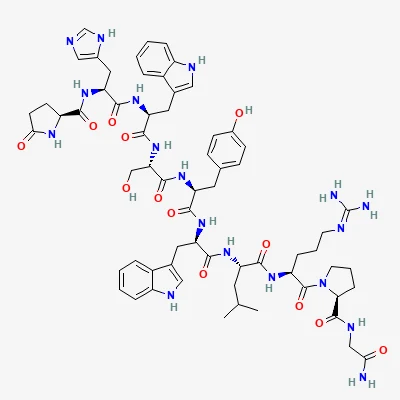
Structure notes: pGlu-His-Trp-Ser-Tyr-D-Trp-Leu-Arg-Pro-Gly-NH2: N-terminal pyroglutamic acid (5-oxoproline), D-tryptophan at position 6, and C-terminal glycinamide. The PubChem formula C64H82N18O13 matches this structure.
What Is Triptorelin?
Triptorelin is a synthetic analog of gonadotropin-releasing hormone (GnRH) that acts as a potent agonist at the pituitary GnRH receptor. It is derived from the native hormone by substituting D-tryptophan for the glycine at position 6, which increases its resistance to enzymatic breakdown and its affinity for LH-RH receptors compared with the native molecule.[1]
Because of this longer half-life, triptorelin behaves as a superagonist: it causes an initial surge in gonadotropin release, then strongly reduces luteinizing hormone (LH) secretion with continued exposure.[1] Clinically this produces medical castration, and reviews describe GnRH agonists as having better safety profiles than estrogens and anti-androgens for that purpose.[2]
Triptorelin is one of the most commonly used GnRH agonists, with published research spanning prostate cancer, endometriosis, central precocious puberty and assisted reproductive technology.[3][4][5]
Chemical Structure and Molecular Identity
Triptorelin is a decapeptide, pGlu-His-Trp-Ser-Tyr-D-Trp-Leu-Arg-Pro-Gly-NH2, identical to native GnRH except for D-tryptophan at position 6. PubChem lists it under CID 25074470 with the molecular formula C64H82N18O13 and a molecular weight of 1311.4 g/mol.
Like native GnRH (gonadorelin), triptorelin has a blocked N-terminus in the form of pyroglutamic acid and a C-terminal glycinamide. The D-configured tryptophan is the only change from the native sequence, and it is the feature responsible for its enzymatic stability and potency.[1] Because of the D-residue and the terminal modifications, triptorelin cannot be represented as a plain one-letter sequence.
Key identifiers
- CAS number: 57773-63-4
- InChIKey: VXKHXGOKWPXYNA-PGBVPBMZSA-N
- ATC code: L02AE04
- Synonyms: [D-Trp6]-LH-RH, D-Trp-6-LHRH, tryptorelin, CL-118532, AY-25650, Wy-42462
| Feature | Gonadorelin | Triptorelin |
|---|---|---|
| Position 6 | Glycine | D-tryptophan |
| Formula | C55H75N17O13 | C64H82N18O13 |
| Molecular weight | 1182.3 g/mol | 1311.4 g/mol |
| Net effect with sustained exposure | Brief stimulation | Stimulation, then suppression |
Research History and Development
Triptorelin dates to 1973, when A.V. Schally, two years after characterizing LH-RH, synthesized several GnRH analogs including D-Trp6-LHRH.[1]
Subsequent pharmaceutical research focused on delayed-release formulations that release the peptide gradually over extended periods.[1] Sustained-release depots of triptorelin pamoate, also called triptorelin embonate, were developed for advanced prostate cancer, and slow-release GnRH agonist formulations were credited with offering patients flexibility and improved quality of life.[6][2] A 2010 review described LH-RH agonists as the major agents for androgen deprivation in advanced and metastatic prostate cancer, noted that some of their growing use had constituted overtreatment, and placed the newest triptorelin embonate formulation as an adjunct to radiation therapy and chemotherapy.[7]
Clinical use broadened to gynecology and pediatrics. GnRH agonists have been used for about 30 years to induce a hypoestrogenic state in women with endometriosis, and triptorelin depot formulations have been widely used in children with central precocious puberty.[3][4] More recently, drug-delivery research has explored transdermal microneedle systems to address triptorelin’s low bioavailability.[5]
Mechanisms Studied in Research
Triptorelin binds pituitary GnRH receptors and, after an initial stimulatory flare, strongly reduces LH secretion by preventing production of the LH beta subunit.[1]
Subunit-level effects
A 2005 pharmacology review reported that while LH beta subunit production falls, production of the LH alpha subunit rises markedly and stays responsive to exogenous GnRH. The authors interpreted this as evidence that the agonist does not cause true pituitary desensitization.[1]
Agonists versus antagonists
GnRH antagonists inhibit both alpha and beta subunit secretion and avoid the initial hyperstimulation of gonadotrophs, the flare-up that characterizes superagonists. Agonists such as triptorelin, by contrast, were described as maintaining their effect even after a day or two of withdrawal.[1]
Downstream hormonal effects
In men with advanced prostate cancer, serum testosterone initially increased and then decreased rapidly and durably after a sustained-release formulation, consistent with this flare-then-suppress pattern.[6] Drug-related adverse events in that trial, such as hot flushes, were likewise consistent with the pharmacological action of triptorelin.[6] In women, the resulting hypoestrogenic state is the basis of GnRH agonist research in endometriosis.[3]
Key Findings From Published Studies
The largest body of evidence on triptorelin comes from clinical trials and reviews in prostate cancer, with additional review-level data in endometriosis and central precocious puberty and preclinical drug-delivery work.
Advanced prostate cancer
In a pivotal noncomparative, multicenter trial of a long-acting triptorelin embonate formulation in 120 men with advanced prostate cancer, 97.5% had castrate serum testosterone levels by day 29, and castrate levels were maintained from months 2 to 12 in 93.0%. In a 15-patient subset, castrate levels were reached in a geometric mean of 18.8 days. Most adverse events were mild, and injection-site reactions occurred in 6.7% of recipients.[6] A 2013 review found that similar proportions of patients achieved and maintained castration with all triptorelin formulations, and that more than 90% maintained a stricter castration threshold with the longest-acting formulation.[2]
Endometriosis
A 2014 review concluded that the studies it covered demonstrate triptorelin’s efficacy in improving endometriosis-related pain, supported by reductions in endometriotic nodule volume during treatment. The authors suggested future research on whether triptorelin given before surgical excision of endometriomas could help preserve ovarian reserve.[3]
Central precocious puberty
A 2018 review reported long experience with triptorelin depot in children with central precocious puberty, with no long-term adverse effects on reproductive function reported. Differences in adult-height outcomes were noted, and the authors recommended that treatment be restricted to tertiary pediatric endocrinology centers because uncertainties and rare serious adverse events remain. A longer-acting formulation appeared to suppress the pituitary-gonadal axis and pubertal development with end results similar to the shorter-acting version, though the authors called for additional trials and noted that few data exist for the longest-acting formulation.[4]
Breast cancer ovarian suppression
Triptorelin was one of two agents used for ovarian suppression in a patient-level meta-analysis of 7,030 premenopausal women with oestrogen receptor-positive early breast cancer from four randomized trials; recurrence was lower with aromatase inhibitors than with tamoxifen (rate ratio 0.79).[8]
Transdermal delivery in rats
Silk fibroin microneedles loaded with triptorelin nanoparticles raised transdermal release to about 65%, prolonged half-life and increased relative bioavailability in rats, with an LH and estradiol surge followed by prolonged downregulation.[5]
Because triptorelin differs from native GnRH by a single D-amino acid, researchers typically confirm identity and purity with HPLC-MS certificates of analysis.
Regulatory and Research Status
Triptorelin is approved by the US Food and Drug Administration, as triptorelin pamoate, for the palliative treatment of advanced prostate cancer and, in an extended-release formulation, for central precocious puberty in children 2 years and older.[4]
Outside the United States, triptorelin is also used in endometriosis and is described as a first-line drug in assisted reproductive technology.[3][5] Off-label uses are subject to national oversight; in Italy, the National Committee for Bioethics has endorsed off-label triptorelin for puberty suppression in adolescent gender dysphoria since 2018, while concerns about long-term effects on bone density, brain development and fertility remain under study.[9]
Its ATC code, L02AE04, classifies triptorelin among the gonadotropin-releasing hormone analogs used in endocrine therapy. In research settings it serves as a reference GnRH superagonist for studying gonadotropin and sex-steroid suppression.[1]
Commonly Supplied Research Formats
Triptorelin is listed by 3 of the 11 major U.S. research-peptide suppliers we track. The most commonly listed formats are:
- 2mg
Supplier catalog survey, October 2026. Quantities refer to net peptide per vial as labeled.
Frequently Asked Questions
Is triptorelin the same as GnRH?
No. Triptorelin is a synthetic analog of GnRH, not the native hormone. It differs from native GnRH (gonadorelin) at a single position: glycine 6 is replaced by D-tryptophan. That change increases resistance to enzymatic breakdown and receptor affinity, turning a brief native signal into a superagonist that suppresses pituitary LH output with sustained exposure.
What is the molecular weight of triptorelin?
Triptorelin has a molecular weight of 1311.4 g/mol and the molecular formula C64H82N18O13, according to PubChem (CID 25074470). This value refers to the free peptide. Salt forms used in pharmaceutical formulations, such as triptorelin pamoate (embonate) and triptorelin acetate, have higher formula weights because of their counterions.
Is triptorelin FDA approved?
Yes. Triptorelin pamoate is FDA-approved for the palliative treatment of advanced prostate cancer, and an extended-release formulation is approved for central precocious puberty in children 2 years and older. In other countries, triptorelin is also used in endometriosis and assisted reproduction. Any other use is off-label or investigational.
How is triptorelin different from gonadorelin?
Gonadorelin is identical to native GnRH and gives a short stimulatory signal. Triptorelin carries D-tryptophan at position 6, which makes it more stable and more potent. With sustained exposure, triptorelin first triggers a flare of LH release and then strongly reduces LH secretion, producing medical castration, which native gonadorelin does not.
Why does triptorelin cause an initial flare?
Triptorelin is an agonist, so it first stimulates the pituitary GnRH receptor and triggers LH release before suppression develops. In men with advanced prostate cancer, serum testosterone initially increased and then fell rapidly to castrate levels. GnRH antagonists avoid this flare because they block the receptor from the start.
What does the research on triptorelin show?
In a pivotal trial of a long-acting formulation in 120 men with advanced prostate cancer, 97.5% reached castrate testosterone by day 29. Reviews report efficacy for endometriosis-related pain and long experience in central precocious puberty, while noting open questions about adult-height outcomes and long-term effects.
References
- Lahlou N. [Pharmacokinetics and pharmacodynamics of triptorelin]. Annales d'urologie 2005. PMID 16302716 · DOI
- Ploussard G, Mongiat-Artus P. Triptorelin in the management of prostate cancer. Future oncology (London, England) 2013. PMID 23252566 · DOI
- Leone Roberti Maggiore U, Scala C, Remorgida V, et al. Triptorelin for the treatment of endometriosis. Expert opinion on pharmacotherapy 2014. PMID 24832495 · DOI
- Bertelloni S, Mucaria C, Baroncelli GI, et al. Triptorelin depot for the treatment of children 2 years and older with central precocious puberty. Expert review of clinical pharmacology 2018. PMID 29957076 · DOI
- Lu X, Sun Y, Han M, et al. Triptorelin nanoparticle-loaded microneedles for use in assisted reproductive technology. Drug delivery 2023. PMID 37387211 · DOI
- Keating GM. Triptorelin embonate (6-month formulation). Drugs 2010. PMID 20166771 · DOI
- Whelan P. Triptorelin embonate: a 6-month formulation for prostate cancer. Expert opinion on pharmacotherapy 2010. PMID 20969451 · DOI
- Aromatase inhibitors versus tamoxifen in premenopausal women with oestrogen receptor-positive early-stage breast cancer treated with ovarian suppression: a patient-level meta-analysis of 7030 women from four randomised trials. The Lancet. Oncology 2022. PMID 35123662 · DOI
- Lippi M, Orsini F, Damato F, et al. Adolescent Gender Dysphoria in Italy: Reflections on Triptorelin, Consent, and Care. La Clinica terapeutica 2025. PMID 40109078 · DOI
Related Compounds
This profile summarizes chemical data and peer-reviewed literature for educational and laboratory-research reference. It is not medical advice, and nothing here describes or recommends use in humans or animals. How we source and verify data.