Oxytocin
Oxytocin is a nine-amino-acid neurohypophysial peptide hormone with a disulfide-bridged ring and an amidated C-terminus, made mainly in the hypothalamus and released from the posterior pituitary. Classically known for driving uterine contraction in labor and milk ejection in lactation, it also acts in the brain as a neuromodulator of social behavior, and its synthetic form is an approved obstetric drug.
Last reviewed · Identity data matched to PubChem · 10 peer-reviewed sources
Key facts
- Class: neurohypophysial nonapeptide hormone and neuromodulator
- Length: 9 residues, Cys-Tyr-Ile-Gln-Asn-Cys-Pro-Leu-Gly-NH2, with a Cys1-Cys6 disulfide
- Formula C43H66N12O12S2; molecular weight 1007.2 g/mol (PubChem CID 439302)
- CAS number 50-56-6
- Receptor: oxytocin receptor (OXTR), a class I G-protein-coupled receptor
- Synthesized mainly in hypothalamic paraventricular and supraoptic nuclei
- Synthetic oxytocin is FDA-approved for obstetric use in labor and postpartum care
Chemical Identity
| Molecular formula | C43H66N12O12S2 |
|---|---|
| Molecular weight | 1007.2 g/mol |
| Monoisotopic mass | 1006.4365 Da |
| CAS number | 50-56-6 |
| PubChem CID | 439302 |
| UNII | 1JQS135EYN |
| InChIKey | XNOPRXBHLZRZKH-DSZYJQQASA-N |
| Compound type | Peptide |
| H-bond donors / acceptors | 12 / 15 |
| XLogP3 | -2.6 |
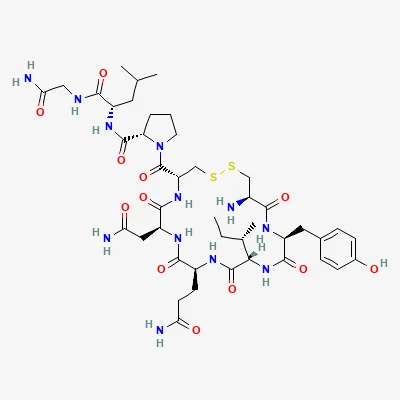
Structure notes: Cys-Tyr-Ile-Gln-Asn-Cys-Pro-Leu-Gly-NH2 with a disulfide bond between Cys1 and Cys6 forming a six-residue ring, and a C-terminal glycinamide. The PubChem formula C43H66N12O12S2 matches CYIQNCPLG with the disulfide and C-terminal amide.
What Is Oxytocin?
Oxytocin is a small, nine-amino-acid peptide hormone synthesized and released mostly in the brain, first identified as a hormone that facilitates labor and lactation.[1] It is produced chiefly by magnocellular neurons of the hypothalamic paraventricular and supraoptic nuclei and released from the posterior pituitary into the circulation in response to stimuli such as suckling, parturition and certain kinds of stress.[2]
Oxytocin and oxytocin-like hormones facilitate reproduction in all vertebrates.[2] Beyond its endocrine roles, oxytocin acts as a neuromodulator in the human central nervous system, and a large literature has examined its effects on social behavior.[3]
Its informal label as a love hormone has been described as erroneous, because it does not reflect oxytocin’s biological actions across different contexts.[1] Synthetic oxytocin is routinely used to induce or augment labor and to prevent postpartum hemorrhage.[4]
Chemical Structure and Molecular Identity
Oxytocin is a cyclic nonapeptide, Cys-Tyr-Ile-Gln-Asn-Cys-Pro-Leu-Gly-NH2, in which a disulfide bond between the two cysteines closes a six-residue ring and the C-terminus is a glycinamide. PubChem lists it under CID 439302 with the molecular formula C43H66N12O12S2 and a molecular weight of 1007.2 g/mol.
The disulfide ring is followed by a three-residue tail, Pro-Leu-Gly-NH2. Oxytocin is closely related to vasopressin, and PubChem records it under the systematic synonym 3-isoleucine-8-leucine vasopressin, reflecting the two positions at which the peptides differ.
Key identifiers
- CAS number: 50-56-6
- InChIKey: XNOPRXBHLZRZKH-DSZYJQQASA-N
- Synonyms: ocytocin, alpha-hypophamine, synthetic oxytocin, oxytocinum
The chemistry has practical consequences. A 2020 review noted that oxytocin’s active disulfide bonds and its capacity to shift chemical forms and bind other molecules make it difficult to work with and to measure.[5]
Research History and Development
Oxytocin was first characterized as a labor and lactation hormone and has since become one of the most extensively studied neuropeptides, with nearly 25,000 PubMed-listed publications since 1930 by one 2018 count.[1][6]
Early research concentrated on its classical actions, stimulation of uterine smooth muscle contraction during labor and milk ejection during lactation. Work in oxytocin-deficient mice later confirmed its essential role in the milk let-down reflex, while its role in parturition proved more complex.[2]
Over recent decades the focus widened to the brain. Studies in animals and humans have linked oxytocin and its receptor to sexual and maternal behavior, pair bonding, anxiety, trust, sociability, food intake and drug abuse.[6] Newer methods for monitoring and manipulating oxytocin and oxytocin-receptor neurons in vivo have driven circuit-level research on social behavior.[7]
Mechanisms Studied in Research
Oxytocin acts through a single oxytocin receptor (OXTR), a class I G-protein-coupled receptor coupled primarily via Gq proteins to phospholipase C-beta.[2] The high-affinity receptor state requires both magnesium and cholesterol, which probably act as allosteric modulators, and the agonist-binding region differs from the antagonist binding site.[2]
Oxytocin is not confined to the pituitary route. It is also released within hypothalamic nuclei, oxytocinergic neurons project widely through the central nervous system, and the peptide is synthesized in peripheral tissues including the uterus, placenta, amnion, corpus luteum, testis and heart. Regulation of the system is strongly steroid dependent.[2]
Intracellular signaling
OXTR can couple to either Gαi or Gαq proteins and activates cascades including MAPK, PKC, PLC and CaMK pathways that converge on transcription factors such as CREB and MEF-2. Cellular responses include regulation of neurite outgrowth, cell viability and survival.[6]
Myometrium
In uterine smooth muscle, receptor activation stimulates contraction mainly by raising intracellular calcium through inositol trisphosphate-mediated store release, store-operated entry and voltage-operated entry, plus calcium-sensitization mechanisms. Receptor signaling is regulated by changes in receptor expression, receptor desensitization and local oxytocin concentration.[8] Before labor, uterine sensitivity to oxytocin rises sharply alongside strong upregulation of myometrial receptors.[2] Oxytocin also stimulates prostaglandin synthesis in the decidua and chorioamniotic membranes, contributing to cervical ripening and contractility.[9]
Brain circuits
Circuit studies indicate that oxytocin can enhance the salience of social stimuli and increase signal-to-noise ratios by modulating spiking and synaptic plasticity.[7] Oxytocinergic projections form anxiety- and stress-regulating circuits linking the paraventricular nucleus with the amygdala, bed nucleus of the stria terminalis and medial prefrontal cortex.[6] Many of its actions depend on interaction with vasopressin and vasopressin receptors, and oxytocin receptors are epigenetically tuned by experience, especially in early life.[5]
Key Findings From Published Studies
Published research on oxytocin spans labor physiology, receptor pharmacology, social neuroscience and psychiatry, with the strongest evidence in obstetric physiology and more mixed findings in behavior and mood.
Labor physiology
A 2024 review described oxytocin release in pulses of increasing frequency and amplitude during the first and second stages of labor. Pressure of the fetus on the cervix activates the Ferguson reflex, a feedforward loop that releases oxytocin, and high circulating estrogen at term makes receptors more sensitive. The brain oxytocin system has also been implicated in reducing maternal fear, pain and stress. Studies suggest, but have not proven, that labor may be associated with long-term behavioral and physiological adaptations in mother and infant, possibly involving epigenetic modulation of the oxytocin system.[9]
Obstetric pharmacology
Because oxytocin induces myometrial contraction, activating and blocking its receptor have long been targets in dysfunctional labor and preterm labor, respectively, with dysfunctional labor, postpartum hemorrhage and preterm birth highlighted as key clinical scenarios.[8]
Social behavior
Human studies show that oxytocin modulates empathy, trust, in-group preference and memory of socially relevant cues. Accumulating evidence indicates that these effects depend on context and individual characteristics and can include antisocial effects such as aggression and envy, leading to a proposed social salience framework involving the dopaminergic system.[3] In monogamous species, both oxytocin and vasopressin facilitate social memory and pair bonding, and oxytocin promotes maternal nurturing, enhances social reward and increases the salience of social stimuli.[10] Prairie voles have been highlighted as a nontraditional model for studying circuit-level modulation of social behavior.[7]
Postpartum depression
A 2020 systematic review of 16 studies found that eight of twelve studies on endogenous oxytocin suggested an inverse relationship between plasma oxytocin levels and depressive symptoms. The authors could draw no conclusions about intravenous synthetic oxytocin and postpartum depression because the four relevant studies were few and heterogeneous.[4]
Stress and inflammation
A 2020 review described oxytocin as able to function as a stress-coping molecule, an anti-inflammatory and an antioxidant, with influences on the autonomic and immune systems. It also stressed that effects are context-dependent, sexually dimorphic and altered by experience.[5]
Because oxytocin's disulfide bond can rearrange and the molecule is hard to measure, researchers typically confirm identity and purity with HPLC-MS certificates of analysis.
Regulatory and Research Status
Synthetic oxytocin is approved by the US Food and Drug Administration for obstetric use, including induction and augmentation of labor and management of postpartum bleeding. In clinical research, synthetic oxytocin infusions are used to induce and augment labor.[9]
All other uses, including behavioral and psychiatric applications, remain investigational. Reviews have discussed translational implications for disorders with social impairments such as autism spectrum disorder, but these remain research questions rather than approved indications.[10] Reviewers have also cautioned that oxytocin’s chemical instability and context-dependent effects present challenges to developing oxytocin-like molecules as drugs.[5]
In laboratory research, oxytocin is used as a reference agonist for OXTR pharmacology, as a tool in social-circuit neuroscience, and as a comparator for vasopressin-system studies.[6][10]
Commonly Supplied Research Formats
Oxytocin is listed by 9 of the 11 major U.S. research-peptide suppliers we track. The most commonly listed formats are:
- 10mg
- 5mg
- 2mg
Supplier catalog survey, October 2026. Quantities refer to net peptide per vial as labeled.
Frequently Asked Questions
What is oxytocin?
Oxytocin is a nine-amino-acid peptide hormone, Cys-Tyr-Ile-Gln-Asn-Cys-Pro-Leu-Gly-NH2 with a disulfide ring, made mainly in the hypothalamus and released from the posterior pituitary. It stimulates uterine contraction in labor and milk ejection in lactation and acts in the brain as a neuromodulator of social behavior through the oxytocin receptor.
What is the molecular weight of oxytocin?
Oxytocin has a molecular weight of 1007.2 g/mol and the molecular formula C43H66N12O12S2, according to PubChem (CID 439302). The two sulfur atoms come from the cysteine residues at positions 1 and 6, which are joined by a disulfide bond. Salt forms such as the acetate have higher formula weights.
Is oxytocin FDA approved?
Yes. Synthetic oxytocin is FDA-approved for obstetric uses, including induction and augmentation of labor and management of postpartum bleeding. Uses outside obstetrics, such as for social, behavioral or psychiatric conditions, are not approved and remain investigational, with reviews noting context-dependent effects and challenges in developing oxytocin-like drugs.
How is oxytocin different from vasopressin?
Oxytocin and vasopressin are closely related nine-residue peptides with the same disulfide ring structure, differing at positions 3 and 8. Their classic peripheral roles differ: oxytocin acts on childbirth and nursing, vasopressin on blood pressure and urine concentration. In the brain, many oxytocin actions depend on interaction with vasopressin receptors.
Is oxytocin really the love hormone?
Not in a scientific sense. A 2025 review called the love hormone label erroneous because it does not reflect oxytocin's actions across contexts. Human studies show oxytocin modulates trust, empathy and in-group preference, but effects depend on context and individual traits and can include antisocial effects such as aggression and envy.
What does the research on oxytocin and postpartum depression show?
A 2020 systematic review of 16 studies found that eight of twelve studies on endogenous oxytocin suggested an inverse relationship between plasma oxytocin levels and depressive symptoms. The authors could not draw conclusions about intravenous synthetic oxytocin and postpartum depression because only four heterogeneous studies addressed it.
Why is oxytocin hard to measure?
Oxytocin's active disulfide bonds and its ability to shift chemical forms and bind other molecules make it difficult to work with and measure, according to a 2020 Pharmacological Reviews article. Laboratory methods also vary; in postpartum depression studies, oxytocin was mostly measured in plasma with differing methods and control of confounders.
References
- Winokur SB, Caslin AY, Davis FM, et al. Oxytocin. Current biology : CB 2025. PMID 41118743 · DOI
- Gimpl G, Fahrenholz F. The oxytocin receptor system: structure, function, and regulation. Physiological reviews 2001. PMID 11274341 · DOI
- Shamay-Tsoory SG, Abu-Akel A. The Social Salience Hypothesis of Oxytocin. Biological psychiatry 2016. PMID 26321019 · DOI
- Thul TA, Corwin EJ, Carlson NS, et al. Oxytocin and postpartum depression: A systematic review. Psychoneuroendocrinology 2020. PMID 32683141 · DOI
- Carter CS, Kenkel WM, MacLean EL, et al. Is Oxytocin "Nature's Medicine"? Pharmacological reviews 2020. PMID 32912963 · DOI
- Jurek B, Neumann ID. The Oxytocin Receptor: From Intracellular Signaling to Behavior. Physiological reviews 2018. PMID 29897293 · DOI
- Froemke RC, Young LJ. Oxytocin, Neural Plasticity, and Social Behavior. Annual review of neuroscience 2021. PMID 33823654 · DOI
- Arrowsmith S, Wray S. Oxytocin: its mechanism of action and receptor signalling in the myometrium. Journal of neuroendocrinology 2014. PMID 24888645 · DOI
- Uvnäs-Moberg K. The physiology and pharmacology of oxytocin in labor and in the peripartum period. American journal of obstetrics and gynecology 2024. PMID 38462255 · DOI
- Rigney N, de Vries GJ, Petrulis A, et al. Oxytocin, Vasopressin, and Social Behavior: From Neural Circuits to Clinical Opportunities. Endocrinology 2022. PMID 35863332 · DOI
Related Compounds
This profile summarizes chemical data and peer-reviewed literature for educational and laboratory-research reference. It is not medical advice, and nothing here describes or recommends use in humans or animals. How we source and verify data.