GHRP-2 (Pralmorelin)
Also known as: Pralmorelin · KP-102
GHRP-2 (pralmorelin) is a synthetic growth hormone-releasing hexapeptide that acts on the growth hormone secretagogue receptor, the same receptor targeted by the gut hormone ghrelin. Developed at Tulane University and later coded KP-102, it strongly stimulates growth hormone release and has been studied mainly as a diagnostic agent for growth hormone deficiency.
Last reviewed · Identity data matched to PubChem · 10 peer-reviewed sources
Key facts
- Class: synthetic growth hormone-releasing peptide (GHRP), a ghrelin receptor agonist
- Length: six residues, including D-alanine, D-2-naphthylalanine and D-phenylalanine, with a C-terminal amide
- Formula C45H55N9O6; molecular weight 818.0 g/mol (PubChem CID 6918245)
- INN: pralmorelin; development codes KP-102 and GPA-748
- Origin: synthesized by Cyril Bowers' group at Tulane University with Polygen
- Used clinically as a diagnostic test for growth hormone deficiency
- Listed as prohibited in sport by the World Anti-Doping Agency (WADA)
Chemical Identity
| Molecular formula | C45H55N9O6 |
|---|---|
| Molecular weight | 818.0 g/mol |
| Monoisotopic mass | 817.4275 Da |
| CAS number | 158861-67-7 |
| PubChem CID | 6918245 |
| UNII | E6S6E1F19M |
| InChIKey | HRNLPPBUBKMZMT-RDRUQFPZSA-N |
| Compound type | Peptide |
| H-bond donors / acceptors | 9 / 8 |
| XLogP3 | 2.5 |
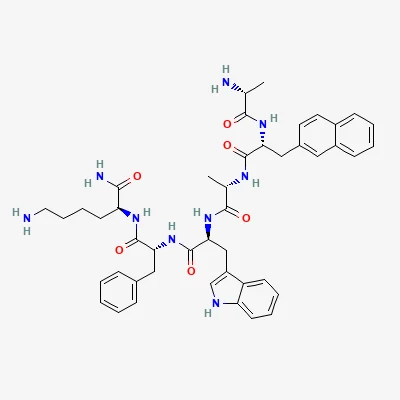
Structure notes: D-Ala-D-2-Nal-Ala-Trp-D-Phe-Lys-NH2: D-alanine at position 1, 3-(2-naphthyl)-D-alanine (D-2-Nal) at position 2, D-phenylalanine at position 5, and a C-terminal lysinamide. The non-standard naphthylalanine residue cannot be written in one-letter code.
What Is GHRP-2?
GHRP-2, also known by its international nonproprietary name pralmorelin, is a synthetic peptide that triggers the release of growth hormone from the pituitary gland. It belongs to the growth hormone-releasing peptides (GHRPs), a family of small non-natural peptides with potent stimulatory effects on growth hormone secretion in animals and humans.[1]
GHRP-2 mimics the actions of ghrelin, the 28-amino-acid octanoylated peptide that regulates growth hormone release, and a 2005 study described it as a synthetic agonist of ghrelin acting at the growth hormone secretagogue receptor.[2][3] Unlike growth hormone-releasing hormone (GHRH) analogs, GHRPs share no structural homology with GHRH and act through their own receptor.[1]
Most clinical research on GHRP-2 concerns its use as a provocative test for diagnosing growth hormone deficiency in adults and children. It has also been used as a research tool for studying appetite, and it appears in anti-doping literature because of its misuse in sport.[2][3][4]
Chemical Structure and Molecular Identity
GHRP-2 is a hexapeptide with the sequence D-Ala-D-2-Nal-Ala-Trp-D-Phe-Lys-NH2, combining three D-configured residues, one non-proteinogenic naphthylalanine and a C-terminal amide. PubChem lists it under CID 6918245 with the molecular formula C45H55N9O6 and a molecular weight of 818.0 g/mol.
The systematic name is D-alanyl-3-(2-naphthyl)-D-alanyl-L-alanyl-L-tryptophyl-D-phenylalanyl-L-lysinamide. Pharmacology studies have used the dihydrochloride salt, and other salt forms such as the acetate appear among PubChem synonyms.[5] The D-amino acids and the bulky aromatic naphthyl side chain distinguish it from natural peptide hormones.
Key identifiers
- CAS number: 158861-67-7
- InChIKey: HRNLPPBUBKMZMT-RDRUQFPZSA-N
- Synonyms: pralmorelin, KP-102, GPA-748, growth hormone-releasing peptide 2
Because GHRP-2 and its analogs are small, mass spectrometry can resolve them precisely. A 2019 analytical study used high-resolution tandem mass spectrometry and de novo sequencing to identify a previously undescribed glycine analog of GHRP-2 with a molecular mass of 874.02 Da in a seized vial.[6]
Research History and Development
GHRP-2 emerged from a series of small, highly active growth hormone-releasing peptides synthesized by researchers at Tulane University led by Dr Cyril Bowers, working with the German company Polygen. The program produced peptides of varying size intended for a range of formulation approaches.[2]
By the late 1990s, GHRP-6 had been the first hexapeptide studied extensively in humans, and GHRP-2 and hexarelin had followed as newer hexapeptides available for human studies.[1] Kaken Pharmaceutical acquired worldwide manufacturing and marketing rights to pralmorelin, sublicensed it to Wyeth for the US and Canada, and retained rights in Japan.[2]
Development focused on diagnostics. Pralmorelin markedly increases plasma growth hormone in healthy subjects regardless of gender, obesity or age, while the response is significantly lower in patients with growth hormone deficiency. That contrast underpins its use as a diagnostic agent, and a 2004 drug profile noted that these ghrelin-mimicking peptides may play a role in bone and muscle growth, food intake and recovery from injury.[2] A 2019 paper stated that GHRP-2 is the only GHRP to have received a clinical approval.[6]
Mechanisms Studied in Research
GHRP-2 stimulates growth hormone secretion through the growth hormone secretagogue receptor at both the pituitary and hypothalamic levels, and its full effect depends on intact hypothalamic input. Reviews proposed that GHRPs work partly by counteracting somatostatin and partly through a GHRH-mediated mechanism.[1]
Evidence from animal and cell studies
- Somatostatin resistance: in conscious rats, GHRP-2 released more growth hormone than injected GHRH, and in conscious dogs it raised growth hormone while GHRH did not, suggesting lower sensitivity to endogenous somatostatin.[5]
- Pituitary dependence: activity was completely absent in hypophysectomized rats and reduced in rats with median eminence lesions, indicating that endogenous GHRH is needed for the full response.[5]
- Direct pituitary action: GHRP-2 stimulated growth hormone secretion from cultured rat anterior pituitary cells, though less potently than GHRH in vitro.[5]
Effects beyond growth hormone
GHRP-2 is not fully selective. In conscious rats it increased adrenocorticotropic hormone (ACTH) and corticosterone but not prolactin.[5] In conscious swine, GHRP-2 and GHRP-6 both raised ACTH and cortisol, whereas none of the secretagogues tested changed FSH, LH, prolactin or TSH.[7] As a ghrelin agonist, GHRP-2 also influences appetite.[3]
Key Findings From Published Studies
Published studies show that GHRP-2 is a strong growth hormone stimulus that separates people with and without growth hormone deficiency, raises ACTH, and increases food intake in healthy men. Most human data come from diagnostic testing rather than therapeutic trials.
Diagnostic testing in adults and children
In adults, receiver-operating characteristic analysis set a peak growth hormone cutoff of 15.0 µg/L to distinguish patients with growth hormone deficiency from healthy controls.[2] In 56 children with growth disorders, peak growth hormone after GHRP-2 correlated favorably with the insulin tolerance test, median peaks were 3.39 µg/L with deficiency versus 25.10 µg/L without, and the test was described as safe and completed within about an hour.[8]
A 2024 retrospective study of 23 adolescents found median peaks of 3.4 ng/mL in organic or genetic deficiency, compared with 88.9 and 90.1 ng/mL in idiopathic deficiency and short stature. Two patients exceeded the GHRP-2 cutoff but fell below cutoffs for other tests, leading the authors to suggest the adolescent cutoff may need revisiting.[9]
Adrenal axis screening
In 36 patients with hypothalamic-pituitary disorders, the ACTH response during the GHRP-2 test screened for pituitary adrenal insufficiency with 83% sensitivity and 88% specificity at a 1.55-fold cutoff. Combined with peak cortisol, specificity reached 100%.[10]
Appetite in healthy men
In a study of seven lean, healthy men, participants ate 35.9% more at a buffet meal during GHRP-2 infusion than during saline, with every subject increasing intake. Growth hormone rose significantly, and macronutrient choice did not change.[3]
Detection in supplements
Analysts have identified and quantified GHRP-2 in tablets sold as an over-the-counter nutritional supplement using liquid chromatography and high-resolution mass spectrometry.[4]
Because unapproved GHRP-2 analogs have turned up in seized products, researchers typically confirm identity with HPLC purity and mass spectrometry certificates of analysis.
Regulatory and Research Status
GHRP-2 is not approved by the US Food and Drug Administration; its clinical use has been as a diagnostic agent for growth hormone deficiency, with rights held by Kaken in Japan. A 2022 study described the GHRP-2 test as widely used for diagnosing growth hormone deficiency.[2][10]
In sport, GHRP-2 is classed as a growth hormone-releasing factor and appears on the World Anti-Doping Agency’s Prohibited List along with other GHRPs.[4][6] Anti-doping researchers have published chromatographic and mass spectrometric data to support detection, and have reported unapproved analogs in seized products.[4][6]
The 2010 case report on supplement tablets highlighted concern about uncontrolled use of potent, non-approved compounds by healthy individuals, and noted that no routine assay for GHRPs in athletes’ biological fluids existed at that time.[4]
Outside diagnostic settings, GHRP-2 remains a research compound. Current literature centers on endocrine testing, appetite physiology and analytical chemistry rather than long-term outcome trials. Reviews of the GHRP class note that responses undergo partial desensitization, more with continuous than intermittent exposure, which is one reason long-term effects remain an open research question.[1]
Commonly Supplied Research Formats
GHRP-2 is listed by 6 of the 11 major U.S. research-peptide suppliers we track. The most commonly listed formats are:
- 5mg
- 10mg
Supplier catalog survey, October 2026. Quantities refer to net peptide per vial as labeled.
Frequently Asked Questions
Is GHRP-2 the same as pralmorelin?
Yes. Pralmorelin is the international nonproprietary name for GHRP-2, short for growth hormone-releasing peptide 2. The same molecule has also been called KP-102 and GPA-748 during development. All of these names refer to the hexapeptide D-Ala-D-2-Nal-Ala-Trp-D-Phe-Lys-NH2, PubChem CID 6918245, CAS number 158861-67-7.
What is the molecular weight of GHRP-2?
GHRP-2 has a molecular weight of 818.0 g/mol and the molecular formula C45H55N9O6, according to PubChem (CID 6918245). This value refers to the free base. Salt forms used in research, such as the dihydrochloride or acetate, have higher formula weights because of the counterions attached to the peptide.
Is GHRP-2 FDA approved?
No. GHRP-2 is not approved by the US Food and Drug Administration. Under the name pralmorelin it has been used clinically as a diagnostic agent for growth hormone deficiency, with Kaken holding rights in Japan. A 2019 analytical paper described it as the only growth hormone-releasing peptide to have received a clinical approval.
How is GHRP-2 different from GHRP-6?
Both are synthetic hexapeptides acting on the ghrelin receptor, but their sequences differ. GHRP-2 starts with D-alanine and D-2-naphthylalanine, while GHRP-6 starts with histidine and D-tryptophan. In conscious swine, GHRP-2 showed higher potency but lower maximal growth hormone response than GHRP-6, and both raised ACTH and cortisol.
Does GHRP-2 increase appetite?
In a small study of seven lean, healthy men, GHRP-2 infusion increased food intake at a buffet meal by 35.9% compared with saline, and every participant ate more. The authors concluded that GHRP-2, like ghrelin, increases food intake and is a useful tool for studying ghrelin's effects on eating behavior in humans.
What does the research on GHRP-2 show?
Research shows GHRP-2 is a potent growth hormone stimulus that works through the ghrelin receptor and depends on intact hypothalamic input. Clinical studies support its use in diagnosing growth hormone deficiency in adults, children and adolescents, and its ACTH response can help screen for adrenal insufficiency. It also raises appetite and is prohibited in sport.
References
- Ghigo E, Arvat E, Muccioli G, et al. Growth hormone-releasing peptides. European journal of endocrinology 1997. PMID 9186261 · DOI
- Pralmorelin: GHRP 2, GPA 748, growth hormone-releasing peptide 2, KP-102 D, KP-102 LN, KP-102D, KP-102LN. Drugs in R&D 2004. PMID 15230633 · DOI
- Laferrère B, Abraham C, Russell CD, et al. Growth hormone releasing peptide-2 (GHRP-2), like ghrelin, increases food intake in healthy men. The Journal of clinical endocrinology and metabolism 2005. PMID 15699539 · DOI
- Thomas A, Kohler M, Mester J, et al. Identification of the growth-hormone-releasing peptide-2 (GHRP-2) in a nutritional supplement. Drug testing and analysis 2010. PMID 20878896 · DOI
- Doi N, Hirotani C, Ukai K, et al. Pharmacological characteristics of KP-102 (GHRP-2), a potent growth hormone-releasing peptide. Arzneimittel-Forschung 2004. PMID 15646370 · DOI
- Popławska M, Błażewicz A. Identification of a novel growth hormone releasing peptide (a glycine analogue of GHRP-2) in a seized injection vial. Drug testing and analysis 2019. PMID 30051972 · DOI
- Raun K, Hansen BS, Johansen NL, et al. Ipamorelin, the first selective growth hormone secretagogue. European journal of endocrinology 1998. PMID 9849822 · DOI
- Asakura Y, Toyota Y, Muroya K, et al. Growth hormone response to GH-releasing peptide-2 in children. Journal of pediatric endocrinology & metabolism : JPEM 2010. PMID 20662346 · DOI
- Onuki T, Hiroaki T, Sawano K, et al. Robust growth hormone responses to GH-releasing peptide 2 in adolescents. Journal of pediatric endocrinology & metabolism : JPEM 2024. PMID 38958228 · DOI
- Suzuki S, Ruike Y, Ishiwata K, et al. Clinical Usefulness of the Growth Hormone-Releasing Peptide-2 Test for Hypothalamic-Pituitary Disorder. Journal of the Endocrine Society 2022. PMID 35795807 · DOI
Related Compounds
This profile summarizes chemical data and peer-reviewed literature for educational and laboratory-research reference. It is not medical advice, and nothing here describes or recommends use in humans or animals. How we source and verify data.