Ibutamoren (MK-677)
Also known as: MK-677 · MK-0677 · L-163,191
Ibutamoren (MK-677) is an orally active, non-peptide small-molecule growth hormone secretagogue that mimics ghrelin at the growth hormone secretagogue receptor. Designed using the peptide GHRP-6 as a template, it raises growth hormone and IGF-1 and has been tested in clinical trials, including a phase IIb hip-fracture study that ended early over a heart failure safety signal.
Last reviewed · Identity data matched to PubChem · 10 peer-reviewed sources
Key facts
- Class: non-peptide growth hormone secretagogue and ghrelin receptor agonist
- Structure: spiroindoline-piperidine small molecule, not a peptide
- Formula C27H36N4O5S; molecular weight 528.7 g/mol (PubChem CID 178024)
- Development codes: MK-677, MK-0677, L-163,191; studied as the mesylate salt
- Orally active; designed from the GHRP-6 template
- Not approved by the FDA; prohibited in sport as a growth hormone secretagogue
Chemical Identity
| Molecular formula | C27H36N4O5S |
|---|---|
| Molecular weight | 528.7 g/mol |
| Monoisotopic mass | 528.2406 Da |
| CAS number | 159634-47-6 |
| PubChem CID | 178024 |
| UNII | GJ0EGN38UL |
| InChIKey | UMUPQWIGCOZEOY-JOCHJYFZSA-N |
| Compound type | Small molecule |
| H-bond donors / acceptors | 2 / 7 |
| XLogP3 | 1.3 |
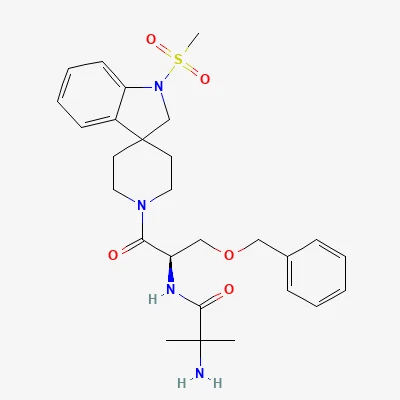
Structure notes: Not a peptide. Ibutamoren is a small molecule: a 1-methanesulfonyl-spiro[indoline-3,4'-piperidine] core acylated with an O-benzyl-D-serine unit that carries an N-terminal 2-aminoisobutyryl (2-methylalanyl) group. It has one defined stereocenter (R configuration at the serine-derived carbon).
What Is Ibutamoren?
Ibutamoren is a synthetic small molecule that stimulates growth hormone release by acting on the growth hormone secretagogue receptor, the same receptor activated by the hormone ghrelin. It belongs to the non-peptide growth hormone secretagogues, and a 1997 review called MK-0677 the most interesting molecule among them.[1]
A 2022 analytical study described ibutamoren as a potent, long-acting, selective non-peptide secretagogue that can be taken orally.[2] Its non-peptide structure sets it apart from the peptide secretagogues such as GHRP-2, GHRP-6 and hexarelin, which were the starting point for its design.[3]
Human research on ibutamoren includes small metabolic studies in healthy volunteers, a phase IIb trial in older adults recovering from hip fracture, and preliminary pediatric work. Its growing use as an unregulated performance product has also produced safety case reports and anti-doping studies.[4][5][6][7]
Chemical Structure and Molecular Identity
Ibutamoren is a non-peptide molecule built on a spiro[indoline-3,4′-piperidine] scaffold bearing a methanesulfonyl group, linked to an O-benzyl-D-serine unit and a 2-amino-2-methylpropanamide side chain. PubChem lists it under CID 178024 with the molecular formula C27H36N4O5S and a molecular weight of 528.7 g/mol.
The IUPAC name is 2-amino-2-methyl-N-[(2R)-1-(1-methylsulfonylspiro[2H-indole-3,4′-piperidine]-1′-yl)-1-oxo-3-phenylmethoxypropan-2-yl]propanamide. The molecule has a single defined stereocenter in the R configuration. Clinical studies have used ibutamoren mesylate, a salt form.[5]
Key identifiers
- CAS numbers listed in PubChem: 159634-47-6 (free base) and 192511-65-2
- InChIKey: UMUPQWIGCOZEOY-JOCHJYFZSA-N
- Synonyms: MK-677, MK-0677, L-163,191
In thoroughbred horses, liquid chromatography with high-resolution mass spectrometry identified 22 ibutamoren metabolites, 17 phase I and 5 phase II. Oxidation produced mono- and dihydroxylated products, side chains such as the benzyl group and 2-amino-2-methylpropanamide dissociated, and glucuronide conjugates formed, while no sulfonic acid conjugates were observed.[2]
Research History and Development
Ibutamoren came out of a reverse-pharmacology program that sought orally active small molecules able to restore a youthful growth hormone and IGF-1 profile. When the program began, neither the receptor nor the natural ligand controlling growth hormone pulse amplitude was known, so lead compounds were chosen by function.[8]
Researchers used the peptide GHRP-6 as a template to discover a series of non-peptide secretagogues, including L-692,429, L-692,585 and MK-0677.[3] The lead developer reasoned that growth hormone pulses could be amplified by increasing GHRH release, amplifying GHRH signaling in the pituitary, reducing somatostatin release or antagonizing somatostatin signaling, and later reported that the secretagogues act through all four mechanisms.[8]
The growth hormone secretagogue receptor was then identified by expression cloning as a previously unknown G-protein-coupled receptor found mainly in brain, pituitary and pancreas. Using the cloned receptor, researchers identified ghrelin as its endogenous agonist, and knockout mouse studies confirmed that the secretagogues are ghrelin mimetics.[8]
Mechanisms Studied in Research
Ibutamoren acts as a ghrelin mimetic at the growth hormone secretagogue receptor, increasing growth hormone secretion and, downstream, circulating IGF-1. Knockout studies of the receptor confirmed this mode of action for the secretagogue class.[8]
Pathways that raise growth hormone
- Hypothalamic input: secretagogues increase GHRH release and reduce somatostatin release.[8]
- Pituitary signaling: they amplify GHRH signaling in somatotroph cells and antagonize somatostatin receptor signaling.[8]
- Dual site of action: GHRP-class compounds probably act on both pituitary and hypothalamus, with activity synergistic with GHRH.[3]
Downstream effects
In healthy volunteers, ibutamoren produced a large growth hormone peak on the first treatment day (55.9 µg/L versus about 9 µg/L with placebo) and a smaller peak after a week (22.6 µg/L versus about 7 µg/L), consistent with partial attenuation of the acute response.[4] In older adults after hip fracture, IGF-1 rose by 51.4 ng/mL relative to placebo.[5] Reported side effects linked to the compound include edema, increased appetite and muscle pain.[7]
Key Findings From Published Studies
Clinical studies show that ibutamoren reliably raises growth hormone and IGF-1 and can improve nitrogen balance, but functional benefits in older adults were limited and a heart failure safety signal ended its phase IIb hip-fracture trial.
Diet-induced catabolism in healthy adults
In a double-blind, randomized, placebo-controlled crossover study, eight healthy volunteers aged 24 to 39 underwent two 14-day periods of caloric restriction. During the treatment week, mean daily nitrogen balance was +0.31 g/day with ibutamoren versus -1.48 g/day with placebo, and the integrated nitrogen balance response also favored ibutamoren. During the preceding diet-only week, nitrogen losses and the fall in IGF-1 were similar in both groups.[4]
Older adults in the secretagogue program
The program’s lead developer reported that growth hormone secretagogues reproduced a young adult growth hormone profile in elderly subjects, accompanied by increased bone mineral density and lean mass, modest improvements in strength and improved recovery from hip fracture. Restoration of thymic function was reported in old mice.[8]
Hip fracture recovery in older adults
A multicenter, randomized, double-blind phase IIb trial enrolled 123 elderly patients recovering from hip fracture. At 24 weeks, gait speed improved relative to placebo, but stair-climbing power did not differ significantly and several other functional measures showed no improvement. Fewer patients in the ibutamoren group fell, though the difference was not significant. The trial was terminated early because of a congestive heart failure safety signal in a limited number of patients, and the authors concluded the compound has an unfavorable safety profile in this population.[5]
Broader reviews and case reports
- A 2026 scoping review of six peptides used in sports medicine found that 67% of publications used preclinical animal models, that human studies were few and mostly lacked robust controls, and that human data showed modest improvements at best; it associated MK-677 with significant risks including congestive heart failure.[9]
- A 2025 case report described transaminitis in a healthy man in his early 30s after two months of use, resolving after he stopped.[7]
- A 2025 pediatric review presented preliminary data on ibutamoren in children with partial growth hormone deficiency.[6]
Because ibutamoren is often sold outside regulated channels, researchers typically verify identity and purity with HPLC and mass spectrometry certificates of analysis.
Regulatory and Research Status
Ibutamoren is not approved by the US Food and Drug Administration for any medical use and remains an investigational compound. It is prohibited in sport by the World Anti-Doping Agency as a growth hormone secretagogue, and doping-control laboratories have developed methods to detect it.[2][10]
In horses, the parent compound persisted for up to 72 hours and major metabolites were detectable for up to 96 hours after a single administration.[2] In human hair, a 2026 study detected ibutamoren after a single exposure and at roughly 170-fold higher concentrations in a performance-enhancing user, the first report of its incorporation into hair, and established a minimal detectable exposure to aid interpretation of anti-doping hair tests.[10]
A case report noted that ibutamoren is gaining popularity among performance-enhancing supplements, and a sports medicine review observed that such products are often perceived as low risk despite missing efficacy or safety data.[7][9] Current clinical interest centers on pediatric growth hormone deficiency, where data remain preliminary.[6]
Commonly Supplied Research Formats
Ibutamoren is listed by 2 of the 11 major U.S. research-peptide suppliers we track. The most commonly listed formats are:
- 10mg x 100 (capsules)
- 12.5mg (capsules)
Supplier catalog survey, October 2026. Quantities refer to net peptide per vial as labeled.
Frequently Asked Questions
Is ibutamoren the same as MK-677?
Yes. Ibutamoren is the international nonproprietary name for the compound developed as MK-677, also written MK-0677 and earlier coded L-163,191. Clinical trials used ibutamoren mesylate, a salt form. All of these names refer to the same non-peptide growth hormone secretagogue, PubChem CID 178024, with CAS number 159634-47-6 for the free base.
Is ibutamoren a peptide or a SARM?
Neither. Ibutamoren is a non-peptide small molecule that acts on the growth hormone secretagogue receptor as a ghrelin mimetic. It is not a selective androgen receptor modulator and does not act on the androgen receptor. It was designed from the peptide GHRP-6 as a template but contains no peptide chain and was developed as an orally active compound.
What is the molecular weight of ibutamoren?
Ibutamoren has a molecular weight of 528.7 g/mol and the molecular formula C27H36N4O5S, according to PubChem (CID 178024). That value refers to the free base. Clinical studies used the mesylate salt, which has a higher formula weight because it includes the methanesulfonic acid counterion.
Is ibutamoren FDA approved?
No. Ibutamoren is not approved by the US Food and Drug Administration for any medical use. A phase IIb trial in older adults recovering from hip fracture was terminated early because of a congestive heart failure safety signal. It remains investigational, with preliminary pediatric research, and is prohibited in sport by the World Anti-Doping Agency.
How is ibutamoren different from GHRP-6?
Both stimulate growth hormone through the growth hormone secretagogue receptor, but GHRP-6 is a six-residue peptide while ibutamoren is a non-peptide small molecule. Researchers used GHRP-6 as a template to design ibutamoren and related compounds. Ibutamoren was developed for oral activity and has been described as long-acting and selective.
What does the research on ibutamoren show?
Research shows ibutamoren raises growth hormone and IGF-1 and improved nitrogen balance during caloric restriction in a small crossover study. In a phase IIb hip-fracture trial, it improved gait speed but not most functional measures, and the trial stopped early over a heart failure safety signal. Case reports describe liver enzyme elevations.
References
- Ghigo E, Arvat E, Muccioli G, et al. Growth hormone-releasing peptides. European journal of endocrinology 1997. PMID 9186261 · DOI
- Philip M, Karakka Kal AK, Subhahar MB, et al. Characterization of growth hormone secretagogue small molecule ibutamoren (MK-0677) and its possible metabolites in thoroughbred horses for doping control. Rapid communications in mass spectrometry : RCM 2022. PMID 35716382 · DOI
- Camanni F, Ghigo E, Arvat E. Growth hormone-releasing peptides and their analogs. Frontiers in neuroendocrinology 1998. PMID 9465289 · DOI
- Murphy MG, Plunkett LM, Gertz BJ, et al. MK-677, an orally active growth hormone secretagogue, reverses diet-induced catabolism. The Journal of clinical endocrinology and metabolism 1998. PMID 9467534 · DOI
- Adunsky A, Chandler J, Heyden N, et al. MK-0677 (ibutamoren mesylate) for the treatment of patients recovering from hip fracture: a multicenter, randomized, placebo-controlled phase IIb study. Archives of gerontology and geriatrics 2011. PMID 21067829 · DOI
- Stawerska R. New directions in growth hormone treatment in children. Pediatric endocrinology, diabetes, and metabolism 2025. PMID 41693185 · DOI
- Cobani E, Amin MS, Hasso M, et al. Hepatotoxicity induced by MK-677. BMJ case reports 2025. PMID 40675653 · DOI
- Smith RG. Development of growth hormone secretagogues. Endocrine reviews 2005. PMID 15814848 · DOI
- Tewari K, Liu TP, Im C, et al. Peptide Supplements and Their Therapeutic Applications in Sports Medicine. The American journal of sports medicine 2026. PMID 42578445 · DOI
- Kintz P, Gheddar L. Knowing the minimal detectable dose can facilitate the interpretation of a hair test result: II. Case example with ibutamoren (MK-677), a growth hormone secretagogue. Clinica chimica acta; international journal of clinical chemistry 2026. PMID 40882886 · DOI
Related Compounds
This profile summarizes chemical data and peer-reviewed literature for educational and laboratory-research reference. It is not medical advice, and nothing here describes or recommends use in humans or animals. How we source and verify data.