GHRP-6
Also known as: Growth Hormone Releasing Hexapeptide · SKF-110679
GHRP-6 (growth hormone-releasing hexapeptide) is a synthetic six-residue peptide, His-D-Trp-Ala-Trp-D-Phe-Lys-NH2, that stimulates growth hormone release through the growth hormone secretagogue receptor. It was the first hexapeptide of its class studied extensively in humans and is used in research on pituitary function, diagnostic testing and tissue protection in animal injury models.
Last reviewed · Identity data matched to PubChem · 11 peer-reviewed sources
Key facts
- Class: synthetic growth hormone-releasing peptide (GHRP), a growth hormone secretagogue
- Length: six residues, His-D-Trp-Ala-Trp-D-Phe-Lys-NH2, with two D-amino acids
- Formula C46H56N12O6; molecular weight 873.0 g/mol (PubChem CID 4345065)
- Development code: SKF-110679
- First GHRP hexapeptide studied extensively in humans
- Not approved by the FDA; remains a research compound
Chemical Identity
| Molecular formula | C46H56N12O6 |
|---|---|
| Molecular weight | 873.0 g/mol |
| Monoisotopic mass | 872.4446 Da |
| PubChem CID | 4345065 |
| InChIKey | WZHKXNSOCOQYQX-UHFFFAOYSA-N |
| Compound type | Peptide |
| H-bond donors / acceptors | 11 / 9 |
| XLogP3 | 1.9 |
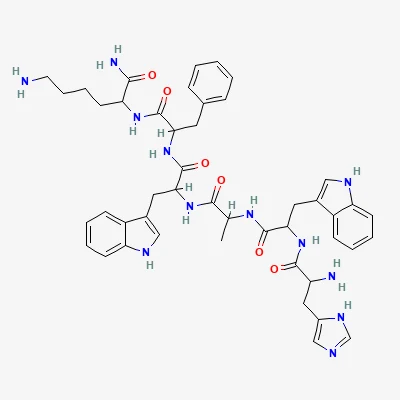
Structure notes: His-D-Trp-Ala-Trp-D-Phe-Lys-NH2: L-histidine at position 1, D-tryptophan at position 2, D-phenylalanine at position 5, and a C-terminal lysinamide (C-terminal amide). The D-residues cannot be represented in standard one-letter code.
What Is GHRP-6?
GHRP-6 is a synthetic hexapeptide that releases growth hormone from the pituitary gland, both in living animals and humans and in isolated pituitary cells. It belongs to the growth hormone-releasing peptides (GHRPs), synthetic, non-natural peptides with potent stimulatory effects on growth hormone secretion.[1][2]
GHRPs have no structural homology with growth hormone-releasing hormone (GHRH). They act through their own receptor, present at both the pituitary and the hypothalamus, which was cloned in the 1990s and shows no sequence homology with other known G-protein-coupled receptors.[1] That receptor is now generally called the growth hormone secretagogue receptor, and its natural ligand is ghrelin.
GHRP-6 was the first hexapeptide in the class to be studied extensively in humans.[1] Its research record spans endocrine testing in people with growth hormone deficiency, hypothyroidism, obesity and type 2 diabetes, and a growing set of animal studies on heart, gut and kidney injury.[3][2][4] Most human data come from short-term endocrine testing rather than long-term clinical trials.
Chemical Structure and Molecular Identity
GHRP-6 is the hexapeptide His-D-Trp-Ala-Trp-D-Phe-Lys-NH2, containing two D-configured aromatic residues and a C-terminal amide.[5] PubChem lists it under CID 4345065 with the molecular formula C46H56N12O6 and a molecular weight of 873.0 g/mol.
The peptide carries three aromatic side chains from two tryptophans and one phenylalanine, plus a histidine imidazole and a lysine amine. The D-tryptophan at position 2 and D-phenylalanine at position 5 are features shared with later GHRPs such as hexarelin, which adds a methyl group to the D-tryptophan.
Key identifiers
- PubChem CID: 4345065
- InChIKey listed in PubChem: WZHKXNSOCOQYQX-UHFFFAOYSA-N (a record without defined stereocenters)
- Synonyms: growth hormone releasing hexapeptide, SKF-110679
Because the PubChem entry does not encode stereochemistry, the D-configuration at positions 2 and 5 is best confirmed from the residue-level sequence. GHRP-6 has also served as a template for conformational chemistry: a 2014 study synthesized eight GHRP-6 analogs containing N-aminoimidazolidin-2-one residues that rigidify the peptide backbone.[6]
Research History and Development
GHRP-6 was among the earliest members of a new chemical class of growth hormone secretagogues that ranges from small synthetic peptides to non-peptide mimetics. A 1998 review described the class as releasing growth hormone through a unique dual and complementary action on the hypothalamus and pituitary.[7]
Early mechanistic work, summarized in a 1993 review, examined GHRP-6 in experimental animal models and in obese subjects and described it as a new hexapeptide that specifically releases growth hormone.[5]
Although GHRPs are of unnatural origin, investigators argued through the 1990s that their activity reflected the action of a natural hypothalamic hormone not yet identified, and that a natural GHRP-like ligand must exist.[7][1] Interest persisted because of possible diagnostic and therapeutic value and because the peptides offered new insight into how growth hormone secretion is regulated.[7]
After GHRP-6, a heptapeptide (GHRP-1) and two further hexapeptides, GHRP-2 and hexarelin, were synthesized for human studies, and non-peptide mimetics such as MK-0677 followed.[1] More recent work has moved beyond endocrinology into cytoprotection, including cardiac, gastrointestinal and renal injury models.[4][8][9]
Mechanisms Studied in Research
GHRP-6 releases growth hormone through its own receptor at the pituitary and hypothalamus, and studies point to functional opposition of somatostatin and cooperation with GHRH. The exact mechanism was still debated in the late 1990s.[1]
Proposed endocrine mechanisms
- Somatostatin antagonism: evidence suggested GHRP-6 acts as a functional somatostatin antagonist at the pituitary level.[2]
- Independence from hypothalamic factors: work in animal models and obese subjects found that GHRP-6 released growth hormone independently of GHRH and somatostatin.[5]
- GHRH-linked action: reviews also proposed a partial GHRH-mediated mechanism, or an unidentified hypothalamic factor.[1]
- Desensitization: responses to GHRPs partially desensitize, more with continuous infusion than with intermittent exposure, although prolonged administration still increased IGF-1 levels.[1]
Cellular pathways in injury models
In a rat doxorubicin cardiotoxicity model, GHRP-6 sustained antioxidant defenses and upregulated the prosurvival gene Bcl-2.[4] In a mouse acute kidney injury model, a self-assembling GHRP-6 hydrogel improved renal tubular epithelial cell survival through activation of the mTOR-P70 pathway and shifted metabolites including spermidine, L-glutamine and acetyl-CoA.[9]
Key Findings From Published Studies
Human studies show that GHRP-6 is a strong growth hormone stimulus whose response depends on pituitary stalk integrity, thyroid status and blood glucose, while animal studies report protective effects in heart, gut and kidney injury.
Human endocrine studies
In short-statured children and adults with growth hormone deficiency, the growth hormone response to GHRP-6 was lower in deficient patients than in normal children, but individual results overlapped considerably. Responses to GHRP-6, alone or combined with GHRH, were almost completely blocked in patients with pituitary stalk transection.[3]
In a study of 11 patients with primary hypothyroidism and 10 controls, each tested in random order on separate days, hypothyroid patients had markedly blunted responses to GHRH (mean peak 4.1 versus 24.9 µg/L) but higher responses to GHRP-6 than to GHRH (12.6 µg/L). Combining GHRP-6 with GHRH produced the largest responses in both groups.[2] In 12 men with type 2 diabetes, peak growth hormone after combined GHRH and GHRP-6 was lower during a hyperglycemic clamp than a euglycemic clamp (112.45 versus 151.06 mU/L).[10] GHRP-6 was also described as a powerful growth hormone releaser in obesity.[5]
Animal and cell studies
- Heart: in healthy rats given doxorubicin, concurrent GHRP-6 prevented ventricular dilation, preserved left ventricular systolic function, attenuated damage to other organs and reduced morbidity and mortality.[4]
- Gut and liver: GHRP-6 tripled migration of IEC-6 and HT29 intestinal cells without increasing proliferation in vitro, and in rat hepatic ischemia-reperfusion it reduced tissue damage markers by 50 to 85%, with added benefit alongside epidermal growth factor; lung and kidney injury were also reduced.[8]
- Kidney: a GHRP-6 hydrogel enhanced recovery in a mouse acute kidney injury model.[9]
Because PubChem's GHRP-6 record omits stereochemistry and a CAS number, researchers typically rely on HPLC purity and mass spectrometry identity data from certificates of analysis.
Regulatory and Research Status
GHRP-6 is not approved by the US Food and Drug Administration for any use and remains an investigational research compound. Growth hormone-releasing peptides as a group, including GHRP-6, are prohibited in sport under the World Anti-Doping Agency’s Prohibited List.
Clinical interest has focused on diagnostic testing of pituitary growth hormone reserve. Investigators suggested that GHRP-6 testing, alone or with GHRH, could be a cost-effective way to diagnose pituitary stalk transection and might help diagnose adult-onset growth hormone deficiency.[3] Other authors cautioned that ambient glucose should be considered when interpreting combined GHRH and GHRP-6 tests in type 2 diabetes.[10]
A 2020 review of growth hormone secretagogues in men with hypogonadism discussed GHRP-6 alongside sermorelin, GHRP-2, ibutamoren and ipamorelin, but concluded that a paucity of clinical data limits understanding of their role.[11] The tissue-protection findings come from rodent and cell models and have not been confirmed in human trials. Analog chemistry also remains active, with GHRP-6 used as a scaffold for testing backbone constraints in peptide design.[6]
Commonly Supplied Research Formats
GHRP-6 is listed by 5 of the 11 major U.S. research-peptide suppliers we track. The most commonly listed formats are:
- 5mg
- 10mg
- 2mg
Supplier catalog survey, October 2026. Quantities refer to net peptide per vial as labeled.
Frequently Asked Questions
What is the sequence of GHRP-6?
GHRP-6 has the sequence His-D-Trp-Ala-Trp-D-Phe-Lys-NH2. It is a hexapeptide with D-tryptophan at position 2, D-phenylalanine at position 5 and an amidated C-terminal lysine. Because two residues are D-amino acids, the sequence cannot be written accurately in standard one-letter amino acid code without additional notation.
What is the molecular weight of GHRP-6?
GHRP-6 has a molecular weight of 873.0 g/mol and the molecular formula C46H56N12O6, according to PubChem (CID 4345065). This refers to the free peptide. Salt forms such as the acetate have higher formula weights because of the attached counterions, so researchers should check which form a given value describes.
Is GHRP-6 FDA approved?
No. GHRP-6 is not approved by the US Food and Drug Administration for any medical use. It has been studied in clinical research settings, mainly as a test of pituitary growth hormone reserve, and in animal injury models. Growth hormone-releasing peptides, including GHRP-6, are also prohibited in sport by the World Anti-Doping Agency.
How is GHRP-6 different from GHRP-2?
Both are synthetic hexapeptides that act on the growth hormone secretagogue receptor, but their sequences differ. GHRP-6 begins with histidine and D-tryptophan, while GHRP-2 begins with D-alanine and D-2-naphthylalanine. GHRP-6 was the first of the two studied extensively in humans; GHRP-2 was developed later and became a diagnostic agent.
How is GHRP-6 different from hexarelin?
Hexarelin is a close analog of GHRP-6. The two share the same six-residue backbone, His-D-Trp-Ala-Trp-D-Phe-Lys-NH2, but hexarelin carries a methyl group on the 2-position of its D-tryptophan indole ring. Hexarelin was synthesized after GHRP-6 as one of a newer generation of hexapeptides made available for human studies.
What does the research on GHRP-6 show?
Research shows GHRP-6 strongly stimulates growth hormone release, with responses shaped by pituitary stalk integrity, thyroid status and blood glucose. Animal studies report reduced doxorubicin-induced heart damage in rats, less ischemia-reperfusion injury in rat liver and gut, and better recovery in a mouse kidney injury model. Human evidence beyond endocrine testing is limited.
References
- Ghigo E, Arvat E, Muccioli G, et al. Growth hormone-releasing peptides. European journal of endocrinology 1997. PMID 9186261 · DOI
- Pimentel-Filho FR, Ramos-Dias JC, Ninno FB, et al. Growth hormone responses to GH-releasing peptide (GHRP-6) in hypothyroidism. Clinical endocrinology 1997. PMID 9156038 · DOI
- Pombo M, Leal-Cerro A, Barreiro J, et al. Growth hormone releasing hexapeptide-6 (GHRP-6) test in the diagnosis of GH-deficiency. Journal of pediatric endocrinology & metabolism : JPEM 1996. PMID 8887178
- Berlanga-Acosta J, Cibrian D, Valiente-Mustelier J, et al. Growth hormone releasing peptide-6 (GHRP-6) prevents doxorubicin-induced myocardial and extra-myocardial damages by activating prosurvival mechanisms. Frontiers in pharmacology 2024. PMID 38873418 · DOI
- Micic D, Mallo F, Peino R, et al. Regulation of growth hormone secretion by the growth hormone releasing hexapeptide (GHRP-6). The Journal of pediatric endocrinology 1993. PMID 7920995 · DOI
- Doan ND, Hopewell R, Lubell WD. N-aminoimidazolidin-2-one peptidomimetics. Organic letters 2014. PMID 24697286 · DOI
- Bowers CY. Growth hormone-releasing peptide (GHRP). Cellular and molecular life sciences : CMLS 1998. PMID 9893708 · DOI
- Cibrián D, Ajamieh H, Berlanga J, et al. Use of growth-hormone-releasing peptide-6 (GHRP-6) for the prevention of multiple organ failure. Clinical science (London, England : 1979) 2006. PMID 16417467 · DOI
- Zhao X, Pan K, Li R, et al. Growth hormone-releasing peptide 6 (GHRP-6) hydrogel for acute kidney injury therapy via metabolic regulation. Journal of nanobiotechnology 2025. PMID 41327290 · DOI
- Micic D, Kendereski A, Sumarac-Dumanovic M, et al. Growth hormone response to GHRH + GHRP-6 in type 2 diabetes during euglycemic and hyperglycemic clamp. Diabetes research and clinical practice 2004. PMID 14693411 · DOI
- Sinha DK, Balasubramanian A, Tatem AJ, et al. Beyond the androgen receptor: the role of growth hormone secretagogues in the modern management of body composition in hypogonadal males. Translational andrology and urology 2020. PMID 32257855 · DOI
Related Compounds
This profile summarizes chemical data and peer-reviewed literature for educational and laboratory-research reference. It is not medical advice, and nothing here describes or recommends use in humans or animals. How we source and verify data.