Hexarelin
Also known as: Examorelin
Hexarelin (examorelin) is a synthetic growth hormone-releasing hexapeptide and close analog of GHRP-6 that activates the growth hormone secretagogue receptor, the receptor for ghrelin. Beyond releasing growth hormone, it binds the receptor CD36 in heart tissue, and research has focused on its cardiovascular, renal and neuroendocrine effects in cell, animal and small human studies.
Last reviewed · Identity data matched to PubChem · 9 peer-reviewed sources
Key facts
- Class: synthetic growth hormone-releasing peptide (GHRP), a GHRP-6 analog
- Length: six residues, His-D-2-methyl-Trp-Ala-Trp-D-Phe-Lys-NH2
- Formula C47H58N12O6; molecular weight 887.0 g/mol (PubChem CID 6918297)
- INN: examorelin; development codes EP-23905 and MF-6003
- Binds the growth hormone secretagogue receptor and the cardiac receptor CD36
- Not approved by the FDA; remains a research compound
Chemical Identity
| Molecular formula | C47H58N12O6 |
|---|---|
| Molecular weight | 887.0 g/mol |
| Monoisotopic mass | 886.4602 Da |
| CAS number | 140703-51-1 |
| PubChem CID | 6918297 |
| UNII | 09QF37C617 |
| InChIKey | RVWNMGKSNGWLOL-GIIHNPQRSA-N |
| Compound type | Peptide |
| H-bond donors / acceptors | 11 / 9 |
| XLogP3 | 2.3 |
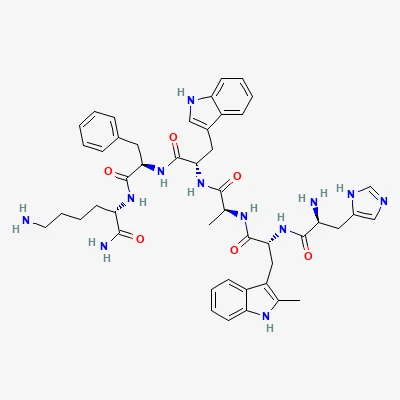
Structure notes: His-D-2-Me-Trp-Ala-Trp-D-Phe-Lys-NH2: L-histidine at position 1, 2-methyl-D-tryptophan (a non-standard residue) at position 2, D-phenylalanine at position 5, and a C-terminal lysinamide (C-terminal amide). Differs from GHRP-6 only by the methyl group on the position-2 indole ring.
What Is Hexarelin?
Hexarelin is a synthetic hexapeptide in the growth hormone-releasing peptide (GHRP) family that stimulates growth hormone release and also acts directly on the heart. It binds to and activates the growth hormone secretagogue receptor (GHSR) in the brain, much like its natural counterpart ghrelin.[1]
Hexarelin was one of the newer GHRP hexapeptides synthesized after GHRP-6 for human studies, alongside GHRP-2 and the heptapeptide GHRP-1.[2] Researchers describe it as a GHRP-6 analog.[3] Receptor-binding work has identified GHRP receptor subtypes in the pituitary gland, the hypothalamus and other brain regions, as well as in several peripheral tissues.[4]
Its research profile is unusual for a growth hormone secretagogue. Alongside endocrine work, a substantial literature examines effects on the cardiovascular system that appear independent of growth hormone, and newer animal studies explore kidney protection.[5][4][6] Compared with ghrelin, hexarelin has been described as chemically more stable and functionally more potent.[1]
Chemical Structure and Molecular Identity
Hexarelin is the hexapeptide His-D-2-methyl-Trp-Ala-Trp-D-Phe-Lys-NH2, identical to GHRP-6 except for a methyl group on the indole ring of the D-tryptophan at position 2. PubChem lists it under CID 6918297 with the molecular formula C47H58N12O6 and a molecular weight of 887.0 g/mol.
The international nonproprietary name is examorelin, and the systematic name is L-histidyl-2-methyl-D-tryptophyl-L-alanyl-L-tryptophyl-D-phenylalanyl-L-lysinamide. Two of the six residues are D-configured, and the 2-methyltryptophan is not a standard proteinogenic amino acid.
Key identifiers
- CAS numbers listed in PubChem: 140703-51-1 and 208251-52-9
- InChIKey: RVWNMGKSNGWLOL-GIIHNPQRSA-N
- Synonyms: examorelin, EP-23905, MF-6003
Because the methyl group is the only change from GHRP-6, the two peptides differ by one carbon and two hydrogens, a molecular weight difference of 14 g/mol (887.0 versus 873.0 g/mol). The added methyl sits on the indole ring that GHRP-6 also carries at position 2.
A radiolabeled extended analog, 125I-Tyr-Ala-hexarelin, has served as a research tool for mapping GHRP binding sites in brain, pituitary and peripheral tissues.[4]
Research History and Development
Hexarelin emerged in the 1990s as part of a series of synthetic hepta- and hexapeptides that proved effective growth hormone releasers in animals and humans. The series included GHRP-1, GHRP-2, GHRP-6 and hexarelin, and GHRP-6 later served as the template for non-peptide secretagogues such as MK-0677.[7]
At the time, investigators knew that GHRPs act through a receptor distinct from the GHRH receptor, cloned in the 1990s with no sequence homology to other known G-protein-coupled receptors. They inferred that a natural GHRP-like ligand existed but had not yet been found.[7][2]
Early mechanistic work examined how hexarelin releases growth hormone, including sheep studies of hypothalamic portal blood and cell-line experiments.[8][3] By 2000, receptor-binding studies had shown GHRP binding sites in the heart and other peripheral tissues, shifting attention toward cardiovascular research.[4] Later reviews identified CD36 as a specific cardiac receptor for hexarelin and discussed its possible relevance to diabetic heart disease.[1][5]
Mechanisms Studied in Research
Hexarelin acts through two receptor systems: the growth hormone secretagogue receptor, which drives growth hormone release, and CD36, a non-GHSR receptor in heart tissue linked to its cardioprotective effects.[1]
Growth hormone release
- Hypothalamic action: in conscious sheep, hexarelin raised jugular growth hormone within 15 minutes and increased GHRH in hypophysial portal blood (145.4 versus 59.2 pg/mL) without changing somatostatin, indicating activation of GHRH neurons in addition to direct pituitary effects.[8]
- Direct pituitary action: hexarelin stimulated growth hormone release from GH1 rat tumor cells that do not respond to GHRH, and in normal rat pituitary cells its effect added to that of GHRH, suggesting distinct sites and modes of action.[3]
- Class features: GHRP activity is synergistic with GHRH, is not affected by opioid receptor antagonists, is similar in both sexes, and varies with age, rising from birth to puberty and declining with aging. Reviews propose a dual site of action on pituitary and hypothalamus, possibly involving regulatory factors beyond GHRH and somatostatin.[7]
Effects beyond growth hormone
GHRPs also release prolactin and ACTH/cortisol and influence food intake and sleep.[4] In macrophages and adipocytes, hexarelin has been reported to regulate peroxisome proliferator-activated receptor gamma (PPAR-γ), a regulator of fat metabolism and insulin sensitivity.[5] In a kidney cell model, molecular docking suggested binding to MDM2, pointing to an MDM2/p53 pathway.[6]
Key Findings From Published Studies
Published studies report that hexarelin binds heart tissue densely, protects heart and kidney tissue in animal ischemia models, and increases cardiac contractility in small human studies. Much of this evidence is summarized in reviews.
Growth hormone release in cells and sheep
In vitro, hexarelin raised growth hormone release to 155% of control in GHRH-insensitive GH1 cells and 185% in normal rat pituitary cells at the highest concentration tested, while the cyclic AMP analog 8Br-cAMP stimulated both cell types.[3] In six conscious rams, jugular growth hormone rose from 3.9 to 9.1 ng/mL after hexarelin.[8]
Receptor binding in human tissue
GHRP binding sites were found in heart, adrenal, ovary, testis, lung and skeletal muscle at densities higher than in the hypothalamic-pituitary system. In the human cardiovascular system, binding was highest in the ventricles, followed by atria, aorta and coronary arteries. Hexarelin, GHRP-6, GHRP-1 and GHRP-2 displaced the radioligand from cardiac membranes, but the non-peptide MK-677 did not.[4]
Cardiovascular findings
- Cell studies: hexarelin showed anti-apoptotic activity in H9c2 cardiomyocyte-derived cells.[4]
- Animal studies: hexarelin protected against ischemia-induced myocardial damage in aged and growth hormone-deficient rats.[4]
- Human studies: hexarelin produced a positive inotropic effect in healthy subjects and in patients with growth hormone deficiency.[4]
Kidney findings
In a rat model of ischemia-reperfusion acute kidney injury, pretreatment with hexarelin reduced tubular damage, improved renal function and inhibited apoptosis, with lower Caspase-3, Bax and Bad and higher Bcl-2. Hexarelin also reduced apoptosis in HK-2 kidney cells after hypoxia-reoxygenation.[6]
Metabolic research
A 2015 review proposed that ghrelin and hexarelin may be relevant to diabetes and diabetic cardiomyopathy, based largely on cell and animal data.[5]
Because hexarelin differs from GHRP-6 by a single methyl group, researchers typically confirm identity with mass spectrometry and HPLC data on a certificate of analysis.
Regulatory and Research Status
Hexarelin is not approved by the US Food and Drug Administration for any use and remains an investigational research compound. Growth hormone secretagogues, including hexarelin, are also prohibited in sport under the World Anti-Doping Agency’s Prohibited List.
A 2026 clinical review grouped hexarelin with GHRP-2, GHRP-6 and ipamorelin among unregulated peptides marketed as research compounds to modulate the growth hormone-IGF-1 axis. It noted the absence of regulatory approval for physique or performance indications and uncertainty about product composition in unregulated supply chains.[9]
Across this peptide group, the review listed reported adverse effects including prolactin and cortisol elevations, appetite changes, dysglycemia, fluid retention and musculoskeletal symptoms.[9] The review stratified these peptides into evidence tiers, ranging from regulatory-grade randomized trial data to a complete absence of human studies, and highlighted uncertainty around putative performance and body-composition benefits.[9]
Most mechanistic and protective findings for hexarelin come from cell and animal models, and controlled human outcome trials are lacking.
Commonly Supplied Research Formats
Hexarelin is listed by 7 of the 11 major U.S. research-peptide suppliers we track. The most commonly listed formats are:
- 5mg
- 2mg
- 10mg
- 3mg
Supplier catalog survey, October 2026. Quantities refer to net peptide per vial as labeled.
Frequently Asked Questions
Is hexarelin the same as examorelin?
Yes. Examorelin is the international nonproprietary name for hexarelin. The molecule has also carried the development codes EP-23905 and MF-6003 during its research history. All of these names refer to the hexapeptide His-D-2-methyl-Trp-Ala-Trp-D-Phe-Lys-NH2, listed in PubChem as CID 6918297 with CAS number 140703-51-1.
What is the molecular weight of hexarelin?
Hexarelin has a molecular weight of 887.0 g/mol and the molecular formula C47H58N12O6, according to PubChem (CID 6918297). That value refers to the free peptide. Salt forms such as the acetate have higher formula weights because of the counterions, so it is worth checking which form a reported value describes.
How is hexarelin different from GHRP-6?
Hexarelin is a GHRP-6 analog that differs by a single methyl group on the indole ring of the D-tryptophan at position 2. Both activate the growth hormone secretagogue receptor. Hexarelin has been studied extensively for cardiovascular effects, including binding to the cardiac receptor CD36, which reviews link to its cardioprotective actions.
Is hexarelin FDA approved?
No. Hexarelin is not approved by the US Food and Drug Administration for any medical use. It remains an investigational compound studied in cell, animal and small human studies. A 2026 clinical review noted it has no regulatory approval for physique or performance indications, and growth hormone secretagogues are prohibited in sport.
What does the research on hexarelin show?
Research shows hexarelin releases growth hormone by acting on both the hypothalamus and pituitary. It binds heart tissue densely, protected against ischemic heart damage in aged and growth hormone-deficient rats, increased cardiac contractility in small human studies, and reduced kidney injury and apoptosis in a rat ischemia-reperfusion model. Controlled human outcome trials are lacking.
What receptor does hexarelin bind?
Hexarelin binds and activates the growth hormone secretagogue receptor (GHSR), the same receptor used by ghrelin. Reviews also identify CD36, a receptor that is not part of the GHSR family, as a specific cardiac receptor for hexarelin that mediates its cardioprotective effects in research models.
References
- Mao Y, Tokudome T, Kishimoto I. The cardiovascular action of hexarelin. Journal of geriatric cardiology : JGC 2014. PMID 25278975 · DOI
- Ghigo E, Arvat E, Muccioli G, et al. Growth hormone-releasing peptides. European journal of endocrinology 1997. PMID 9186261 · DOI
- Giustina A, Bonfanti C, Licini M, et al. Hexarelin, a novel GHRP-6 analog, stimulates growth hormone (GH) release in a GH-secreting rat cell line (GH1) insensitive to GH-releasing hormone. Regulatory peptides 1997. PMID 9250581 · DOI
- Muccioli G, Broglio F, Valetto MR, et al. Growth hormone-releasing peptides and the cardiovascular system. Annales d'endocrinologie 2000. PMID 10790589
- Mosa RM, Zhang Z, Shao R, et al. Implications of ghrelin and hexarelin in diabetes and diabetes-associated heart diseases. Endocrine 2015. PMID 25645463 · DOI
- Guan C, Li C, Shen X, et al. Hexarelin alleviates apoptosis on ischemic acute kidney injury via MDM2/p53 pathway. European journal of medical research 2023. PMID 37710348 · DOI
- Camanni F, Ghigo E, Arvat E. Growth hormone-releasing peptides and their analogs. Frontiers in neuroendocrinology 1998. PMID 9465289 · DOI
- Guillaume V, Magnan E, Cataldi M, et al. Growth hormone (GH)-releasing hormone secretion is stimulated by a new GH-releasing hexapeptide in sheep. Endocrinology 1994. PMID 7915227 · DOI
- Dominikowski A, Rękoś Z, Olejarz M, et al. The emerging landscape of performance-enhancing peptides modulating GH-IGF1 axis: bridging the gap between clinical evidence and patient self-administration. Frontiers in endocrinology 2026. PMID 42395176 · DOI
Related Compounds
This profile summarizes chemical data and peer-reviewed literature for educational and laboratory-research reference. It is not medical advice, and nothing here describes or recommends use in humans or animals. How we source and verify data.