Melanotan II
Also known as: MT-2 · MT-II
Melanotan II is a synthetic cyclic heptapeptide analog of alpha-melanocyte-stimulating hormone (alpha-MSH) that acts as a non-selective melanocortin receptor agonist. Its effects in humans include increased skin pigmentation and spontaneous penile erection. It has been studied in rodent and zebrafish behavioral models, is the subject of clinical case reports, and has never been approved as a drug by the FDA.
Last reviewed · Identity data matched to PubChem · 9 peer-reviewed sources
Key facts
- Class: synthetic alpha-MSH analog; non-selective melanocortin receptor agonist
- Length: 7 residues, cyclized by a lactam bridge between aspartic acid and lysine
- Formula C50H69N15O9; molecular weight 1024.2 g/mol (PubChem CID 92432)
- CAS 121062-08-6; also called MT-II or MT-2
- Structural relative: differs from bremelanotide only by a C-terminal amide instead of a free acid
- Evidence base: animal behavioral studies, chemistry studies, human case reports and surveys
- Regulatory status: unapproved, unlicensed compound; not an FDA-approved drug
Chemical Identity
| Molecular formula | C50H69N15O9 |
|---|---|
| Molecular weight | 1024.2 g/mol |
| Monoisotopic mass | 1023.5403 Da |
| CAS number | 121062-08-6 |
| PubChem CID | 92432 |
| UNII | UPF5CJ93X7 |
| InChIKey | JDKLPDJLXHXHNV-MFVUMRCOSA-N |
| Compound type | Peptide |
| H-bond donors / acceptors | 13 / 11 |
| XLogP3 | 0 |
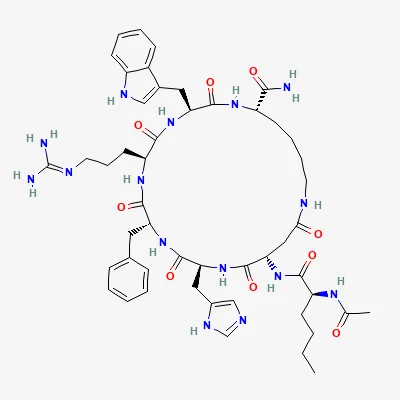
Structure notes: Ac-Nle-cyclo[Asp-His-D-Phe-Arg-Trp-Lys]-NH2: N-terminal acetyl group; norleucine (non-standard) at position 1; D-phenylalanine at position 4; side-chain lactam bridge between aspartic acid (position 2) and lysine (position 7); C-terminal lysinamide.
What Is Melanotan II?
Melanotan II is a synthetic, cyclic analog of alpha-MSH that binds several melanocortin receptors rather than one. Case-report authors describe it as a non-selective melanocortin-receptor agonist whose effects in humans include increased skin pigmentation, spontaneous penile erection and sexual stimulation.[1]
Its pigmentary effect is attributed to interaction with the melanocortin-1 receptor (MC1R) in skin, which induces hyperpigmentation.[2] It is also described as a melanocortin-4 receptor (MC4R) agonist, a property that has led researchers to use it as a pharmacological tool for stimulating oxytocin-related activity in animal models.[3]
Melanotan II has never been approved as a drug. Melanocortin analogs of this type have been used illegally for artificial tanning and have also been suggested as possible agents for erectile dysfunction.[4] Much of the human literature therefore consists of case reports and surveys of unsupervised use rather than controlled trials.
Chemical Structure and Molecular Identity
Melanotan II is a seven-residue cyclic peptide, Ac-Nle-cyclo[Asp-His-D-Phe-Arg-Trp-Lys]-NH2, in which a lactam bond between the side chains of aspartic acid and lysine closes the ring. PubChem (CID 92432) lists the molecular formula C50H69N15O9 and a molecular weight of 1024.2 g/mol. The CAS number is 121062-08-6.
The ring encloses the His-D-Phe-Arg-Trp sequence, the same central segment found in afamelanotide (Melanotan I). The N-terminus carries an acetylated norleucine, a non-standard amino acid, and the C-terminus is a lysinamide. Because of the cyclic structure, the D-phenylalanine and the norleucine, the sequence cannot be written in standard one-letter code.
Melanotan II is structurally almost identical to bremelanotide: PubChem records show the same cyclic backbone, with bremelanotide carrying a free C-terminal carboxylic acid where Melanotan II has an amide. That single change gives bremelanotide the formula C50H68N14O10.
Comparison with Melanotan I
| Feature | Melanotan I (afamelanotide) | Melanotan II |
|---|---|---|
| Residues | 13 | 7 |
| Topology | Linear | Cyclic (lactam bridge) |
| Molecular weight | 1646.8 g/mol | 1024.2 g/mol |
| Approval status | Approved for erythropoietic protoporphyria | Not approved |
Research History and Development
Melanotan II emerged from melanocortin peptide research as a compact, cyclic alpha-MSH analog, and was investigated for both tanning and sexual-function effects. Its ability to cause spontaneous erections led to suggestions that melanocortin analogs could be developed for erectile dysfunction.[4][1]
Over recent decades, the compound has become better known outside the laboratory. Unregulated acquisition of Melanotan II through the internet and other outlets became popular for use as a tanning agent, and clinicians began reporting adverse events in users.[2] A 2026 review placed it among unapproved peptides, alongside BPC-157 and TB-500, that are used without prescriptions and lack established human safety profiles.[5]
In parallel, laboratory research has continued to use Melanotan II as a melanocortin probe. Recent studies have examined it in mouse and zebrafish behavioral models[3][6] and as a scaffold for new peptide-stapling chemistry.[7]
Mechanisms Studied in Research
Melanotan II activates multiple melanocortin receptors; research has focused on MC1R-driven pigmentation and on central MC4R-linked effects on behavior and sexual function.[1]
Pigmentation via MC1R
Like alpha-MSH, Melanotan II acts on MC1R to induce skin hyperpigmentation, which is the basis of its unregulated use as a tanning agent.[2]
Central melanocortin signaling
Researchers studying autism-like behavior in mice chose Melanotan II as an MC4R agonist to stimulate oxytocinergic activity, building on evidence that oxytocin modulates social adaptation.[3] In zebrafish, Melanotan II was used to target melanotropin receptors in a study of diet-related behavior.[6]
Receptor binding of modified analogs
A 2024 chemistry study developed tryptathionine and 2,2′-bis-indole peptide staples, motifs borrowed from natural products, and applied them to Melanotan II, using chemoselective stapling of alpha-MSH-based sequences. Both classes of stapled peptides showed nanomolar binding affinities (Ki), with one analog reaching a sub-nanomolar Ki value.[7]
Proposed mechanisms of toxicity
For renal injury reported in users, authors have proposed both a thrombotic pharmacological influence and a possible direct toxic effect on renal tissue.[1]
Key Findings From Published Studies
Animal studies report behavioral effects of Melanotan II in models of autism and diet-induced memory impairment, while the human literature consists of case reports and observational data describing adverse events. No controlled human efficacy trials appear in the literature reviewed here.
Animal studies
- In a maternal immune activation mouse model of autism, Melanotan II rescued social behavioral metrics in adult male mice. In normal C57 mice it did not change social, anxiety-like or repetitive behaviors, but subacute treatment caused significant weight loss.[3]
- In zebrafish, three weeks of a high-fat diet impaired recognition memory, raised anxiety and reduced exploration; Melanotan II reversed these changes, bringing behavior close to that of control animals.[6]
Human case reports and observational studies
- A 2020 case report described renal infarction most likely attributed to Melanotan II and reviewed earlier reports of rhabdomyolysis and renal failure.[1]
- A 2019 case report described low-flow priapism after melanotan use; the patient avoided surgical shunting but had not recovered erectile function at four-week follow-up.[4]
- A systematic review of 179 patients with eruptive melanocytic nevi found that immunosuppressive agents, chemotherapy or melanotan accounted for 41% of suspected causes; 16% of cases had at least one histologically confirmed dysplastic nevus, and five associated melanoma cases were reported across all causes. The authors noted that the data did not allow assessment of malignant transformation risk.[8]
- A case of melanoma in situ has been reported in association with melanotropic peptides sold as melanotan.[9]
- A qualitative study of 623 online forum entries from 205 UK and Ireland participants found that users sought a tan before holidays or fitness competitions and identified misinformation, sunbed use and concerning practices.[2]
Several case reports refer to melanotan without specifying which analog was used, so not every report can be assigned to Melanotan II with certainty.[4][8][9]
Given published concerns about contamination and impurities in unregulated melanotan products, researchers typically verify identity and purity with HPLC and mass spectrometry certificates of analysis.
Given published concerns about contamination and impurities in unregulated melanotan products, researchers typically verify identity and purity with HPLC and mass spectrometry certificates of analysis.
Regulatory and Research Status
Melanotan II is not approved by the US Food and Drug Administration or, as far as the published literature shows, by any other regulator; it is an unlicensed compound with an unproven safety record.[9][5] Its FDA Unique Ingredient Identifier (UNII UPF5CJ93X7) is a registration code, not an approval. Its close structural relative bremelanotide is an approved drug, but that approval does not extend to Melanotan II.
Reviewers have warned that unregulated peptides of this kind carry risks including product contamination and manufacturing impurities, and have urged clinicians to recognize their use.[5] The authors of the forum study highlighted risks related to pigmented skin lesions, transmission of infectious diseases, contaminated products, polypharmacy and sunbed exposure.[2]
As a research compound, Melanotan II remains a useful non-selective melanocortin agonist for receptor pharmacology, behavioral neuroscience and peptide chemistry. Open questions include its long-term effects on melanocytic lesions, the mechanisms behind reported renal events, and whether behavioral findings in mice and zebrafish translate to other models.[8][1]
Commonly Supplied Research Formats
Melanotan II is listed by 10 of the 11 major U.S. research-peptide suppliers we track. The most commonly listed formats are:
- 10mg
Supplier catalog survey, October 2026. Quantities refer to net peptide per vial as labeled.
Frequently Asked Questions
Is Melanotan II the same as bremelanotide (PT-141)?
No, but they are very close. Both share the cyclic Ac-Nle-cyclo[Asp-His-D-Phe-Arg-Trp-Lys] structure, but Melanotan II ends in a C-terminal amide, while bremelanotide ends in a free carboxylic acid. That gives them slightly different formulas, C50H69N15O9 versus C50H68N14O10. Bremelanotide is an FDA-approved drug; Melanotan II is not.
What is the molecular weight of Melanotan II?
PubChem lists Melanotan II (CID 92432) with a molecular weight of 1024.2 g/mol and the molecular formula C50H69N15O9. Its CAS number is 121062-08-6 and its InChIKey is JDKLPDJLXHXHNV-MFVUMRCOSA-N. Commercial peptide is often supplied as an acetate salt, which changes the weight of the bulk solid relative to the free peptide.
How is Melanotan II different from Melanotan I?
Melanotan I (afamelanotide) is a linear 13-residue alpha-MSH analog and an approved drug for erythropoietic protoporphyria. Melanotan II is a shorter, cyclic seven-residue peptide that acts on multiple melanocortin receptors, producing pigmentation as well as erections and sexual stimulation. Melanotan II has never been approved as a drug and has no established human safety profile.
Is Melanotan II FDA approved?
No. Melanotan II has never been approved by the FDA as a drug for any indication, and the published literature describes it as an unlicensed compound with an unproven safety record. Reviews list it among unregulated peptides that lack established human safety profiles. It is supplied as a research compound for laboratory study of melanocortin receptors.
What does the research on Melanotan II show?
In a mouse model of autism, Melanotan II rescued social behavior in male mice, and in zebrafish it reversed memory and anxiety changes caused by a high-fat diet. Human data come from case reports and observational studies describing adverse events, including renal infarction, priapism and eruptive nevi associated with melanotan use. No controlled human efficacy trials were found.
Which receptors does Melanotan II act on?
Melanotan II is a non-selective melanocortin receptor agonist. Its skin-darkening effect is attributed to the melanocortin-1 receptor (MC1R) on pigment cells, while researchers have used it as a melanocortin-4 receptor (MC4R) agonist to stimulate oxytocin-related activity in mouse studies. Activity at multiple receptors helps explain its combination of pigmentary and sexual effects.
References
- Peters B, Hadimeri H, Wahlberg R, et al. Melanotan II: a possible cause of renal infarction: review of the literature and case report. CEN case reports 2020. PMID 31953620 · DOI
- Gilhooley E, Daly S, McKenna D. Melanotan II User Experience: A Qualitative Study of Online Discussion Forums. Dermatology (Basel, Switzerland) 2021. PMID 34464955 · DOI
- Minakova E, Lang J, Medel-Matus JS, et al. Melanotan-II reverses autistic features in a maternal immune activation mouse model of autism. PloS one 2019. PMID 30629642 · DOI
- Dreyer BA, Amer T, Fraser M. Melanotan-induced priapism: a hard-earned tan. BMJ case reports 2019. PMID 30796078 · DOI
- Moiz A, O'Keefe EL, O'Keefe JH. Dangers of Injectable Peptides and Other Unregulated "Biohacking" Drugs. Missouri medicine 2026. PMID 42757290 · DOI
- Wekwejt P, Wojda U, Kiryk A. Melanotan-II reverses memory impairment induced by a short-term HF diet. Biomedicine & pharmacotherapy = Biomedecine & pharmacotherapie 2023. PMID 37478579 · DOI
- Todorovic M, Blanc A, Wang Z, et al. 5-Hydroxypyrroloindoline Affords Tryptathionine and 2,2'-bis-Indole Peptide Staples: Application to Melanotan-II. Chemistry (Weinheim an der Bergstrasse, Germany) 2024. PMID 38285527 · DOI
- Burian EA, Jemec GBE. Eruptive Melanocytic Nevi: A Review. American journal of clinical dermatology 2019. PMID 31119650 · DOI
- Ong S, Bowling J. Melanotan-associated melanoma in situ. The Australasian journal of dermatology 2012. PMID 22724573 · DOI
Related Compounds
This profile summarizes chemical data and peer-reviewed literature for educational and laboratory-research reference. It is not medical advice, and nothing here describes or recommends use in humans or animals. How we source and verify data.