Bremelanotide (PT-141)
Also known as: PT-141
Bremelanotide (PT-141) is a synthetic cyclic heptapeptide analog of alpha-melanocyte-stimulating hormone (alpha-MSH) and a melanocortin receptor agonist with high affinity for the melanocortin-4 receptor (MC4R). Originally developed as a nasal spray for erectile dysfunction, it was approved in the US in 2019 for premenopausal women with acquired, generalized hypoactive sexual desire disorder (HSDD).
Last reviewed · Identity data matched to PubChem · 7 peer-reviewed sources
Key facts
- Class: synthetic alpha-MSH analog; melanocortin receptor agonist with high MC4R affinity
- Length: 7 residues, cyclized by a lactam bridge between aspartic acid and lysine
- Formula C50H68N14O10; molecular weight 1025.2 g/mol (PubChem CID 9941379)
- CAS 189691-06-3; development code PT-141
- Structural relative: identical ring to Melanotan II, but with a free C-terminal carboxylic acid
- Regulatory status: FDA-approved for premenopausal women with acquired, generalized HSDD (generic name bremelanotide)
Chemical Identity
| Molecular formula | C50H68N14O10 |
|---|---|
| Molecular weight | 1025.2 g/mol |
| Monoisotopic mass | 1024.5243 Da |
| CAS number | 189691-06-3 |
| PubChem CID | 9941379 |
| UNII | 6Y24O4F92S |
| InChIKey | FFHBJDQSGDNCIV-MFVUMRCOSA-N |
| Compound type | Peptide |
| H-bond donors / acceptors | 13 / 12 |
| XLogP3 | 0.7 |
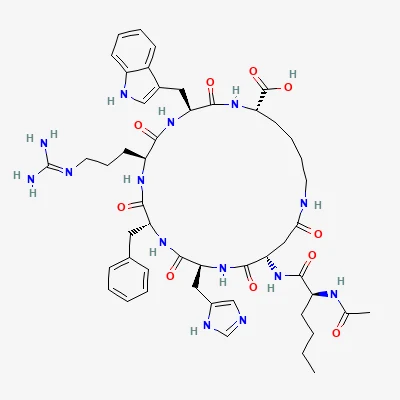
Structure notes: Ac-Nle-cyclo[Asp-His-D-Phe-Arg-Trp-Lys]-OH: N-terminal acetyl group; norleucine (non-standard) at position 1; D-phenylalanine at position 4; side-chain lactam bridge between aspartic acid (position 2) and lysine (position 7); free C-terminal carboxylic acid on lysine.
What Is Bremelanotide (PT-141)?
Bremelanotide, developed under the code PT-141, is a synthetic peptide analog of alpha-MSH that activates melanocortin receptors in the brain and is approved to treat low sexual desire in premenopausal women. It has high affinity for the melanocortin type 4 receptor, which is thought to be important for sexual function, giving it the potential to modulate brain pathways involved in sexual response.[1]
In the United States it is approved for premenopausal women with acquired, generalized hypoactive sexual desire disorder, characterized by low sexual desire that causes marked distress or interpersonal difficulty.[1] Clinical reviews describe it as one of two recently approved medications for HSDD, alongside flibanserin.[2]
Bremelanotide belongs to a small group of FDA-approved melanocortin agonists that also includes afamelanotide, approved for erythropoietic protoporphyria, and setmelanotide, approved for certain genetic forms of obesity.[3] It is closely related in structure to the unapproved research peptide Melanotan II.
Chemical Structure and Molecular Identity
Bremelanotide is a seven-residue cyclic peptide, Ac-Nle-cyclo[Asp-His-D-Phe-Arg-Trp-Lys]-OH, closed by a lactam bond between the side chains of aspartic acid and lysine. PubChem (CID 9941379) lists the molecular formula C50H68N14O10 and a molecular weight of 1025.2 g/mol. The CAS number is 189691-06-3.
The ring encloses the His-D-Phe-Arg-Trp segment shared with alpha-MSH-derived melanocortin peptides. The N-terminus carries an acetylated norleucine, a non-standard amino acid, and position 4 is D-phenylalanine. Because of these features and the cyclic structure, its sequence cannot be written in standard one-letter code.
Bremelanotide and Melanotan II share the same cyclic backbone. The only difference is at the C-terminus: bremelanotide ends in a free carboxylic acid, whereas Melanotan II ends in an amide. That gives bremelanotide one more oxygen and one fewer nitrogen and hydrogen (C50H68N14O10 versus C50H69N15O9) and a molecular weight about one unit higher.
Comparison with Melanotan II
| Feature | Bremelanotide (PT-141) | Melanotan II |
|---|---|---|
| C-terminus | Free carboxylic acid | Amide |
| Formula | C50H68N14O10 | C50H69N15O9 |
| Molecular weight | 1025.2 g/mol | 1024.2 g/mol |
| CAS number | 189691-06-3 | 121062-08-6 |
| FDA status | Approved for HSDD | Not approved |
Names and synonyms
- Generic name: bremelanotide (INN and USAN)
- Development code: PT-141, PT141
- Chemical description: N-acetyl-L-norleucyl-L-alpha-aspartyl-L-histidyl-D-phenylalanyl-L-arginyl-L-tryptophyl-L-lysine (2-7)-lactam
Research History and Development
Bremelanotide began as a nasal spray for erectile dysfunction and was later redeveloped for women with hypoactive sexual desire disorder, leading to US approval in 2019. A 2004 profile described PT-141 as a synthetically modified analog of the peptide PT-14, then in development as a nasal spray for erectile dysfunction and female sexual dysfunction. A phase IIb trial in men with erectile dysfunction had been completed in September 2003, and phase III trials were planned.[4]
A randomized, double-blind, placebo-controlled study published in 2008 tested intranasal bremelanotide in men with erectile dysfunction who had not responded to sildenafil.[5] Development subsequently shifted to women. Palatin Technologies sponsored the phase 3 clinical trials and later out-licensed exclusive North American rights to develop and commercialize the drug, including submission of the New Drug Application to the FDA.[1]
The 2019 US approval for premenopausal women with acquired, generalized HSDD was the drug’s first regulatory approval.[1] Since then, reviewers have examined its place among treatments for female sexual dysfunction and for low libido in specific populations, such as women with breast cancer receiving endocrine therapy.[6][7]
Mechanisms Studied in Research
Bremelanotide works as a melanocortin receptor agonist, and its effects on sexual desire are attributed mainly to activation of the melanocortin-4 receptor in the central nervous system.[1]
Melanocortin receptor activation
Melanocortin receptors serve functions ranging from skin pigmentation, appetite regulation, stress response and cognition to steroid synthesis, energy balance and immunomodulation.[3] Bremelanotide’s high MC4R affinity is the property linked to its sexual-function effects.[1]
Contrast with other HSDD treatments
Bremelanotide’s mechanism differs from that of flibanserin, the other approved HSDD medication: flibanserin acts as a serotonin and dopamine modulator, while bremelanotide acts as a melanocortin receptor agonist.[7] Clinical reviewers frame HSDD within a dual-control model, in which multiple hormones and neurotransmitters likely balance excitation and inhibition of sexual desire, although a definitive physiology of the disorder is still unknown.[2]
Diagnostic context
HSDD is defined by a deficiency of sexual thoughts, feelings or receptiveness to sexual stimulation that has persisted for at least six months, causes personal distress and is not due to another medical condition. It is the most commonly identified sexual problem among women, and nearly half of women in the United States report some problem with sexual function. Reviewers stress validated screening tools and a biopsychosocial assessment when evaluating it, since many providers do not routinely ask about sexual concerns.[2]
Key Findings From Published Studies
Controlled trials and a 2026 meta-analysis show that bremelanotide improved measures of sexual desire, arousal and related distress in women, and an earlier trial reported benefit in men with erectile dysfunction who had not responded to sildenafil. Findings are summarized below by population.
Women with sexual desire and arousal disorders
- A 2026 systematic review and meta-analysis of 36 studies of female desire, arousal and orgasmic dysfunction (26 of them randomized controlled trials) found that bremelanotide improved the total Female Sexual Function Index score and its desire and arousal subscales, and reduced distress.[6]
- In the same analysis, flibanserin improved total score and desire, and mindfulness-based cognitive behavioral therapy improved desire, arousal and orgasm; no studies directly compared therapy with medication.[6]
- Clinical trials of bremelanotide excluded patients with breast cancer, so data in that population are lacking.[7]
Men with erectile dysfunction
- In a randomized, double-blind, placebo-controlled trial of 342 men with erectile dysfunction who had not responded to sildenafil, positive clinical results were seen in 33.5% of the bremelanotide group versus 8.5% of the placebo group (p = 0.03).[5]
- The bremelanotide group reported significantly greater intercourse satisfaction, but also had more drug-related adverse effects (p = 0.01). The authors called for further studies before drawing final conclusions.[5]
Erectile dysfunction is not an approved indication for bremelanotide.
Because bremelanotide and Melanotan II differ by one C-terminal group, researchers typically confirm identity with mass spectrometry and HPLC certificates of analysis.
Because bremelanotide and Melanotan II differ by one C-terminal group, researchers typically confirm identity with mass spectrometry and HPLC certificates of analysis.
Regulatory and Research Status
Bremelanotide is an FDA-approved prescription drug for premenopausal women with acquired, generalized hypoactive sexual desire disorder; it is not approved for men or for erectile dysfunction.[1][3] The approval covers a specific pharmaceutical product and indication.
Material labeled PT-141 and sold as a research peptide is chemically the same molecule but is not the approved drug product and has not been evaluated by regulators for identity, purity or sterility. Because PT-141 and Melanotan II differ by a single terminal group, mislabeling between the two would be difficult to detect without accurate mass spectrometry.
Open research questions include the drug’s effects in populations excluded from pivotal trials, such as women with breast cancer on endocrine therapy, how it compares directly with non-drug approaches, and whether the early erectile dysfunction findings would hold up with further study.[7][6][5]
Commonly Supplied Research Formats
Bremelanotide is listed by 11 of the 11 major U.S. research-peptide suppliers we track. The most commonly listed formats are:
- 10mg
- 9mg
- 30mg (nasal/atomized spray)
Supplier catalog survey, October 2026. Quantities refer to net peptide per vial as labeled.
Frequently Asked Questions
Is PT-141 the same as bremelanotide?
Yes. PT-141 is the development code for the peptide that received the generic name bremelanotide. The approved drug is indicated for premenopausal women with acquired, generalized hypoactive sexual desire disorder. Peptide sold as PT-141 for research is chemically the same molecule, Ac-Nle-cyclo[Asp-His-D-Phe-Arg-Trp-Lys]-OH, but it is not the regulator-evaluated drug product.
What is the molecular weight of bremelanotide?
PubChem lists bremelanotide (CID 9941379) with a molecular weight of 1025.2 g/mol and the molecular formula C50H68N14O10. Its CAS number is 189691-06-3 and its InChIKey is FFHBJDQSGDNCIV-MFVUMRCOSA-N. Commercial peptide is often supplied as an acetate salt, which changes the weight of the bulk solid relative to the free peptide.
How is PT-141 different from Melanotan II?
PT-141 (bremelanotide) and Melanotan II share the same seven-residue cyclic backbone, but bremelanotide ends in a free carboxylic acid, while Melanotan II ends in an amide. Their molecular weights differ by about one unit (1025.2 versus 1024.2 g/mol). Bremelanotide is an FDA-approved drug for HSDD; Melanotan II has never been approved.
Is bremelanotide FDA approved?
Yes. Bremelanotide was approved in the United States in 2019 for premenopausal women with acquired, generalized hypoactive sexual desire disorder, meaning low sexual desire that causes marked distress or interpersonal difficulty. It is one of several FDA-approved melanocortin agonists, alongside afamelanotide and setmelanotide. It is not approved for erectile dysfunction or for use in men.
What does the research on bremelanotide show?
A 2026 meta-analysis found that bremelanotide improved total Female Sexual Function Index scores, desire and arousal subscales, and reduced distress in women with sexual desire and arousal dysfunction. In a 2008 randomized trial in men with erectile dysfunction unresponsive to sildenafil, 33.5% had positive results with bremelanotide versus 8.5% with placebo, with more drug-related adverse effects.
How does bremelanotide work?
Bremelanotide is a melanocortin receptor agonist with high affinity for the melanocortin-4 receptor, which is thought to be important for sexual function. By acting on this receptor, it can modulate brain pathways involved in sexual response. This differs from flibanserin, the other approved HSDD medication, which acts on serotonin and dopamine signaling.
References
- Dhillon S, Keam SJ. Bremelanotide: First Approval. Drugs 2019. PMID 31429064 · DOI
- Pettigrew JA, Novick AM. Hypoactive Sexual Desire Disorder in Women: Physiology, Assessment, Diagnosis, and Treatment. Journal of midwifery & women's health 2021. PMID 34510696 · DOI
- Bardhan M, Anand A, Javed A, et al. Polymorphism of Melanocortin Receptor Genes-Association with Inflammatory Traits and Diseases. Diseases (Basel, Switzerland) 2025. PMID 41002740 · DOI
- Hedlund P. PT-141 Palatin. Current opinion in investigational drugs (London, England : 2000) 2004. PMID 15134289
- Safarinejad MR, Hosseini SY. Salvage of sildenafil failures with bremelanotide: a randomized, double-blind, placebo controlled study. The Journal of urology 2008. PMID 18206919 · DOI
- Toledo RG, Winkelman WD, Reyes-Gonzalez D, et al. Female Sexual Desire, Arousal, and Orgasmic Dysfunctions: A Systematic Review and Meta-Analysis of Treatment Options. Journal of minimally invasive gynecology 2026. PMID 40543759 · DOI
- Fuhrman J, Yun J, Indorf A. Practical considerations and emerging approaches for the management of vasomotor and sexual symptoms in breast cancer patients on endocrine therapies. Expert review of clinical pharmacology 2025. PMID 41088800 · DOI
Related Compounds
This profile summarizes chemical data and peer-reviewed literature for educational and laboratory-research reference. It is not medical advice, and nothing here describes or recommends use in humans or animals. How we source and verify data.