Tesofensine
Also known as: NS2330
Tesofensine is a synthetic phenyltropane small molecule, development code NS2330, that inhibits reuptake of dopamine, norepinephrine and serotonin. It was first studied in Alzheimer's and Parkinson's disease, where trials showed no benefit for those conditions but unintended weight loss. It was then evaluated in phase 2 obesity trials. It is not approved by the US FDA.
Last reviewed · Identity data matched to PubChem · 11 peer-reviewed sources
Key facts
- Class: triple monoamine reuptake inhibitor (dopamine, norepinephrine, serotonin); phenyltropane structure
- Development code: NS2330 (also written NS-2330)
- Formula C17H23Cl2NO; molecular weight 328.3 g/mol (PubChem CID 11370864)
- CAS number 195875-84-4
- Originally developed for Alzheimer's and Parkinson's disease, later for obesity
- Long reported half-life: about 234 hours in a population pharmacokinetic model
- Regulatory status: not approved by the US FDA
Chemical Identity
| Molecular formula | C17H23Cl2NO |
|---|---|
| Molecular weight | 328.3 g/mol |
| Monoisotopic mass | 327.1157 Da |
| CAS number | 195875-84-4 |
| PubChem CID | 11370864 |
| UNII | BLH9UKX9V1 |
| InChIKey | VCVWXKKWDOJNIT-ZOMKSWQUSA-N |
| Compound type | Small molecule |
| H-bond donors / acceptors | 0 / 2 |
| XLogP3 | 4.5 |
What Is Tesofensine?
Tesofensine is an investigational small-molecule drug that blocks the reuptake of three monoamine neurotransmitters: dopamine, norepinephrine and serotonin. In vitro, it potently inhibited reuptake of all three.[1]
The compound was developed by NeuroSearch, initially in collaboration with Boehringer Ingelheim, as a potential treatment for neurodegenerative conditions. It proved ineffective for those conditions, but researchers noticed unintended weight loss in treated participants, and development was redirected toward obesity.[1]
Tesofensine is often grouped with other triple reuptake inhibitors, a class also explored as antidepressants.[2] In obesity research, reviews list it among novel agents that reached clinical development with limited success.[3]
Comparisons with older anti-obesity drugs feature prominently in the literature. The authors of a 2008 meta-analysis described the placebo-subtracted weight loss as similar to that seen with sibutramine but without an effect on blood pressure, while a 2009 evaluation of a phase 2 trial suggested tesofensine might have a higher maximal capacity to reduce weight than agents then available.[4][5]
Chemical Structure and Molecular Identity
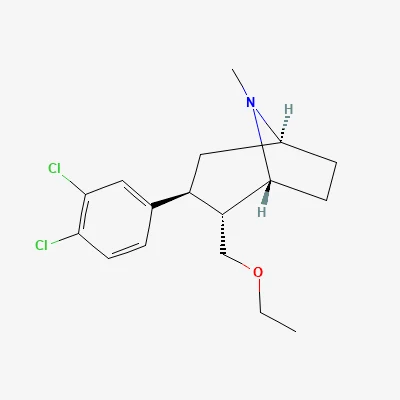
Tesofensine is a tropane derivative: (1R,2R,3S,5S)-3-(3,4-dichlorophenyl)-2-(ethoxymethyl)-8-methyl-8-azabicyclo[3.2.1]octane. PubChem lists it under CID 11370864 with the formula C17H23Cl2NO, a molecular weight of 328.3 g/mol, CAS number 195875-84-4 and InChIKey VCVWXKKWDOJNIT-ZOMKSWQUSA-N.
The core is an 8-azabicyclo[3.2.1]octane (tropane) ring with an N-methyl group. A 3,4-dichlorophenyl ring sits at position 3 and an ethoxymethyl group at position 2, placing tesofensine in the phenyltropane family of monoamine transporter ligands. The molecule has four defined stereocenters, no hydrogen-bond donors and a computed XLogP of 4.5, indicating a lipophilic compound.
Its International Nonproprietary Name is tesofensine, and literature from its early development uses the code NS-2330.[6] Human pharmacokinetic studies also describe a major metabolite, designated M1, whose plasma profile was modeled alongside the parent compound in patients with Alzheimer’s disease.[7]
Research History and Development
Tesofensine moved from neurology to obesity research after weight loss appeared as an unintended effect in neurodegenerative-disease trials. In 2001, NeuroSearch was developing NS-2330 as a compound that increases dopamine, norepinephrine and acetylcholine activity, with a phase 2 program in Alzheimer’s disease and a phase 2 tolerability trial in Parkinson’s disease patients with dyskinesia.[6]
A 2008 meta-analysis pooled four randomized, double-blind, multicenter trials in Parkinson’s or Alzheimer’s disease, comparing 740 tesofensine-treated patients with 228 placebo-treated patients over 14 weeks, without any weight-loss program. The dose-related weight loss it documented became the basis for developing tesofensine for obesity.[4]
Preclinical work in diet-induced obese rats supported the weight-loss hypothesis, and phase 2 trials in people with obesity followed.[1] A 2009 review reported that the FDA had endorsed the planned phase 3 program.[1] Later reviews of the anti-obesity pipeline listed tesofensine among compounds still under study or with limited success in early clinical development.[8][3]
Mechanisms Studied in Research
Tesofensine’s primary studied mechanism is inhibition of the dopamine, norepinephrine and serotonin transporters, which raises the availability of these neurotransmitters. Animal studies have linked its appetite effects to specific downstream receptor pathways and hypothalamic neurons.[1][9][10]
Early descriptions of NS-2330 framed it as a compound that increases dopamine, norepinephrine and acetylcholine activity, reflecting its original evaluation for cognitive and motor symptoms in neurodegenerative disease.[6]
Transporter binding
A 2025 structural study determined structures of the dopamine transporter bound to five triple reuptake inhibitors. Tesofensine and dasotraline stabilized the transporter in an outward-facing conformation, while centanafadine, ansofaxine and nefazodone captured an inward-facing conformation.[2]
Receptor pathways in appetite suppression
In diet-induced obese rats, tesofensine produced a dose-dependent reduction in food intake. This effect was almost completely reversed by the alpha-1 adrenoceptor antagonist prazosin and partially reversed by the dopamine D1 antagonist SCH23390, but was not affected by antagonists of alpha-2, D2, D3 or 5-HT2A/C receptors. The authors concluded that the hypophagia depends on indirect stimulation of alpha-1 adrenoceptor and D1 receptor function.[9]
Lateral hypothalamus
In Vgat-ChR2 and Vgat-IRES-cre transgenic mice, tesofensine inhibited a subset of GABAergic neurons in the lateral hypothalamus, reducing their ability to promote feeding. Chemogenetic silencing of these neurons enhanced tesofensine’s food-suppressing effect.[10]
Key Findings From Published Studies
Tesofensine produced dose-related weight loss in both neurodegenerative-disease and obesity trials, accompanied by dose-dependent increases in heart rate. Findings are summarized below by evidence type.
Human trials
- Pooled Parkinson’s and Alzheimer’s trials (14 weeks): mean weight change ranged from +0.5% with placebo to -2.8% in the highest-dose arm, a placebo-subtracted loss of about 4%. In the obese subgroup, 32.1% of the highest-dose arm reached at least 5% weight loss, versus 2.1% on placebo. Heart rate rose by up to 6.8 beats per minute, with no effect on blood pressure.[4]
- Phase 2 obesity trials: tesofensine produced dose-related reductions in body weight, body fat and waist circumference, with dose-dependent heart-rate increases and significant blood-pressure increases at the highest dose tested.[1]
- 26-week phase 2 trial (independent evaluation): an evaluator noted significant weight loss and increases in blood pressure and heart rate, plus adverse effects including nausea, dry mouth, flatulence, insomnia and depressed mood, and called for larger phase 3 trials to assess tolerability.[5]
- Abuse-potential study: in a randomized, double-blind crossover study in 52 recreational stimulant users, single-dose tesofensine did not differ from placebo and scored lower than D-amphetamine on all primary measures. Its effects were lower than or no different from those of bupropion or atomoxetine, and the authors concluded it was unlikely to be recreationally abused.[11]
Pharmacokinetics
A population model built from 320 patients with Alzheimer’s disease estimated half-lives of 234 hours for tesofensine and 374 hours for its M1 metabolite. Low apparent clearance combined with a large apparent volume of distribution accounted for these long half-lives. Weight, sex, creatinine clearance, body mass index and age were identified as covariates, but in simulations only sex and creatinine clearance significantly affected steady-state exposure.[7]
Animal studies
In rats, tesofensine caused greater weight loss in obese than in lean animals, prolonged weight loss induced by the serotonin precursor 5-HTP and blocked subsequent weight rebound. Unlike phentermine, it produced little head-weaving stereotypy, and its appetite effects appeared independent of taste aversion.[10]
Because tesofensine has four defined stereocenters, researchers typically review HPLC purity and mass-spectrometry identity data on a certificate of analysis.
Regulatory and Research Status
Tesofensine is an investigational compound and is not approved by the US Food and Drug Administration for any use. Its human data come from phase 2 trials in obesity and from earlier trials in Alzheimer’s and Parkinson’s disease.[1][4]
Reviews from 2012 and 2014 placed tesofensine among anti-obesity candidates that were still under study or that had shown limited success in early clinical development, alongside agents such as velneperit and beloranib.[8][3] Cardiovascular effects, particularly heart-rate increases, and possible psychiatric adverse effects were the main tolerability questions raised in the trial literature.[4][5]
Current research interest includes its neural mechanisms in rodent feeding circuits and its structural interaction with the dopamine transporter, which informs the design of other triple reuptake inhibitors.[10][2]
Commonly Supplied Research Formats
Tesofensine is listed by 2 of the 11 major U.S. research-peptide suppliers we track. The most commonly listed formats are:
- 500mcg x 60 (capsules)
- 500mcg x 100 (capsules)
Supplier catalog survey, October 2026. Quantities refer to net peptide per vial as labeled.
Frequently Asked Questions
What is tesofensine?
Tesofensine is an investigational phenyltropane small molecule, development code NS2330, that inhibits the reuptake of dopamine, norepinephrine and serotonin. It was originally tested in Alzheimer's and Parkinson's disease, where weight loss emerged as an unintended effect, and was then studied in phase 2 obesity trials. It is not approved by the US FDA.
Is tesofensine the same as NS2330?
Yes. NS2330, also written NS-2330, is the development code used for tesofensine during its early clinical program by NeuroSearch. Studies from the Alzheimer's and Parkinson's disease trials, including a population pharmacokinetic analysis in Alzheimer's patients, refer to the compound by this code, while later obesity literature uses the name tesofensine.
What is the molecular weight of tesofensine?
Tesofensine has a molecular weight of 328.3 g/mol and the molecular formula C17H23Cl2NO, according to PubChem (CID 11370864). Its CAS number is 195875-84-4. Structurally it is a tropane ring bearing an N-methyl group, a 3,4-dichlorophenyl ring and an ethoxymethyl side chain, with four defined stereocenters.
Is tesofensine FDA approved?
No. Tesofensine is not approved by the US Food and Drug Administration for any use. A 2009 review reported FDA endorsement of a planned phase 3 obesity program, but later reviews described tesofensine as a compound still under study or with limited success in early clinical development. Its human evidence comes mainly from phase 2 trials.
How is tesofensine different from phentermine?
Phentermine is described as a dopaminergic appetite suppressant, while tesofensine blocks the reuptake of dopamine, norepinephrine and serotonin. In a 2024 rodent study, tesofensine produced little head-weaving stereotypy compared with phentermine. In obese rats, its appetite effect depended on indirect stimulation of alpha-1 adrenoceptor and dopamine D1 receptor pathways.
What does the research on tesofensine show?
Pooled data from four Parkinson's and Alzheimer's trials showed dose-related weight loss of about 4% beyond placebo over 14 weeks, and phase 2 obesity trials reported reductions in body weight, body fat and waist circumference. Trials also recorded dose-dependent heart-rate increases, and blood-pressure increases at the highest dose in obesity studies.
References
- Bello NT, Zahner MR. Tesofensine, a monoamine reuptake inhibitor for the treatment of obesity. Current opinion in investigational drugs (London, England : 2000) 2009. PMID 19777399
- Li Y, Meng Y, Li N, et al. Structural basis for pharmacotherapeutic action of triple reuptake inhibitors. Nature communications 2025. PMID 41392177 · DOI
- George M, Rajaram M, Shanmugam E. New and emerging drug molecules against obesity. Journal of cardiovascular pharmacology and therapeutics 2014. PMID 24064009 · DOI
- Astrup A, Meier DH, Mikkelsen BO, et al. Weight loss produced by tesofensine in patients with Parkinson's or Alzheimer's disease. Obesity (Silver Spring, Md.) 2008. PMID 18356831 · DOI
- Doggrell SA. Tesofensine--a novel potent weight loss medicine. Evaluation of: Astrup A, Breum L, Jensen TJ, Kroustrup JP, Larsen TM. Effect of tesofensine on bodyweight loss, body composition, and quality of life in obese patients: a randomised, double-blind, placebo-controlled trial. Lancet 2008;372:1906-13. Expert opinion on investigational drugs 2009. PMID 19548858 · DOI
- Thatte U. NS-2330 (Neurosearch). Current opinion in investigational drugs (London, England : 2000) 2001. PMID 11763162
- Lehr T, Staab A, Tillmann C, et al. Population pharmacokinetic modelling of NS2330 (tesofensine) and its major metabolite in patients with Alzheimer's disease. British journal of clinical pharmacology 2007. PMID 17324246 · DOI
- Derosa G, Maffioli P. Anti-obesity drugs: a review about their effects and their safety. Expert opinion on drug safety 2012. PMID 22439841 · DOI
- Axel AM, Mikkelsen JD, Hansen HH. Tesofensine, a novel triple monoamine reuptake inhibitor, induces appetite suppression by indirect stimulation of alpha1 adrenoceptor and dopamine D1 receptor pathways in the diet-induced obese rat. Neuropsychopharmacology : official publication of the American College of Neuropsychopharmacology 2010. PMID 20200509 · DOI
- Perez CI, Luis-Islas J, Lopez A, et al. Tesofensine, a novel antiobesity drug, silences GABAergic hypothalamic neurons. PloS one 2024. PMID 38656972 · DOI
- Schoedel KA, Meier D, Chakraborty B, et al. Subjective and objective effects of the novel triple reuptake inhibitor tesofensine in recreational stimulant users. Clinical pharmacology and therapeutics 2010. PMID 20520602 · DOI
Related Compounds
This profile summarizes chemical data and peer-reviewed literature for educational and laboratory-research reference. It is not medical advice, and nothing here describes or recommends use in humans or animals. How we source and verify data.