DSIP (Delta Sleep-Inducing Peptide)
Also known as: Delta sleep-inducing peptide · Emideltide
DSIP (delta sleep-inducing peptide) is a nine-amino-acid neuropeptide, Trp-Ala-Gly-Gly-Asp-Ala-Ser-Gly-Glu, first isolated in the 1970s from the cerebral venous blood of rabbits. Its international nonproprietary name is emideltide. Early animal and small human studies linked it to delta (slow-wave) sleep, but later reviews describe its natural role and receptor as still unresolved.
Last reviewed · Identity data matched to PubChem · 9 peer-reviewed sources
Key facts
- Class: nonapeptide (nine amino acids); INN emideltide
- Sequence: Trp-Ala-Gly-Gly-Asp-Ala-Ser-Gly-Glu (WAGGDASGE)
- Formula C35H48N10O15; molecular weight 848.8; CAS 62568-57-4
- Origin: isolated from cerebral venous blood of rabbits, sequence reported in 1978
- No identified gene, precursor protein or receptor as of the reviewed literature
- Evidence: animal studies plus small human sleep studies from the 1980s
- Not FDA approved for any use
Chemical Identity
| Molecular formula | C35H48N10O15 |
|---|---|
| Molecular weight | 848.8 g/mol |
| Monoisotopic mass | 848.3301 Da |
| CAS number | 62568-57-4 |
| PubChem CID | 68816 |
| UNII | YN28Z5YZ73 |
| InChIKey | ZRZROXNBKJAOKB-GFVHOAGBSA-N |
| Length | 9 amino acids |
| Compound type | Peptide |
| H-bond donors / acceptors | 14 / 16 |
| XLogP3 | -7.1 |
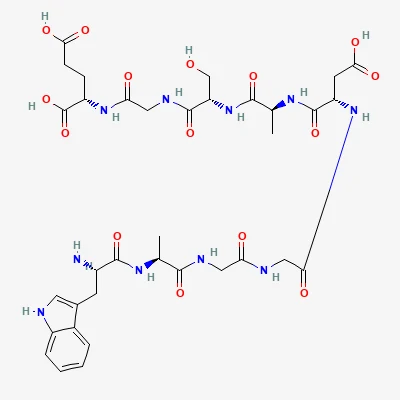
Sequence: WAGGDASGE
Free N-terminus and free C-terminal carboxylic acid; the aspartic acid at position 5 is alpha-linked (the beta-aspartyl isomer was much less active)
What Is DSIP?
DSIP, or delta sleep-inducing peptide, is a nonapeptide first isolated from rabbit cerebral venous blood and named for its ability to enhance delta (slow-wave) EEG activity in early experiments. Its sequence is Trp-Ala-Gly-Gly-Asp-Ala-Ser-Gly-Glu.[1]
DSIP was one of the first proposed sleep factors to be purified and characterized. A 1984 review noted that it was one of only two sleep peptides purified to homogeneity at that time and that it induced mainly delta sleep in rabbits, rats, mice and humans.[2]
Its standing has since become less clear. A 2006 review called DSIP a still unresolved riddle: its link to sleep was never further characterized, and its natural occurrence and biological activity remain obscure.[3]
Although named for sleep, DSIP was also investigated in early research for possible roles in pain and in drug withdrawal, reflecting the wide range of effects reported in animal studies.[4]
Chemical Structure and Molecular Identity
DSIP is a linear nine-residue peptide with the molecular formula C35H48N10O15 and a molecular weight of 848.8. Its one-letter sequence is WAGGDASGE, with free amino and carboxyl termini, and early reviews reported its molecular weight as 849.[2]
The 1978 characterization paper established the sequence by amino-acid analysis and sequence determination, then confirmed activity with synthetic peptide. Only the pure alpha-aspartyl form was highly active; the beta-aspartyl isomer was not.[1] That distinction matters for synthesis, because aspartic acid residues can rearrange to the beta form.
Identifiers
- CAS: 62568-57-4 (PubChem also lists 69431-45-4)
- InChIKey: ZRZROXNBKJAOKB-GFVHOAGBSA-N
- INN: emideltide
- Three-letter sequence: H-Trp-Ala-Gly-Gly-Asp-Ala-Ser-Gly-Glu-OH
A 2006 review noted that the DSIP structure differs from every other known peptide family.[3] With three acidic groups (the Asp and Glu side chains and the C-terminal carboxyl) and no basic side chains, DSIP is highly polar; PubChem lists a computed XLogP of -7.1.
Research History and Development
DSIP was discovered by the Schoenenberger-Monnier group in Basel, Switzerland, which isolated it in 1977 and published its sequence and synthesis in 1978. It was initially regarded as a candidate sleep-promoting factor.[3][1] A 1986 review dated the isolation and characterization work from 1963 to 1977, reflecting a long search for a humoral sleep factor.[4]
The peptide was isolated from the dialysate of cerebral venous blood collected from rabbits whose intralaminar thalamic area was electrically stimulated to induce sleep.[1] Interest grew quickly. A 1986 update reported that, within two years of the first review, much new literature had accumulated, including work on insomnia, pain and withdrawal.[4][2]
Human studies followed in the early 1980s, mainly small trials in people with chronic insomnia.[5][6] Researchers also mapped DSIP-like immunoreactivity in tissues, finding it in brain, peripheral organs and plasma.[2] Immunohistochemical and radioimmunoassay studies were interpreted as suggesting possible links between the peptide and certain diseases, though these were not established.[4]
Momentum later slowed. By 2006, reviewers noted that no DSIP gene, precursor protein or receptor had been isolated, and they described the sleep-factor hypothesis as extremely poorly documented and still weak.[3]
Mechanisms Studied in Research
No receptor or signaling pathway for DSIP has been confirmed; its mechanism of action remains unknown. Proposed mechanisms have included modulation of adrenergic transmission, which a 1986 review said remained to be established.[4]
Broad biological activity
Beyond sleep, early studies reported effects on electrophysiological activity, brain neurotransmitter levels, circadian and locomotor patterns, hormone levels, psychological performance and responses to neuropharmacological drugs, including withdrawal.[2] Its activity followed a U-shaped curve for both dose and infusion time, meaning intermediate conditions produced the largest effects.[2]
The DSIP-like peptide hypothesis
The 2006 review proposed that an as-yet-unidentified DSIP-like peptide may account for DSIP immunoreactivity and activity. Its authors cited four lines of evidence: DSIP-like immunoreactivity concentrated in neurosecretory hypothalamic nuclei not closely tied to sleep, broad in-vitro activity, slow-wave-sleep promotion by certain synthetic DSIP analogs but not DSIP itself in their rabbit and rat studies, and sleep-promoting activity of a dermorphin decapeptide that matches DSIP at five of nine positions. The optical isomer of that decapeptide suppressed sleep in rabbits.[3]
Key Findings From Published Studies
DSIP research includes animal EEG studies, small human sleep studies and tissue-distribution work, with results that later reviewers found difficult to build on. Most primary studies date from 1978 to 1992.
Animal studies
In the original rabbit study, which included 61 animals, synthetic DSIP infused into the brain ventricles under double-blind conditions increased EEG delta activity by a mean of 35% in the neocortex and limbic cortex compared with controls given CSF-like solution or eight related peptides.[1] Those comparison peptides included five possible DSIP metabolic fragments, two nonapeptide analogs with one or two amino acids exchanged, and the tripeptide Trp-Ser-Glu, none of which reproduced the effect.[1] Effects on REM sleep were more pronounced than delta effects in cats.[2]
Human studies
- In six middle-aged adults with chronic insomnia, intravenous synthetic DSIP was followed by longer and less interrupted sleep and slightly more REM sleep, without daytime sedation. Sleep-promoting effects began in the second hour, after a slight arousing effect in the first hour, and the authors reported no side effects.[5]
- A 1984 summary of insomnia studies reported improved sleep, with progressive normalization of sleep structure on repeated administration. It also described a case of insomnia associated with organic brain disease that responded well.[6]
- In 15 drug-free men with schizophrenia, cerebrospinal fluid DSIP-like immunoreactivity correlated with stage 3 and delta sleep during the first NREM period and negatively with the percentage of stage 2 sleep. The authors cautioned that the finding needed testing in people without psychiatric illness.[7]
Tissue distribution
DSIP-like immunoreactivity has been found in brain neurons, pituitary and adrenal medulla endocrine cells, and gut endocrine cells of humans, pigs and rats. The human gut was the richest source, and chromatography showed material resembling the fragment DSIP 3-9.[8] In human gut, the immunoreactivity sat in cells that also contain gastrin/CCK, secretin and PYY/glicentin.[8]
Summary of evidence
| Study | Evidence type | Main observation |
|---|---|---|
| Rabbit EEG, 1978 | Animal | Increased delta EEG activity |
| Chronic insomnia, 1981 | Human, six participants | Longer, less interrupted sleep |
| Schizophrenia CSF study, 1992 | Human, observational | CSF immunoreactivity tracked slow-wave sleep |
| Gut distribution, 1989 | Human, pig and rat tissue | Immunoreactivity in gut endocrine cells |
Because only the alpha-aspartyl form of DSIP was highly active, researchers typically confirm identity and isomeric purity with HPLC and mass spectrometry certificates of analysis.
Regulatory and Research Status
DSIP is not approved by the FDA for any use. It has an assigned international nonproprietary name, emideltide, but no approved product is described in the literature reviewed here.
The human evidence consists of small studies from the 1980s and early 1990s, without large controlled trials.[5][6] A 2026 review of therapeutic peptides listed DSIP among recovery-oriented peptides and noted that clinical trials are lacking across that group.[9]
The central open questions are basic ones: whether DSIP is produced naturally from a specific precursor, what receptor it acts on, and whether its reported effects reflect DSIP itself or a related peptide.[3] DSIP is supplied for laboratory research only.
Commonly Supplied Research Formats
DSIP is listed by 10 of the 11 major U.S. research-peptide suppliers we track. The most commonly listed formats are:
- 5mg
- 10mg
- 2mg
Supplier catalog survey, October 2026. Quantities refer to net peptide per vial as labeled.
Frequently Asked Questions
What is the sequence of DSIP?
DSIP has the nine-amino-acid sequence Trp-Ala-Gly-Gly-Asp-Ala-Ser-Gly-Glu, or WAGGDASGE in one-letter code, with free amino and carboxyl ends. The sequence was determined in 1978 from peptide isolated from rabbit cerebral venous blood. Only the alpha-aspartyl form was highly active in that study; the beta-aspartyl isomer was not.
What is the molecular weight of DSIP?
DSIP has a molecular weight of 848.8 and the molecular formula C35H48N10O15, according to PubChem (CID 68816). Older reviews round the figure to 849, and its monoisotopic exact mass is 848.33, the value typically checked by mass spectrometry. Its primary CAS number is 62568-57-4, and its InChIKey is ZRZROXNBKJAOKB-GFVHOAGBSA-N.
Is DSIP the same as emideltide?
Yes. Emideltide is the international nonproprietary name (INN) assigned to delta sleep-inducing peptide. Both names refer to the same nonapeptide, Trp-Ala-Gly-Gly-Asp-Ala-Ser-Gly-Glu, with formula C35H48N10O15. Research papers almost always use the name DSIP or delta sleep-inducing peptide rather than the INN.
Is DSIP FDA approved?
No. DSIP is not approved by the FDA for any use. Its human data come from small studies in the 1980s and early 1990s, and a 2026 review noted that clinical trials are lacking for the group of recovery-oriented peptides that includes it.
What does the research on DSIP show?
Early studies reported that DSIP increased delta EEG activity in rabbits and improved sleep in small groups of people with chronic insomnia. However, no gene, precursor protein or receptor for DSIP has been identified, and a 2006 review described its role as a sleep factor as poorly documented and still weak.
How is DSIP different from melatonin?
DSIP is a nine-amino-acid peptide whose natural origin and receptor are still unknown. Melatonin is a small indoleamine hormone made by the pineal gland, with well-characterized receptors. Both have been studied in relation to sleep, but they are chemically unrelated and act through different, and in DSIP's case unconfirmed, mechanisms.
References
- Schoenenberger GA, Maier PF, Tobler HJ, et al. The delta EEG (sleep)-inducing peptide (DSIP). XI. Amino-acid analysis, sequence, synthesis and activity of the nonapeptide. Pflugers Archiv : European journal of physiology 1978. PMID 568769 · DOI
- Graf MV, Kastin AJ. Delta-sleep-inducing peptide (DSIP): a review. Neuroscience and biobehavioral reviews 1984. PMID 6145137 · DOI
- Kovalzon VM, Strekalova TV. Delta sleep-inducing peptide (DSIP): a still unresolved riddle. Journal of neurochemistry 2006. PMID 16539679 · DOI
- Graf MV, Kastin AJ. Delta-sleep-inducing peptide (DSIP): an update. Peptides 1986. PMID 3550726 · DOI
- Schneider-Helmert D, Schoenenberger GA. The influence of synthetic DSIP (delta-sleep-inducing-peptide) on disturbed human sleep. Experientia 1981. PMID 7028502 · DOI
- Schneider-Helmert D. DSIP in insomnia. European neurology 1984. PMID 6391925 · DOI
- van Kammen DP, Widerlöv E, Neylan TC, et al. Delta sleep-inducing-peptide-like immunoreactivity (DSIP-LI) and delta sleep in schizophrenic volunteers. Sleep 1992. PMID 1475566 · DOI
- Bjartell A, Ekman R, Hedenbro J, et al. Delta sleep-inducing peptide (DSIP)-like immunoreactivity in gut: coexistence with known peptide hormones. Peptides 1989. PMID 2664725 · DOI
- Rahman OF, Lee SJ, Seeds WA. Therapeutic Peptides in Orthopaedics: Applications, Challenges, and Future Directions. Journal of the American Academy of Orthopaedic Surgeons. Global research & reviews 2026. PMID 41490200 · DOI
Related Compounds
This profile summarizes chemical data and peer-reviewed literature for educational and laboratory-research reference. It is not medical advice, and nothing here describes or recommends use in humans or animals. How we source and verify data.