Aniracetam
Aniracetam is a synthetic small molecule of the pyrrolidinone (racetam) class, chemically 1-(4-methoxybenzoyl)pyrrolidin-2-one. It is studied as a positive modulator of AMPA-type glutamate receptors and for its interactions with cholinergic signaling. Published research includes rodent memory models, small clinical trials in older adults with cognitive impairment, and studies showing no effect in healthy animals.
Last reviewed · Identity data matched to PubChem · 12 peer-reviewed sources
Key facts
- Class: pyrrolidinone-derived nootropic (racetam family)
- Chemical name: 1-(4-methoxybenzoyl)pyrrolidin-2-one; an N-anisoyl derivative of 2-pyrrolidinone
- Formula C12H13NO3; molecular weight 219.24 g/mol (PubChem CID 2196)
- CAS number 72432-10-1; development code Ro 13-5057
- Main mechanism studied: positive modulation of AMPA-type glutamate receptors
- Evidence base: rodent and pigeon studies, plus small clinical trials reviewed in the 1990s
- Regulatory status: not approved by the US FDA
Chemical Identity
| Molecular formula | C12H13NO3 |
|---|---|
| Molecular weight | 219.24 g/mol |
| Monoisotopic mass | 219.0895 Da |
| CAS number | 72432-10-1 |
| PubChem CID | 2196 |
| UNII | 5L16LKN964 |
| InChIKey | ZXNRTKGTQJPIJK-UHFFFAOYSA-N |
| Compound type | Small molecule |
| H-bond donors / acceptors | 0 / 3 |
| XLogP3 | 1.6 |
What Is Aniracetam?
Aniracetam is a synthetic pyrrolidinone compound belonging to the racetam family of so-called nootropic drugs, a group studied for possible cognition-enhancing effects. A 1994 review described it as a member of the nootropic class that appears to positively modulate AMPA-sensitive and metabotropic glutamate receptors and may facilitate cholinergic transmission.[1]
Aniracetam sits alongside structurally related compounds such as piracetam, oxiracetam, pramiracetam and nefiracetam. A broad review of the racetams covering literature from 1965 through 1992 noted that, despite decades of study, no commonly accepted mechanism of action had been established for the group.[2]
A 2002 review reported that aniracetam has been used clinically for behavioral and psychological symptoms of dementia following stroke and in Alzheimer’s disease, and that several of its metabolites also affect learning and memory in animals.[3] Much of the more recent literature uses rodent models, and several controlled animal studies have found no effect in healthy subjects.[4][5]
Chemical Structure and Molecular Identity
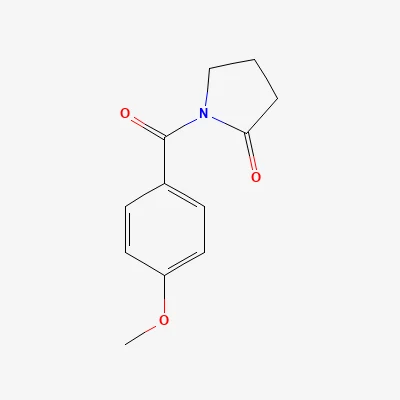
Aniracetam is a small organic molecule, 1-(4-methoxybenzoyl)pyrrolidin-2-one, made of a 2-pyrrolidinone ring acylated on its nitrogen by a 4-methoxybenzoyl (anisoyl) group. PubChem lists it under CID 2196 with the molecular formula C12H13NO3, a molecular weight of 219.24 g/mol, CAS number 72432-10-1 and InChIKey ZXNRTKGTQJPIJK-UHFFFAOYSA-N.
The structure is an imide: the ring nitrogen is bonded to two carbonyl groups, one in the lactam ring and one from the anisoyl group. The molecule has no stereocenters, no hydrogen-bond donors and three hydrogen-bond acceptors. PubChem’s computed XLogP of 1.6 indicates moderate lipophilicity, higher than that of the parent 2-pyrrolidinone scaffold shared across the racetam family.
Synonyms in chemical databases include 1-p-anisoyl-2-pyrrolidinone and the development code Ro 13-5057. Its World Health Organization ATC code is N06BX11, which places it among other psychostimulants and nootropics.
Research History and Development
Aniracetam emerged from the wave of racetam research that followed the discovery of piracetam in the 1960s. Reviews from the late 1980s and early 1990s grouped it with other pyrrolidinone derivatives that reversed experimentally induced amnesia in animals.[2][6]
Clinical evaluation focused on older adults. The 1994 review summarized trials in elderly patients with mild to moderate cognitive impairment due to senile dementia of the Alzheimer type, along with preliminary evidence in cognitive impairment of cerebrovascular origin, and called for further trials to confirm efficacy.[1]
By 2002, reviewers had expanded the list of animal models in which aniracetam had been tested, including models of attention, arousal, impulsiveness, anxiety, depression, rapid-eye-movement sleep and bladder hyperactivity. The same review cautioned that promising effects in animal models did not guarantee clinical efficacy.[3]
Since 2014, work has shifted toward controlled tests in healthy animals and genetic models. Studies in healthy mice and pigeons reported no cognitive benefit, while two studies in a genetic mouse model of attention-deficit/hyperactivity disorder (ADHD) reported behavioral and neurochemical changes.[4][5][7][8]
Mechanisms Studied in Research
The most cited mechanism for aniracetam is positive modulation of AMPA-type glutamate receptors, with additional research on metabotropic glutamate receptors, cholinergic signaling and second-messenger systems. No single mechanism has been accepted as definitive.[1][2]
Glutamate receptors
Reviews describe aniracetam as a positive modulator of AMPA and metabotropic glutamate receptors.[1] The broader racetam review proposed potentiated sodium influx through AMPA receptor-gated channels as one explanation, while noting that racetams showed no direct affinity for a wide panel of receptors, including glutamate receptors in binding assays.[2]
Cholinergic signaling
A 1989 review listed aniracetam among pyrrolidinone derivatives with direct or indirect evidence of cholinergic activation. In animal studies, it prevented the brain acetylcholine decrease and amnesia induced by the muscarinic antagonist scopolamine, with a bell-shaped dose-effect relationship.[6]
Metabolites
Several aniracetam metabolites have been reported to affect learning and memory in animals, which has led reviewers to suggest that major metabolites may contribute to the parent compound’s pharmacological effects.[3]
Signal transduction
In rats treated repeatedly with aniracetam, frontocortical and hippocampal synaptic membranes showed potentiated basal and neurotransmitter-stimulated adenylyl cyclase activity, and hippocampal synaptosomes showed increased intracellular calcium.[9] In TARP γ-8 knockout mice, aniracetam altered the expression of glutamate receptor, GABA receptor and monoamine transporter genes in the prefrontal cortex.[8]
A 2024 paper proposed, as a hypothesis rather than a tested result, that aniracetam might reduce amyloid-β production by increasing α-secretase activity through brain-derived neurotrophic factor and metabotropic glutamate receptor pathways.[10]
Key Findings From Published Studies
Aniracetam has shown effects mainly in models of impaired memory, while controlled studies in healthy animals have found no benefit. Human evidence consists of older, small trials summarized in reviews.
Animal models of impairment
- Rat scopolamine amnesia: across a year-long series of inhibitory avoidance tests, 53% of scopolamine-treated rats given aniracetam responded correctly at retention, versus 9% given vehicle.[11]
- Rat avoidance learning: aniracetam increased conditioned active avoidance responses and counteracted scopolamine-induced failure in a passive avoidance test without changing locomotion.[9]
- TARP γ-8 knockout mice (ADHD-like model): aniracetam improved hyperactivity, recognition memory and short- and long-term memory deficits.[7]
Healthy animals
In adult C57BL/6J mice, aniracetam given by mouth produced no differences from naive or placebo groups in spatial learning, fear conditioning, motor learning, odor discrimination, anxiety or repetitive behavior.[4] In neurologically healthy pigeons, it did not affect short-term memory on a delayed matching-to-sample task or response latency.[5]
Class-level observations
The 1994 racetam review reported that compounds in this family, including aniracetam, reversed amnesia induced by scopolamine, electroconvulsive shock and hypoxia in animal models, protected against barbiturate intoxication and showed very low toxicity. The authors attributed the class’s effects to potentiation of existing neurotransmission rather than to a direct receptor action.[2]
Human studies
In trials in elderly patients with mild to moderate Alzheimer-type dementia, aniracetam was reported as significantly more effective than placebo on all tests at 4 and 6 months, and more effective than piracetam on 8 of 18 tests in a separate 6-month trial. The review described it as well tolerated, without increases in liver enzymes, but noted that adverse-effect incidence rates were not yet available.[1] A small uncontrolled report in nine older patients with insomnia found that combined zopiclone and aniracetam prolonged sleep time by more than 50% in seven cases.[12]
For a small-molecule reference compound like aniracetam, researchers typically confirm identity and purity with HPLC and mass-spectrometry certificates of analysis.
Regulatory and Research Status
Aniracetam is not approved by the US Food and Drug Administration for any medical use. Reviews report that it has been used clinically in some countries for dementia-related symptoms.[3]
The clinical evidence base is dated and limited. The main human trials were summarized in 1994, with reviewers calling for further studies to confirm efficacy and identify which patients might respond.[1] Later reviews and animal studies emphasize that results in impaired-memory models have not translated into demonstrated effects in healthy subjects.[3][4][5]
Current research activity centers on animal models, particularly genetic models relevant to attention and memory, and on mechanistic questions about glutamate and cholinergic signaling.
Commonly Supplied Research Formats
Aniracetam is listed by 1 of the 11 major U.S. research-peptide suppliers we track. The most commonly listed formats are:
- 750mg x 60 (capsules)
Supplier catalog survey, October 2026. Quantities refer to net peptide per vial as labeled.
Frequently Asked Questions
What is aniracetam?
Aniracetam is a synthetic pyrrolidinone compound of the racetam family, chemically 1-(4-methoxybenzoyl)pyrrolidin-2-one. It has been studied for possible cognition-related effects, mainly as a positive modulator of AMPA-type glutamate receptors with additional effects on cholinergic signaling. Most evidence comes from animal models of memory impairment and small clinical trials in older adults reviewed in the 1990s.
What is the molecular weight of aniracetam?
Aniracetam has a molecular weight of 219.24 g/mol and the molecular formula C12H13NO3, according to PubChem (CID 2196). Its CAS number is 72432-10-1. The molecule consists of a 2-pyrrolidinone ring bearing a 4-methoxybenzoyl group on the ring nitrogen, and it has no stereocenters.
Is aniracetam the same as piracetam?
No. Both belong to the pyrrolidinone (racetam) family, but they are different molecules. Aniracetam carries a 4-methoxybenzoyl group on the pyrrolidinone nitrogen, while piracetam carries an acetamide side chain. In a 6-month trial in elderly patients with Alzheimer-type dementia summarized in a 1994 review, aniracetam outperformed piracetam on 8 of 18 tests.
Is aniracetam FDA approved?
No. Aniracetam is not approved by the US Food and Drug Administration for any medical use. A 2002 review reported that it has been used clinically in some other countries for behavioral and psychological symptoms of dementia following stroke and in Alzheimer's disease. Its clinical trial evidence is limited and largely dates from the 1990s.
How does aniracetam work?
Research describes aniracetam as a positive modulator of AMPA-type and metabotropic glutamate receptors that may also facilitate cholinergic transmission. In rats, it potentiated adenylyl cyclase activity in cortical and hippocampal membranes and raised intracellular calcium in hippocampal synaptosomes. Reviews note that no single mechanism has been firmly established for aniracetam or the racetam class.
What does the research on aniracetam show?
Aniracetam reversed scopolamine-induced memory impairment in rats and improved behavioral deficits in a genetic mouse model of ADHD. However, controlled studies in healthy mice and healthy pigeons found no effect on memory or behavior. Older clinical trials in elderly patients with Alzheimer-type dementia reported benefits over placebo, but reviewers called for further confirmation.
References
- Lee CR, Benfield P. Aniracetam. An overview of its pharmacodynamic and pharmacokinetic properties, and a review of its therapeutic potential in senile cognitive disorders. Drugs & aging 1994. PMID 8199398 · DOI
- Gouliaev AH, Senning A. Piracetam and other structurally related nootropics. Brain research. Brain research reviews 1994. PMID 8061686 · DOI
- Nakamura K. Aniracetam: its novel therapeutic potential in cerebral dysfunctional disorders based on recent pharmacological discoveries. CNS drug reviews 2002. PMID 12070527 · DOI
- Elston TW, Pandian A, Smith GD, et al. Aniracetam does not alter cognitive and affective behavior in adult C57BL/6J mice. PloS one 2014. PMID 25099639 · DOI
- Phillips H, McDowell A, Mielby BS, et al. Aniracetam does not improve working memory in neurologically healthy pigeons. PloS one 2019. PMID 31002681 · DOI
- Pepeu G, Spignoli G. Nootropic drugs and brain cholinergic mechanisms. Progress in neuro-psychopharmacology & biological psychiatry 1989. PMID 2694231 · DOI
- Sun XL, Cui J, Bai H, et al. Aniracetam Ameliorates Attention Deficit Hyperactivity Disorder Behavior in Adolescent Mice. eNeuro 2025. PMID 40118526 · DOI
- Cui J, Sun XL, Shi S, et al. Aniracetam restores the excitation-inhibition balance of neurotransmitters in the prefrontal cortex of mice with ADHD. Scientific reports 2026. PMID 41644999 · DOI
- Ventra C, Grimaldi M, Meucci O, et al. Aniracetam improves behavioural responses and facilitates signal transduction in the rat brain. Journal of psychopharmacology (Oxford, England) 1994. PMID 22298538 · DOI
- Love RWB. Aniracetam: An Evidence-Based Model for Preventing the Accumulation of Amyloid-β Plaques in Alzheimer's Disease. Journal of Alzheimer's disease : JAD 2024. PMID 38552113 · DOI
- Martin JR, Moreau JL, Jenck F. Aniracetam reverses memory impairment in rats. Pharmacological research 1995. PMID 7596957 · DOI
- Katsunuma H, Shimizu T, Ogawa K, et al. Treatment of insomnia by concomitant therapy with Zopiclone and Aniracetam in patients with cerebral infarction, cerebroatrophy, Alzheimer's disease and Parkinson's disease. Psychiatry and clinical neurosciences 1998. PMID 9628149 · DOI
Related Compounds
This profile summarizes chemical data and peer-reviewed literature for educational and laboratory-research reference. It is not medical advice, and nothing here describes or recommends use in humans or animals. How we source and verify data.