TRH (Protirelin)
Also known as: Thyrotropin-releasing hormone · Protirelin
TRH (thyrotropin-releasing hormone), or protirelin, is a hypothalamic tripeptide hormone with the structure pyroglutamyl-histidyl-prolinamide (pGlu-His-Pro-NH2). It signals the anterior pituitary to release thyrotropin and also acts in the central and peripheral nervous systems through class A G-protein-coupled receptors. Synthetic protirelin, formula C16H22N6O4 and molecular weight 362.38 g/mol, has been used diagnostically and studied as a neuromodulator.
Last reviewed · Identity data matched to PubChem · 9 peer-reviewed sources
Key facts
- Class: hypothalamic releasing hormone (tripeptide neuropeptide)
- Structure: pGlu-His-Pro-NH2; three residues with modified N- and C-termini
- Formula C16H22N6O4; molecular weight 362.38 g/mol; CAS 24305-27-9
- Generic name: protirelin (INN, USAN, BAN, JAN); also called thyroliberin
- Receptors: class A GPCRs, with a second subtype known as TRH-R2
- Development code Abbott 38579 appears among its synonyms
- Regulatory status: formerly FDA-approved diagnostic, no longer marketed in the US
Chemical Identity
| Molecular formula | C16H22N6O4 |
|---|---|
| Molecular weight | 362.38 g/mol |
| Monoisotopic mass | 362.1703 Da |
| CAS number | 24305-27-9 |
| PubChem CID | 638678 |
| UNII | 5Y5F15120W |
| InChIKey | XNSAINXGIQZQOO-SRVKXCTJSA-N |
| Compound type | Peptide |
| H-bond donors / acceptors | 4 / 5 |
| XLogP3 | -2.5 |
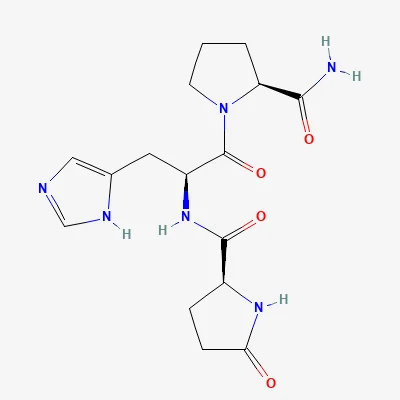
Structure notes: Tripeptide pGlu-His-Pro-NH2: N-terminal pyroglutamic acid (5-oxo-L-proline, cyclized glutamate) and C-terminal prolinamide (C-terminal amide); all residues L-configuration.
What Is TRH (Protirelin)?
TRH (thyrotropin-releasing hormone), known by the generic name protirelin, is a hypothalamic tripeptide with the structure pyroglutamyl-histidyl-prolinamide (pGlu-His-Pro-NH2). It regulates the activity of cells in the anterior pituitary and also acts within the central and peripheral nervous systems [1].
Its name describes its classic role: it is the hypothalamic factor that signals the pituitary to release thyrotropin, also called thyroid-stimulating hormone (TSH). Older literature also refers to it as thyroliberin, TSH-releasing factor and thyrotropin-releasing factor. Protirelin is the name used for the synthetic peptide, which is identical to the native hormone.
TRH has been studied for more than five decades. Research spans pituitary-thyroid physiology, its activity as a neuromodulator outside the hypothalamus, the development of receptor-selective analogs, and a family of related “TRH-like” peptides found in peripheral tissues [1].
Chemical Structure and Molecular Identity
Protirelin has the molecular formula C16H22N6O4 and a molecular weight of 362.38 g/mol (PubChem CID 638678; CAS 24305-27-9). Its systematic name is 5-oxo-L-prolyl-L-histidyl-L-prolinamide.
Although TRH is only three residues long, neither end of the molecule is a free amino acid terminus:
- N-terminus: pyroglutamic acid (5-oxo-L-proline), a cyclized glutamate residue with no free amino group.
- Middle residue: L-histidine, whose imidazole side chain is the basic residue in the molecule.
- C-terminus: L-prolinamide, meaning the terminal carboxyl group is an amide.
Because of these two terminal modifications, the peptide cannot be written accurately as a plain one-letter sequence; it is usually written as pGlu-His-Pro-NH2. All three stereocenters have the natural L (S) configuration. PubChem lists a calculated XLogP of -2.5, consistent with a small, highly polar molecule, and the standard InChIKey XNSAINXGIQZQOO-SRVKXCTJSA-N.
Other computed descriptors fit the same picture: a monoisotopic exact mass of 362.170 Da, 26 heavy atoms, four hydrogen-bond donors, five hydrogen-bond acceptors, six rotatable bonds and a topological polar surface area of 150 square angstroms. The exact mass is the value used when confirming the peptide by high-resolution mass spectrometry.
The histidine position matters for identity: a family of closely related “TRH-like” peptides differs from TRH only at this middle residue, which is discussed further below.
Research History and Development
TRH has been reviewed in the scientific literature for more than five decades, first as a hypothalamic releasing factor and later as a neuropeptide with wider roles. Burgus and Guillemin reviewed the hypothalamic releasing factors in the Annual Review of Biochemistry in 1970 [2].
Clinical and physiological interest followed. By 1979, TRH tests of pituitary-thyroid function were being compared in a report published in the Lancet [3]. In 1981, a New England Journal of Medicine editorial titled “What does brain thyrotropin-releasing hormone do?” reflected growing attention to TRH outside its pituitary role [4], and a 1982 review of thyrotropin-releasing hormone appeared in the same journal [5]. A 1995 review in the Journal of Neurochemistry continued this line of work on TRH in the nervous system [6].
Later research moved in two directions. One examined whether protirelin’s activity on spinal motor function was relevant to amyotrophic lateral sclerosis (ALS) [7]. The other focused on medicinal chemistry: designing TRH analogs and mapping how they interact with TRH receptors, including analogs that bind selectively at a second receptor subtype [1].
Mechanisms Studied in Research
TRH acts through class A G-protein-coupled receptors (GPCRs). The discovery of a second receptor subtype, TRH-R2, prompted a search for analogs that can distinguish between the two subtypes [1].
Pituitary and thyroid axis
TRH regulates the activity of cells in the anterior pituitary [1], and its name reflects its classic action of stimulating thyrotropin release. TRH-like peptides, which replace the basic histidine of TRH with a neutral or acidic amino acid such as glutamic acid, phenylalanine, glutamine or tyrosine, have been proposed to act as a form of negative feedback on the pituitary and to participate in regulating thyroid status [8].
Energy balance
A 1998 review described how information on energy balance is fed back to the paraventricular nucleus of the hypothalamus, where interplay between TRH and corticotropin-releasing hormone (CRH) shapes thermogenesis and stress responses. The same review noted that inflammatory mediators implicated in anorexia suppress TRH strongly enough to override thyroid hormone feedback, and that TRH metabolism is affected by dietary changes [9].
Nervous system
Outside the hypothalamus, protirelin has been described as a neuromodulator [7]. Reviews of TRH-like peptides also discuss proposed neuroprotective and antidepressant functions of these peptides in the brain [8].
Key Findings From Published Studies
The published record on TRH is dominated by reviews of physiology and analog chemistry, plus experimental work on its neuromodulatory effects. Findings are summarized by evidence type below.
Animal studies
In neonatal male rats, castration lowered sensitivity to protirelin’s ability to potentiate the monosynaptic spinal reflex, and testosterone treatment restored that sensitivity. The authors described this as evidence of a sex-related specificity in protirelin’s effect [7].
Human clinical studies
Protirelin was investigated as a possible adjunct in ALS, but clinical studies were divided on its efficacy despite strong experimental findings. A 1989 review noted that these trials either did not identify patients’ sex or did not analyze results by sex, and argued that hormonal status should be accounted for in future work [7].
Related peptides and analogs
- TRH-like peptides have been reported in peripheral tissues including the gastrointestinal tract, placenta, neural tissue, the male reproductive system and certain endocrine tissues [8].
- One TRH-like peptide, pGlu-Glu-Pro-NH2 (pEEPam), has been described as a fertilization-promoting peptide, and TRH-like peptides have been linked to the proliferative capacity of prostatic tissue [8].
- Medicinal chemistry work has produced a range of TRH analogs, and a 2006 review described the identification of analogs that bind selectively at TRH-R2 as a recent breakthrough [1].
Physiology reviews
Review literature places TRH inside the hypothalamic networks that set energy balance. In this model, TRH in the paraventricular nucleus contributes to the regulation of food intake, satiety, thermogenesis and other autonomic responses, and its suppression by inflammatory mediators has been implicated in anorexia [9]. These are conclusions drawn from reviewing earlier experimental work rather than results of a single controlled study.
Because TRH differs from TRH-like peptides by a single residue, researchers typically confirm identity with HPLC purity data and mass spectrometry matching 362.38 g/mol.
Regulatory and Research Status
Protirelin is a recognized drug substance with an assigned International Nonproprietary Name and USAN, BAN and JAN listings. Its established clinical role has been diagnostic: it has been used in the TRH stimulation test to assess pituitary-thyroid function [3].
In the United States, a protirelin diagnostic product was previously approved by the FDA but is no longer marketed. Protirelin is not approved by the FDA as a treatment for any condition, including ALS, where clinical studies were divided on its efficacy [7].
The name protirelin applies to the defined tripeptide only. TRH analogs and TRH-like peptides are separate chemical entities with their own structures, and findings for one cannot be assumed to apply to the others [8].
Synthetic TRH used in laboratory work is supplied for research use only. Review literature from the 2000s and 2010s has focused on TRH receptor pharmacology, receptor subtype-selective analogs [1], and the biology of TRH-like peptides in peripheral tissues [8].
Commonly Supplied Research Formats
TRH is listed by 2 of the 11 major U.S. research-peptide suppliers we track. The most commonly listed formats are:
- 25mg
Supplier catalog survey, October 2026. Quantities refer to net peptide per vial as labeled.
Frequently Asked Questions
What is TRH (protirelin)?
TRH, or thyrotropin-releasing hormone, is a hypothalamic tripeptide with the structure pGlu-His-Pro-NH2. Protirelin is the generic name for the synthetic form, which is identical to the native hormone. TRH regulates hormone-secreting cells in the anterior pituitary, including thyrotropin release, and also acts in the central and peripheral nervous systems through G-protein-coupled receptors.
What is the molecular weight of protirelin?
Protirelin has a molecular weight of 362.38 g/mol and the molecular formula C16H22N6O4, according to PubChem (CID 638678). Its CAS number is 24305-27-9. The molecule is small and highly polar, with a calculated XLogP of -2.5, reflecting its three-residue peptide structure with a pyroglutamate N-terminus and an amidated proline C-terminus.
Is protirelin the same as TRH?
Yes. Protirelin is the International Nonproprietary Name for synthetic thyrotropin-releasing hormone, and its structure matches the native hypothalamic peptide, pGlu-His-Pro-NH2. Older literature also uses the names thyroliberin, TSH-releasing factor and thyrotropin-releasing factor. TRH-like peptides are different molecules: they replace the middle histidine with another amino acid.
Is protirelin FDA approved?
Protirelin was previously approved in the United States as a diagnostic agent for testing pituitary-thyroid function, but that product is no longer marketed. Protirelin is not FDA approved as a treatment for any condition. It was investigated as a possible adjunct in amyotrophic lateral sclerosis, but clinical studies gave divided results and no treatment indication followed.
Why is TRH written as pGlu-His-Pro-NH2 instead of a simple sequence?
Both ends of TRH are chemically modified. The N-terminal residue is pyroglutamic acid, a cyclized form of glutamate with no free amino group, and the C-terminal proline is an amide rather than a free acid. A plain one-letter sequence cannot show these modifications, so the notation pGlu-His-Pro-NH2 is used.
What are TRH-like peptides?
TRH-like peptides are close relatives of TRH in which the basic histidine is replaced by a neutral or acidic amino acid, such as glutamic acid, phenylalanine, glutamine or tyrosine. They have been reported in the gastrointestinal tract, placenta, neural tissue, male reproductive system and endocrine tissues, and one of them, pEEPam, is described as a fertilization-promoting peptide.
What does the research on TRH show?
Research shows TRH regulates the pituitary through class A GPCRs, with a second receptor subtype that has prompted work on subtype-selective analogs. Reviews link TRH to hypothalamic energy-balance circuits. In rats, protirelin's effect on a spinal reflex depended on androgen status, while human ALS trials reported mixed results.
References
- Colson AO, Gershengorn MC. Thyrotropin-releasing hormone analogs. Mini reviews in medicinal chemistry 2006. PMID 16472189 · DOI
- Burgus R, Guillemin R. Hypothalamic releasing factors. Annual review of biochemistry 1970. PMID 4320674 · DOI
- Kirkegaard C, Olgaard K, Faber J, et al. Thyrotropin-releasing-hormone tests. Lancet (London, England) 1979. PMID 85141 · DOI
- Prange AJ, Utiger RD. What does brain thyrotropin-releasing hormone do? The New England journal of medicine 1981. PMID 6116193 · DOI
- Jackson IM. Thyrotropin-releasing hormone. The New England journal of medicine 1982. PMID 6798440 · DOI
- O'Leary R, O'Connor B. Thyrotropin-releasing hormone. Journal of neurochemistry 1995. PMID 7643125 · DOI
- Miller SC, Warnick JE. Protirelin (thyrotropin-releasing hormone) in amyotrophic lateral sclerosis. The role of androgens. Archives of neurology 1989. PMID 2563937 · DOI
- Bílek R, Bičíková M, Šafařík L. TRH-like peptides. Physiological research 2011. PMID 21114375 · DOI
- Karydis I, Tolis G. Orexis, anorexia, and thyrotropin-releasing hormone. Thyroid : official journal of the American Thyroid Association 1998. PMID 9827664 · DOI
Related Compounds
This profile summarizes chemical data and peer-reviewed literature for educational and laboratory-research reference. It is not medical advice, and nothing here describes or recommends use in humans or animals. How we source and verify data.