Vitamin B12 (Cyanocobalamin)
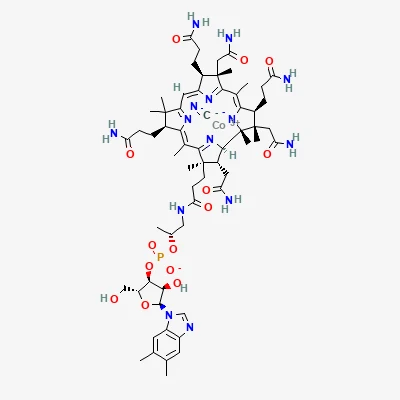
Cyanocobalamin is the cyano form of vitamin B12: a cobalt(III) corrinoid carrying a cyanide ligand, with the formula C63H88CoN14O14P (1355.4 g/mol). In cells it is converted to methylcobalamin and adenosylcobalamin, the cofactors for methionine synthase and methylmalonyl-CoA mutase. It is the most stable common B12 form and an FDA-approved drug for vitamin B12 deficiency.
Last reviewed · Identity data matched to PubChem · 12 peer-reviewed sources
Key facts
- Class: cobalt-containing corrinoid; the cyano form of vitamin B12
- Structure: cobalt(III) in a corrin ring, with a dimethylbenzimidazole nucleotide below and cyanide above
- Formula C63H88CoN14O14P; molecular weight 1355.4 g/mol; CAS 68-19-9
- One of four B12 forms used commercially, with hydroxo-, methyl- and adenosylcobalamin
- Made only by prokaryotes in nature; humans depend on dietary vitamin B12
- Cofactor forms derived from it serve methionine synthase and methylmalonyl-CoA mutase
- Regulatory status: FDA-approved prescription drug for vitamin B12 deficiency
Chemical Identity
| Molecular formula | C63H88CoN14O14P |
|---|---|
| Molecular weight | 1355.4 g/mol |
| Monoisotopic mass | 1354.5674 Da |
| CAS number | 68-19-9 |
| PubChem CID | 5311498 |
| InChIKey | FDJOLVPMNUYSCM-WZHZPDAFSA-L |
| Compound type | Small molecule |
| H-bond donors / acceptors | 9 / 21 |
What Is Cyanocobalamin?
Cyanocobalamin is the cyanide-bearing form of vitamin B12, a cobalt-containing molecule that humans must obtain from food. Plants, fungi, animals and humans do not synthesize vitamin B12; only prokaryotes do[1].
Vitamin B12 was historically called the anti-pernicious anemia factor. Four forms are used commercially in foods and medicines: cyanocobalamin, hydroxocobalamin, 5′-deoxyadenosylcobalamin and methylcobalamin[2]. Cyanocobalamin itself is not a cofactor. Cells remove its cyanide ligand and convert the cobalamin core into the two active coenzyme forms[3].
Vitamin B12 behaves differently from most B-complex vitamins: it is more stable, has a highly specific absorption mechanism, and is stored in large amounts in the body[1]. Research on cyanocobalamin covers its coordination chemistry, stability, absorption and the consequences of deficiency.
Chemical Structure and Molecular Identity
Cyanocobalamin is a cobalt(III) complex built on a corrin ring, with a 5,6-dimethylbenzimidazole nucleotide as the lower axial ligand and a cyanide ion as the upper axial ligand. PubChem (CID 5311498) lists the molecular formula C63H88CoN14O14P and a molecular weight of 1355.4 g/mol. The CAS number is 68-19-9.
The corrin macrocycle holds the cobalt ion through four nitrogen atoms. A 2023 review of cobalt corrinoid chemistry emphasizes how the corrin ligand controls and modifies the properties of the metal, including its axial ligand substitution, redox chemistry and photochemistry[4]. The different B12 forms are distinguished by the upper axial ligand: cyanide in cyanocobalamin, hydroxide in hydroxocobalamin, a methyl group in methylcobalamin and a 5′-deoxyadenosyl group in adenosylcobalamin[2].
Stability and analytical identification
Stability varies among the forms. A 2022 review compared their reactivity under temperature, pH and light, and in the presence of oxidants, reductants and other water-soluble vitamins, and summarized published data on the content-related quality of B12 products[2]. Cyanocobalamin is generally regarded as the most robust of the four, which is one reason it is widely used in fortified foods and medicines.
In the laboratory, cyanocobalamin is a dark red crystalline solid with characteristic visible-UV absorption maxima near 361 and 550 nm. Pharmacopeial identity tests use absorbance ratios at these wavelengths, and HPLC with UV detection or LC-MS separates cyanocobalamin from hydroxocobalamin and other corrinoid impurities.
Research History and Development
Vitamin B12 research began with the search for the factor that corrected pernicious anemia and expanded into absorption physiology, coordination chemistry and enzymology. Absorption depends on intrinsic factor, a gastric protein that was the subject of a 1964 review in the New England Journal of Medicine[5].
Reviews from the 1970s and 1980s covered vitamin B12 nutrition and the clinical chemistry of its measurement[6][7]. A 2005 review in Chemical Reviews addressed the chemistry and enzymology of vitamin B12[8], and coordination chemists continue to refine models of corrinoid ligand substitution and redox behavior, increasingly with density functional theory calculations[4].
Later work focused on how cobalamin is processed inside cells. The complex structure and dual cofactor forms of cobalamin require a multistep series of absorptive and processing events before it can serve as an enzyme cofactor[3]. Studies of the cblC (MMACHC) processing protein have used cells with disrupted cblC as a model of functional cobalamin deficiency[9].
Mechanisms Studied in Research
Vitamin B12 is required for two enzymatic reactions in humans: the conversion of L-methylmalonyl-CoA to succinyl-CoA, and the methylation of homocysteine to methionine. Cyanocobalamin contributes to both only after conversion into the appropriate cofactor form[1].
- Methylmalonyl-CoA mutase uses adenosylcobalamin in mitochondria. It is required for the catabolism of certain branched-chain amino acids into an anaplerotic substrate, and its failure disrupts mitochondrial energy metabolism[3].
- Methionine synthase uses methylcobalamin to remethylate homocysteine to methionine, producing S-adenosylmethionine, the main cellular methyl donor. The reaction uses 5-methyltetrahydrofolate as the one-carbon donor, linking B12 to folate metabolism and to thymidylate and purine synthesis[3].
Because these reactions consume methylmalonyl-CoA and homocysteine, B12 deficiency raises methylmalonic acid and homocysteine, which serve as diagnostic biomarkers[9]. Absorption is mediated by intrinsic factor, and a 2007 review notes that this system saturates at physiologic intakes, so the fraction absorbed falls as the amount per meal rises[10].
Key Findings From Published Studies
Published findings on vitamin B12 center on bioavailability, deficiency biomarkers, intracellular processing defects and associations with neuropathy.
Bioavailability and dietary sources
The main dietary sources of vitamin B12 are meat, milk and dairy products, fish, shellfish and eggs, which is why vegetarians are considered at risk of deficiency[1]. A 2007 review reported that average B12 bioavailability in healthy humans was 42% from fish, 56% to 89% from sheep meat and 61% to 66% from chicken, while B12 in eggs appeared poorly absorbed (under 9%)[10]. Most edible blue-green algae contain predominantly pseudovitamin B12, which is inactive in humans, whereas fortified breakfast cereals were identified as a valuable source for vegans and older adults[10].
Cell models of processing defects
In cultured cells with cblC (MMACHC) mutations, proteomic changes involved the cytoskeleton, neurological proteins and signaling and detoxification pathways. Adding hydroxocobalamin to these cells failed to restore the normal phenotype, suggesting that a defective processing pathway produces irreversible changes at the protein level[9].
Human observational and trial data
A 2021 systematic review and meta-analysis of 46 observational and 7 interventional studies found that peripheral neuropathy was associated with lower B12 levels and higher methylmalonic acid and homocysteine. B12 treatment showed a non-significant association with symptom improvement across four studies, and the authors noted that most trials did not assess vitamin status before treatment[11].
Measurement itself has limits. A 2026 position paper from the European Federation of Clinical Chemistry and Laboratory Medicine on recreational nitrous oxide use identified plasma homocysteine and methylmalonic acid as the central diagnostic markers and cautioned that serum B12 results may be falsely reassuring, often falling in the low-normal range[12].
Because cobalamin forms differ only in one axial ligand, researchers typically verify cyanocobalamin identity and purity with HPLC and mass spectrometry certificates of analysis.
Because cobalamin forms differ only in one axial ligand, researchers typically verify cyanocobalamin identity and purity with HPLC and mass spectrometry certificates of analysis.
Regulatory and Research Status
Cyanocobalamin is an FDA-approved drug, available by prescription for the treatment of vitamin B12 deficiency, including deficiency caused by pernicious anemia. It is also widely used in food fortification.
A 2025 review describes the full range of current topics, from structure, stability and pharmacokinetics to the diagnosis of deficiency, analytical methods for measuring B12, and potential toxicity[1]. Quality remains an active research question: the 2022 stability review summarized published data on the B12 content of products on the market and evaluated stabilization approaches for manufacturing and storage[2].
Open research questions include how intracellular processing defects cause lasting cellular changes[9] and whether B12 status should be measured before treatment in neuropathy trials[11].
Commonly Supplied Research Formats
Vitamin B12 is listed by 1 of the 11 major U.S. research-peptide suppliers we track. The most commonly listed formats are:
- 0.5mg / 2mL
- 10mg/10mL
Supplier catalog survey, October 2026. Quantities refer to net peptide per vial as labeled.
Frequently Asked Questions
Is cyanocobalamin the same as vitamin B12?
Cyanocobalamin is one form of vitamin B12. The term vitamin B12 covers a family of cobalamins that share the same cobalt-corrin core and differ in the upper axial ligand: cyanide, hydroxide, methyl or 5'-deoxyadenosyl. Cyanocobalamin is the most stable of these and must be converted in cells to the active cofactor forms.
What is the molecular weight of cyanocobalamin?
Cyanocobalamin has a molecular weight of 1355.4 g/mol according to PubChem (CID 5311498). Its molecular formula is C63H88CoN14O14P and its CAS number is 68-19-9. The single cobalt atom sits at the center of the corrin ring, and the cyanide ligand accounts for one carbon and one nitrogen.
How is cyanocobalamin different from methylcobalamin?
The two differ only in the upper ligand on cobalt: a cyanide group in cyanocobalamin and a methyl group in methylcobalamin. Methylcobalamin is one of the two active coenzyme forms and serves methionine synthase directly. Cyanocobalamin is not a coenzyme; cells must remove the cyanide and convert it. Cyanocobalamin is also more stable to light.
Is cyanocobalamin FDA approved?
Yes. Cyanocobalamin is an FDA-approved prescription drug for treating vitamin B12 deficiency, including deficiency due to pernicious anemia. Approval applies to specific finished drug products and indications. Research-grade cyanocobalamin sold as a laboratory chemical is not an approved drug product.
Does cyanocobalamin contain cyanide?
Yes, cyanocobalamin contains one cyanide ion coordinated to its central cobalt atom, which is where the name comes from. Inside cells, the cobalamin processing pathway removes this upper ligand before the core is converted into methylcobalamin or adenosylcobalamin. The cyanide group is a small fraction of the molecule's 1355.4 g/mol mass.
What does the research on vitamin B12 show?
Research shows that vitamin B12 is required for two human enzymes, methylmalonyl-CoA mutase and methionine synthase, and that deficiency raises methylmalonic acid and homocysteine. Bioavailability varies widely by food source. A 2021 meta-analysis linked peripheral neuropathy to low B12 status, though treatment effects in available trials were not statistically significant.
References
- Moravcová M, Siatka T, Krčmová LK, et al. Biological properties of vitamin B12. Nutrition research reviews 2025. PMID 39376196 · DOI
- Temova Rakuša Ž, Roškar R, Hickey N, et al. Vitamin B12 in Foods, Food Supplements, and Medicines-A Review of Its Role and Properties with a Focus on Its Stability. Molecules (Basel, Switzerland) 2022. PMID 36615431 · DOI
- Froese DS, Fowler B, Baumgartner MR. Vitamin B12 , folate, and the methionine remethylation cycle-biochemistry, pathways, and regulation. Journal of inherited metabolic disease 2019. PMID 30693532 · DOI
- Marques HM. The inorganic chemistry of the cobalt corrinoids - an update. Journal of inorganic biochemistry 2023. PMID 36871417 · DOI
- HERBERT V, CASTLE WB. INTRINSIC FACTOR. The New England journal of medicine 1964. PMID 14129067 · DOI
- Gräsbeck R, Salonen EM. Vitamin B12. Progress in food & nutrition science 1976. PMID 792955
- Davis RE. Clinical chemistry of vitamin B12. Advances in clinical chemistry 1985. PMID 3911750 · DOI
- Brown KL. Chemistry and enzymology of vitamin B12. Chemical reviews 2005. PMID 15941210 · DOI
- Hannibal L, DiBello PM, Jacobsen DW. Proteomics of vitamin B12 processing. Clinical chemistry and laboratory medicine 2013. PMID 23241609 · DOI
- Watanabe F. Vitamin B12 sources and bioavailability. Experimental biology and medicine (Maywood, N.J.) 2007. PMID 17959839 · DOI
- Stein J, Geisel J, Obeid R. Association between neuropathy and B-vitamins: A systematic review and meta-analysis. European journal of neurology 2021. PMID 33619867 · DOI
- Grzych G, Lee GR, Alpdemir M, et al. Addressing the silent epidemic of recreational nitrous oxide use: a position, call to action and recommendations by the European Federation of Clinical Chemistry and Laboratory Medicine Committee on Biological Markers of Nitrous Oxide Abuse. Clinical chemistry and laboratory medicine 2026. PMID 41292176 · DOI
Related Compounds
This profile summarizes chemical data and peer-reviewed literature for educational and laboratory-research reference. It is not medical advice, and nothing here describes or recommends use in humans or animals. How we source and verify data.