L-Carnitine
Also known as: Levocarnitine
L-carnitine (levocarnitine) is a small quaternary ammonium compound, (3R)-3-hydroxy-4-(trimethylazaniumyl)butanoate, that transports long-chain fatty acids into the mitochondrial matrix for beta-oxidation. Its formula is C7H15NO3 (161.20 g/mol). The body makes it from lysine and methionine. Levocarnitine is FDA-approved for carnitine deficiency, and its metabolic effects have been examined in many randomized trials.
Last reviewed · Identity data matched to PubChem · 10 peer-reviewed sources
Key facts
- Class: quaternary ammonium amino-acid derivative; INN levocarnitine
- Stereochemistry: the (R)-enantiomer; D-carnitine is not the biologically active form
- Formula C7H15NO3; molecular weight 161.20 g/mol; CAS 541-15-1
- Biosynthesized in the body from the amino acids lysine and methionine
- Core role: carries long-chain fatty acids into the mitochondrial matrix as acylcarnitine esters
- Related esters studied: acetyl-, propionyl- and glycine-propionyl-L-carnitine, and L-carnitine L-tartrate
- Regulatory status: levocarnitine is FDA-approved for primary and certain secondary carnitine deficiencies
Chemical Identity
| Molecular formula | C7H15NO3 |
|---|---|
| Molecular weight | 161.20 g/mol |
| Monoisotopic mass | 161.1052 Da |
| CAS number | 541-15-1 |
| PubChem CID | 10917 |
| UNII | 0G389FZZ9M |
| InChIKey | PHIQHXFUZVPYII-ZCFIWIBFSA-N |
| Compound type | Small molecule |
| H-bond donors / acceptors | 1 / 3 |
| XLogP3 | -0.2 |
What Is L-Carnitine?
L-carnitine is an endogenous molecule involved in fatty acid metabolism, synthesized in the human body from the amino acids lysine and methionine. Its central function is to transport long-chain fatty acids into the mitochondrial matrix, where they can be broken down for energy[1].
Besides synthesis, the body obtains carnitine from food. Red meats such as beef and lamb are the richest dietary sources, and fish, poultry and milk also contribute[1]. L-carnitine also helps maintain the mitochondrial acetyl-CoA/CoA ratio, a second role that has drawn research attention[2].
Research on L-carnitine spans inherited carnitine deficiency, cardiac energy metabolism, exercise physiology and body-weight outcomes. Unlike most compounds in this category, it has an extensive base of randomized controlled trials, summarized in several meta-analyses[3][4].
Chemical Structure and Molecular Identity
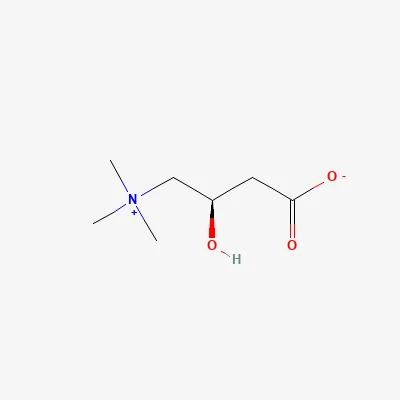
L-carnitine is (3R)-3-hydroxy-4-(trimethylazaniumyl)butanoate: a four-carbon hydroxy acid carrying a trimethylammonium group. PubChem (CID 10917) lists the molecular formula C7H15NO3 and a molecular weight of 161.20 g/mol; the CAS number is 541-15-1.
At physiological pH the molecule is a zwitterion, with a permanently positive quaternary nitrogen and a negatively charged carboxylate. The hydroxyl group on carbon 3 is the attachment point for fatty acyl groups. When a fatty acid is esterified there, the product is an acylcarnitine, the form in which fatty acids cross the inner mitochondrial membrane. Carbon 3 is also a stereocenter. Only the (R) form, L-carnitine, is the natural biological form, so the D-isomer and the racemic DL-mixture are treated as distinct materials.
Analytical identification
L-carnitine has no strong UV chromophore, so it is poorly suited to plain HPLC-UV. Laboratories typically use LC-MS/MS, HPLC after derivatization, or detectors such as charged-aerosol detection. Tandem mass spectrometry is also the standard technique for profiling free carnitine and acylcarnitines in biological samples. Chiral methods are needed to confirm enantiomeric purity, since D-carnitine cannot be distinguished from L-carnitine by mass alone.
Research History and Development
L-carnitine research moved from basic fatty acid biochemistry to clinical study of carnitine deficiency, cardiovascular disease and, later, exercise and body-weight outcomes. Its well-defined role in mitochondrial beta-oxidation made it a natural candidate for conditions involving disturbed energy metabolism[5].
One clinical thread concerns inherited deficiency. Carnitine depletion caused by reduced expression of the organic cation transporter-2 (OCTN2) gene is an autosomal recessive metabolic disorder that is frequently associated with cardiovascular disease[5]. Another thread explored esters of carnitine. Propionyl-L-carnitine was studied in double-blind multicenter phase III trials in peripheral arterial obstructive disease, where it improved maximum walking distance compared with placebo[6].
Sports science later examined L-carnitine and its forms, including L-carnitine L-tartrate and glycine-propionyl-L-carnitine, for effects on exercise performance[2]. Since the mid-2010s, a series of systematic reviews and meta-analyses have pooled randomized trials on body weight and cardiometabolic markers[7][8].
Mechanisms Studied in Research
The best-established mechanism is the carnitine shuttle: L-carnitine forms acylcarnitine esters that carry long-chain fatty acids across the inner mitochondrial membrane for beta-oxidation. Without adequate carnitine, cells cannot efficiently break down stored fat for energy[1].
Other mechanisms proposed in the literature include:
- Acetyl-CoA buffering: maintaining the mitochondrial acetyl-CoA/CoA ratio[2].
- Cardiac energy balance: promoting mitochondrial beta-oxidation in heart muscle, with reported reductions in oxidative stress, inflammation and myocyte necrosis in experimental settings[5].
- Cellular homeostasis: effects on calcium influx, endothelial integrity, intracellular enzyme release and membrane phospholipid content[5].
- Endothelial function: a proposed increase in muscle blood flow and oxygen supply, cited as a possible basis for reduced markers of exercise-induced muscle damage[9].
For the propionyl ester, studies reported increased citric acid cycle flux and pyruvate dehydrogenase activity in ischemic muscle[6]. In animal studies, L-carnitine has been suggested to play a role in preventing age-associated muscle protein degradation and in regulating mitochondrial homeostasis[9].
Key Findings From Published Studies
Meta-analyses of randomized trials report modest reductions in body weight and some cardiometabolic markers, while exercise findings are mixed and long-term cardiovascular questions remain open.
Body weight and composition
A 2016 meta-analysis of nine randomized trials (911 adults) found that participants receiving carnitine lost more weight than controls (mean difference -1.33 kg) and that the effect diminished with longer duration[7]. A 2020 meta-analysis of 37 randomized trials (2,292 participants) reported reductions in body weight, body mass index and fat mass, with no significant effect on waist circumference or body fat percentage; analysis restricted to high-quality trials confirmed only the body-weight effect[3]. A 2025 umbrella meta-analysis of eight meta-analyses also reported reductions in weight, BMI and waist circumference, with high heterogeneity for weight and BMI[4].
Type 2 diabetes
A 2024 meta-analysis of 21 randomized trials in 2,041 adults with type 2 diabetes reported small reductions in BMI, HbA1c, LDL cholesterol, triglycerides, total cholesterol and fasting glucose. The authors rated certainty from low to high depending on the outcome and advised very cautious interpretation because of high statistical heterogeneity[8].
Exercise and long-term studies
A 2011 review concluded that L-carnitine appears safe but does not seem to have a significant effect on fatigue or exercise performance[1], whereas a 2018 review described studies reporting reduced markers of muscle injury and soreness after exercise[9]. The same review noted studies in older adults reporting increased muscle mass alongside decreased body weight and reduced physical and mental fatigue[9]. A 2020 systematic review of 11 trials lasting 12 or 24 weeks in healthy adults found that L-carnitine combined with carbohydrate raised skeletal muscle carnitine content and that it increased fasting plasma trimethylamine-N-oxide (TMAO), a compound proposed to be pro-atherogenic. In centenarians, 24 weeks of L-carnitine increased muscle mass and improved physical effort tolerance and cognitive function, while muscle strength in healthy older women was unchanged. The authors called for long-term studies of cardiovascular effects[10].
Because L-carnitine lacks a UV chromophore and has a non-natural D-enantiomer, researchers typically seek certificates of analysis confirming identity, chiral purity and assay.
Because L-carnitine lacks a UV chromophore and has a non-natural D-enantiomer, researchers typically seek certificates of analysis confirming identity, chiral purity and assay.
Regulatory and Research Status
Levocarnitine is an FDA-approved drug, available as oral and intravenous prescription formulations for primary systemic carnitine deficiency and certain secondary carnitine deficiencies, including in patients with end-stage renal disease on dialysis. These approvals cover deficiency states only.
Outside those indications, L-carnitine remains a research subject. A 2011 review concluded that continued studies are required before L-carnitine could be recommended as routine therapy for conditions such as heart failure, angina or weight loss[1]. Meta-analysis authors have repeatedly flagged high heterogeneity among trials[8][4], and the TMAO finding has prompted calls for longitudinal cardiovascular studies[10].
The esters acetyl-L-carnitine and propionyl-L-carnitine are separate compounds with their own literature, and findings for one form should not be assumed to apply to the others[6].
Commonly Supplied Research Formats
L-Carnitine is listed by 4 of the 11 major U.S. research-peptide suppliers we track. The most commonly listed formats are:
- 600mg/mL (10mL)
- 600mg
- 25mL
- 200mg
Supplier catalog survey, October 2026. Quantities refer to net peptide per vial as labeled.
Frequently Asked Questions
Is L-carnitine the same as levocarnitine?
Yes. Levocarnitine is the International Nonproprietary Name for L-carnitine, the (R)-enantiomer of carnitine. Both names refer to the same molecule, C7H15NO3, with CAS number 541-15-1. D-carnitine and the racemic DL-carnitine are different materials, and only the L-form is the natural biological form.
What is the molecular weight of L-carnitine?
L-carnitine has a molecular weight of 161.20 g/mol according to PubChem (CID 10917). Its molecular formula is C7H15NO3 and its IUPAC name is (3R)-3-hydroxy-4-(trimethylazaniumyl)butanoate. Salt forms such as L-carnitine L-tartrate or hydrochloride have higher molecular weights because they include the counter-ion.
Is L-carnitine FDA approved?
Levocarnitine is FDA-approved as a prescription drug, in oral and intravenous forms, for primary systemic carnitine deficiency and certain secondary carnitine deficiencies, including patients with end-stage renal disease on dialysis. Approval does not extend to other uses that have been studied, such as weight loss or exercise performance.
How is L-carnitine different from acetyl-L-carnitine?
Acetyl-L-carnitine is an ester in which an acetyl group is attached to the hydroxyl of L-carnitine. It is one of several acylcarnitines, along with propionyl-L-carnitine. These esters have distinct properties and their own research literature, so results reported for one form, such as propionyl-L-carnitine trials in peripheral arterial disease, do not transfer automatically.
What does the research on L-carnitine show?
Meta-analyses of randomized trials report modest reductions in body weight, BMI and fat mass, and small improvements in some glucose and lipid markers in type 2 diabetes, with high heterogeneity. Exercise findings are mixed. Longer-term studies found that L-carnitine raises plasma TMAO, prompting calls for cardiovascular follow-up research.
Where does the body get L-carnitine?
The body both synthesizes L-carnitine and obtains it from food. Synthesis uses the amino acids lysine and methionine as substrates. Dietary sources are mainly animal foods, with red meats such as beef and lamb the richest, followed by fish, poultry and milk, according to a 2011 review.
References
- Pekala J, Patkowska-Sokoła B, Bodkowski R, et al. L-carnitine--metabolic functions and meaning in humans life. Current drug metabolism 2011. PMID 21561431 · DOI
- Mielgo-Ayuso J, Pietrantonio L, Viribay A, et al. Effect of Acute and Chronic Oral l-Carnitine Supplementation on Exercise Performance Based on the Exercise Intensity: A Systematic Review. Nutrients 2021. PMID 34959912 · DOI
- Talenezhad N, Mohammadi M, Ramezani-Jolfaie N, et al. Effects of l-carnitine supplementation on weight loss and body composition: A systematic review and meta-analysis of 37 randomized controlled clinical trials with dose-response analysis. Clinical nutrition ESPEN 2020. PMID 32359762 · DOI
- Hamedi-Kalajahi F, Zarezadeh M, Malekahmadi M, et al. The Effect of the L-Carnitine Supplementation on Obesity Indices: An Umbrella Meta-Analysis. International journal for vitamin and nutrition research. Internationale Zeitschrift fur Vitamin- und Ernahrungsforschung. Journal international de vitaminologie et de nutrition 2025. PMID 40298161 · DOI
- Wang ZY, Liu YY, Liu GH, et al. l-Carnitine and heart disease. Life sciences 2018. PMID 29241711 · DOI
- Wiseman LR, Brogden RN. Propionyl-L-carnitine. Drugs & aging 1998. PMID 9534023 · DOI
- Pooyandjoo M, Nouhi M, Shab-Bidar S, et al. The effect of (L-)carnitine on weight loss in adults: a systematic review and meta-analysis of randomized controlled trials. Obesity reviews : an official journal of the International Association for the Study of Obesity 2016. PMID 27335245 · DOI
- Mirrafiei A, Jayedi A, Shab-Bidar S. The Effects of L-Carnitine Supplementation on Weight Loss, Glycemic Control, and Cardiovascular Risk Factors in Patients With Type 2 Diabetes: A Systematic Review and Dose-response Meta-Analysis of Randomized Controlled Trials. Clinical therapeutics 2024. PMID 38594107 · DOI
- Fielding R, Riede L, Lugo JP, et al. l-Carnitine Supplementation in Recovery after Exercise. Nutrients 2018. PMID 29534031 · DOI
- Sawicka AK, Renzi G, Olek RA. The bright and the dark sides of L-carnitine supplementation: a systematic review. Journal of the International Society of Sports Nutrition 2020. PMID 32958033 · DOI
Related Compounds
This profile summarizes chemical data and peer-reviewed literature for educational and laboratory-research reference. It is not medical advice, and nothing here describes or recommends use in humans or animals. How we source and verify data.