NAD+ (Nicotinamide Adenine Dinucleotide)
Also known as: Nadide · β-NAD · Nicotinamide adenine dinucleotide
NAD+ (nicotinamide adenine dinucleotide) is a dinucleotide coenzyme present in all living cells that carries electrons in redox reactions and is consumed as a cosubstrate by sirtuins, PARPs and CD38. Its formula is C21H27N7O14P2 (663.4 g/mol). Research focuses on the age-related decline of NAD+; human trials mainly test precursors, and NAD+ itself is not an FDA-approved drug.
Last reviewed · Identity data matched to PubChem · 9 peer-reviewed sources
Key facts
- Class: pyridine dinucleotide coenzyme; INN nadide, also called beta-NAD or coenzyme I
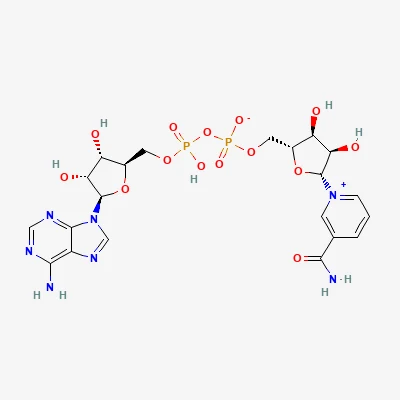
- Structure: adenosine monophosphate and nicotinamide mononucleotide joined by a pyrophosphate bridge
- Formula C21H27N7O14P2; molecular weight 663.4 g/mol; CAS 53-84-9
- Exists as a redox pair: oxidized NAD+ and reduced NADH
- Consumed as a cosubstrate by sirtuins, PARPs and the CD38/CD157 ectoenzymes
- Made by salvage (via NAMPT) and de novo from tryptophan through the kynurenine pathway
- Regulatory status: not an FDA-approved drug; widely used as a laboratory reagent
Chemical Identity
| Molecular formula | C21H27N7O14P2 |
|---|---|
| Molecular weight | 663.4 g/mol |
| Monoisotopic mass | 663.1091 Da |
| CAS number | 53-84-9 |
| PubChem CID | 5892 |
| UNII | 0U46U6E8UK |
| InChIKey | BAWFJGJZGIEFAR-NNYOXOHSSA-N |
| Compound type | Small molecule |
| H-bond donors / acceptors | 7 / 18 |
| XLogP3 | -6 |
What Is NAD+?
NAD+ (nicotinamide adenine dinucleotide, INN nadide) is a coenzyme found in all living cells. It carries electrons from one reaction to another in reduction-oxidation chemistry and also serves as a cosubstrate for enzymes such as the sirtuins and poly(ADP-ribose) polymerases (PARPs)[1].
The molecule cycles between an oxidized form, NAD+, and a reduced form, NADH, as dehydrogenase enzymes transfer hydride equivalents between substrates. This redox role makes NAD+ central to energy metabolism[2]. Unlike a vitamin, NAD+ is synthesized inside cells from smaller precursors, including the vitamin B3 forms nicotinamide and nicotinic acid and the amino acid tryptophan.
Research interest has grown because tissue and cellular NAD+ levels decline with age in multiple model organisms, including rodents and humans[2]. Most of the literature consists of biochemical, cell and rodent studies. Human intervention studies are fewer and mostly test NAD+ precursors rather than NAD+ itself[3].
Chemical Structure and Molecular Identity
NAD+ is a dinucleotide: an adenosine monophosphate unit and a nicotinamide mononucleotide unit linked through a pyrophosphate (diphosphate) bridge. PubChem (CID 5892) lists its molecular formula as C21H27N7O14P2 and its molecular weight as 663.4 g/mol. The primary CAS number is 53-84-9.
The reactive part of the molecule is the nicotinamide ring. In the oxidized form its ring nitrogen carries a positive charge, which is the source of the “+” in the name. Reduction adds a hydride to this ring and produces NADH. The adenine half does not take part in hydride transfer but contributes to binding by enzymes. The biologically active form is the beta anomer at the nicotinamide riboside linkage, which is why beta-NAD appears among its synonyms.
Analytical identification
NAD+ and NADH are distinguished spectroscopically. Both absorb ultraviolet light near 260 nm because of the adenine ring, but only NADH shows a second band near 340 nm. That difference is the basis of the standard spectrophotometric assays for NAD-dependent dehydrogenases.
NAD+ is extremely polar (PubChem lists an XLogP of -6), so identity and purity testing usually relies on ion-pair or hydrophilic-interaction HPLC coupled with mass spectrometry. Its glycosidic bond to nicotinamide is labile, and hydrolysis releases nicotinamide and ADP-ribose, which are common impurities to check for.
Research History and Development
NAD+ was long studied as a classical redox coenzyme; over the past two decades it has been reframed as a signaling cosubstrate that links metabolism with gene regulation and longevity pathways. A 2020 review describes this conceptual shift, from simple metabolic cofactor to pivotal cosubstrate for the sirtuin family of protein deacylases, as the driver of a new wave of scientific interest[4].
A second line of work concerns how cells make NAD+. In the salvage pathway, nicotinamide phosphoribosyltransferase (NAMPT) is a key enzyme, and NAMPT-mediated NAD+ biosynthesis and SIRT1 function together to regulate metabolism and circadian rhythm[5]. NAD+ can also be produced from tryptophan through the kynurenine pathway, which a 2020 review describes as playing a critical role in generating NAD+ and as a regulator of the immune system[6].
The observation that NAD+ falls with age led researchers to test precursors such as nicotinamide riboside (NR) and nicotinamide mononucleotide (NMN). Reviews from 2014 and 2015 proposed that restoring NAD+ with such intermediates could counteract age-associated functional defects observed in model organisms[5][1]. NAD+ is also listed among the nutrient-sensing pathways affected by dietary restriction, alongside AMPK, mTOR and FGF21[7].
Mechanisms Studied in Research
Research on NAD+ centers on two roles: a reusable hydride carrier in redox metabolism, and a substrate that is consumed by signaling enzymes. In the second role NAD+ is broken down rather than recycled, so the activity of these enzymes affects the size of the cellular NAD+ pool.
The main NAD+-consuming enzyme families described in the literature are:
- Sirtuins: NAD+-dependent protein deacylases that regulate metabolism and longevity-associated pathways[4].
- Poly(ADP-ribose) polymerases (PARPs): NAD+-dependent enzymes linked to DNA repair[2].
- CD38 and CD157: ectoenzymes that consume NAD+[5].
Through these enzymes, NAD+ influences metabolic pathways, DNA repair, chromatin remodeling, cellular senescence and immune cell function[2]. Its relationship with senescence appears complex. Low NAD+ can promote senescence by allowing DNA damage and mitochondrial dysfunction to accumulate, yet a low-NAD+ state might also restrain the senescence-associated secretory phenotype (SASP), which is metabolically demanding[8]. The authors of that 2024 review note that the effect of NAD+ metabolism on senescence progression has not been fully characterized[8].
Reviews of neurodegeneration research list NAD+ precursors among candidate approaches that target biological hallmarks of aging such as mitochondrial dysfunction[9].
Key Findings From Published Studies
Rodent studies frequently show that raising NAD+ changes metabolic and mitochondrial outcomes, while human trials so far show biochemical target engagement without consistent functional effects. Almost all human data concern oral precursors, not NAD+ itself.
Model-organism and rodent evidence
A 2021 review reports that the age-related decline in NAD+ has been linked causally to cognitive decline, cancer, metabolic disease, sarcopenia and frailty, and that several of these conditions were slowed or reversed by restoring NAD+ in experimental models[2]. A 2015 review noted that modulating NAD+ production or usage prolonged health span and life span in the studies it summarized[1]. In a 2026 PRISMA-guided systematic review of 80 rodent intervention studies, NAD+ augmentation was frequently associated with improvements in metabolic, mitochondrial, inflammatory and functional outcomes, although effects varied across models and endpoints[3].
Human evidence
The same systematic review identified 33 human intervention studies (28 randomized, 5 nonrandomized) published between January 2010 and October 2025[3]. Oral NR and NMN consistently raised NAD-related metabolites in plasma, whole blood or peripheral blood mononuclear cells and were generally well tolerated over weeks to months. Effects on functional, metabolic, vascular and other healthspan-related outcomes were heterogeneous and often null or endpoint-specific[3].
No eligible outcome trials evaluated intravenous or intramuscular NAD+ itself; the review found only an intravenous NAD+ pharmacokinetic pilot without clinical outcomes[3]. The authors concluded that NAD+ augmentation shows clear biological activity but that clinical effectiveness for anti-aging or wellness outcomes remains inconclusive. Earlier reviewers had also flagged open questions about how to restore NAD+ effectively, whether doing so is safe, and whether repletion benefits aging humans[2].
Because NAD+ can hydrolyze to nicotinamide and ADP-ribose, researchers typically confirm identity and purity with lot-specific HPLC and mass spectrometry certificates of analysis.
Because NAD+ can hydrolyze to nicotinamide and ADP-ribose, researchers typically confirm identity and purity with lot-specific HPLC and mass spectrometry certificates of analysis.
Regulatory and Research Status
NAD+ is not an FDA-approved drug, and no approved prescription product lists nadide as its active ingredient. Nadide has an International Nonproprietary Name and an FDA UNII code (0U46U6E8UK); these identify the substance but do not indicate approval.
NAD+ is a standard reagent in enzymology and clinical chemistry assays, and it is the subject of an extensive basic-science literature. Controlled human evidence for NAD+ itself is thin: the 2026 systematic review found no outcome trials of parenterally administered NAD+ and called for larger, well-designed randomized trials with longer follow-up[3].
For researchers, the open questions include how NAD+ levels are regulated across tissues, how the competing NAD+-consuming enzymes are balanced, and whether findings from precursor studies apply to NAD+ itself[2].
Commonly Supplied Research Formats
NAD+ (Nicotinamide Adenine Dinucleotide) is listed by 11 of the 11 major U.S. research-peptide suppliers we track. The most commonly listed formats are:
- 500mg
- 1000mg
- 100mg
- 500mg (10mL)
- 1500mg (nasal/atomized spray)
- 750mg
- 250mg
Supplier catalog survey, October 2026. Quantities refer to net peptide per vial as labeled.
Frequently Asked Questions
Is NAD+ the same as NADH?
No. NAD+ and NADH are the oxidized and reduced forms of the same coenzyme. NADH carries an extra hydride on its nicotinamide ring and acts as an electron donor, while NAD+ accepts electrons. Only NADH absorbs strongly near 340 nm, which is how laboratories tell the two apart and track dehydrogenase reactions spectrophotometrically.
What is the molecular weight of NAD+?
NAD+ has a molecular weight of 663.4 g/mol according to PubChem (CID 5892). Its molecular formula is C21H27N7O14P2 and its primary CAS number is 53-84-9. The two phosphorus atoms belong to the pyrophosphate bridge that links its adenosine and nicotinamide nucleotide halves.
Is NAD+ FDA approved?
No. NAD+ (INN nadide) is not an FDA-approved drug, and no approved prescription product contains it as the active ingredient. A 2026 systematic review found no outcome trials of intravenous or intramuscular NAD+ for anti-aging or wellness indications, only a small pharmacokinetic pilot without clinical outcomes.
How is NAD+ different from NMN and NR?
Nicotinamide mononucleotide (NMN) and nicotinamide riboside (NR) are smaller precursors that cells convert into NAD+. NMN is one nucleotide half of NAD+, and NR is NMN without its phosphate. Most human trials have tested oral NR or NMN rather than NAD+ itself, and those trials consistently raised blood NAD-related metabolites.
What enzymes use NAD+?
Dehydrogenases use NAD+ and NADH as a reusable redox pair. Other enzymes consume NAD+ as a substrate: the sirtuin protein deacylases, the poly(ADP-ribose) polymerases (PARPs) involved in DNA repair, and the CD38 and CD157 ectoenzymes. Their combined activity is one reason cellular NAD+ levels are actively regulated.
What does the research on NAD+ show?
In rodents, raising NAD+ is frequently associated with improved metabolic, mitochondrial and functional measures, though results vary by model. In humans, a 2026 systematic review of 33 intervention studies found that oral precursors reliably raise NAD-related metabolites, but effects on functional and metabolic outcomes were inconsistent and often null.
References
- Verdin E. NAD⁺ in aging, metabolism, and neurodegeneration. Science (New York, N.Y.) 2015. PMID 26785480 · DOI
- Covarrubias AJ, Perrone R, Grozio A, et al. NAD+ metabolism and its roles in cellular processes during ageing. Nature reviews. Molecular cell biology 2021. PMID 33353981 · DOI
- Gallagher C, Emmanuel OO. NAD⁺ supplementation for anti-aging and wellness: A PRISMA-guided systematic review of preclinical and clinical evidence. Ageing research reviews 2026. PMID 41655607 · DOI
- Katsyuba E, Romani M, Hofer D, et al. NAD+ homeostasis in health and disease. Nature metabolism 2020. PMID 32694684 · DOI
- Imai S, Guarente L. NAD+ and sirtuins in aging and disease. Trends in cell biology 2014. PMID 24786309 · DOI
- Savitz J. The kynurenine pathway: a finger in every pie. Molecular psychiatry 2020. PMID 30980044 · DOI
- Green CL, Lamming DW, Fontana L. Molecular mechanisms of dietary restriction promoting health and longevity. Nature reviews. Molecular cell biology 2022. PMID 34518687 · DOI
- Chini CCS, Cordeiro HS, Tran NLK, et al. NAD metabolism: Role in senescence regulation and aging. Aging cell 2024. PMID 37424179 · DOI
- Hou Y, Dan X, Babbar M, et al. Ageing as a risk factor for neurodegenerative disease. Nature reviews. Neurology 2019. PMID 31501588 · DOI
Related Compounds
This profile summarizes chemical data and peer-reviewed literature for educational and laboratory-research reference. It is not medical advice, and nothing here describes or recommends use in humans or animals. How we source and verify data.