Glutathione
Also known as: L-Glutathione · GSH
Glutathione is a tripeptide thiol, gamma-L-glutamyl-L-cysteinylglycine, and the most abundant low-molecular-weight thiol in animal cells. Its formula is C10H17N3O6S (307.33 g/mol). Glutathione and its disulfide form the major cellular redox couple, and it works with glutathione peroxidases and transferases in antioxidant defense and detoxification. It is not an FDA-approved drug.
Last reviewed · Identity data matched to PubChem · 10 peer-reviewed sources
Key facts
- Class: tripeptide thiol (gamma-L-glutamyl-L-cysteinylglycine), abbreviated GSH
- Unusual linkage: glutamate joins cysteine through its side-chain gamma-carboxyl, not a standard peptide bond
- Formula C10H17N3O6S; molecular weight 307.33 g/mol; CAS 70-18-8
- Redox pair: reduced glutathione (GSH) and glutathione disulfide (GSSG)
- Made in the cytosol by glutamate cysteine ligase, then glutathione synthetase
- Cofactor for glutathione peroxidases, including GPX4, and substrate for glutathione transferases
- Regulatory status: not an FDA-approved drug
Chemical Identity
| Molecular formula | C10H17N3O6S |
|---|---|
| Molecular weight | 307.33 g/mol |
| Monoisotopic mass | 307.0838 Da |
| CAS number | 70-18-8 |
| PubChem CID | 124886 |
| UNII | GAN16C9B8O |
| InChIKey | RWSXRVCMGQZWBV-WDSKDSINSA-N |
| Compound type | Small molecule |
| H-bond donors / acceptors | 6 / 8 |
| XLogP3 | -4.5 |
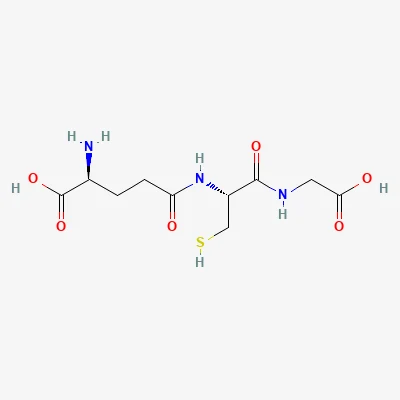
Structure notes: gamma-L-glutamyl-L-cysteinylglycine: glutamate is linked to cysteine through its side-chain (gamma) carboxyl group rather than a standard alpha-peptide bond; cysteine-glycine is a normal peptide bond; free cysteine thiol; free N-terminal amine and both carboxyl groups unmodified.
What Is Glutathione?
Glutathione (GSH) is a tripeptide made from glutamate, cysteine and glycine, and it is the most abundant low-molecular-weight thiol in animal cells. Together with its oxidized form, glutathione disulfide (GSSG), it makes up the major redox couple in animal cells[1].
GSH is present in all mammalian tissues. It defends against oxidative stress, takes part in redox signaling and the detoxification of foreign compounds, and helps regulate cell proliferation, apoptosis, immune function and fibrogenesis[2]. A 2023 review describes it as the central redox agent of most aerobic organisms[3].
Much of what glutathione does is carried out together with enzymes that use it as a substrate or cofactor, chiefly the glutathione peroxidases and glutathione transferases[3]. Research on glutathione therefore spans basic biochemistry, toxicology, cancer biology and aging.
Chemical Structure and Molecular Identity
Glutathione is gamma-L-glutamyl-L-cysteinylglycine: a tripeptide in which glutamate is attached to cysteine through its side-chain carboxyl group. That gamma linkage is not a standard peptide bond; after export from cells, glutathione is degraded by a dedicated ectoenzyme, gamma-glutamyl transferase[3].
PubChem (CID 124886) lists the molecular formula C10H17N3O6S and a molecular weight of 307.33 g/mol for reduced glutathione, with CAS number 70-18-8. The single sulfur atom belongs to the cysteine thiol (-SH), the functional group responsible for its reducing and nucleophilic chemistry. When two GSH molecules are oxidized, their thiols join through a disulfide bond to form GSSG.
Analytical identification
Because GSH and GSSG interconvert, analytical work usually reports both. Common approaches include reversed-phase HPLC with UV or electrochemical detection, LC-MS, and colorimetric thiol assays based on Ellman’s reagent (DTNB), often combined with glutathione reductase recycling to measure total glutathione. The GSH/GSSG ratio is widely used as a readout of cellular redox state[4].
In solution, reduced glutathione oxidizes on exposure to air and trace metals, so purity specifications for the reduced form normally list GSSG as a separate impurity.
Research History and Development
Glutathione biochemistry is a mature field: its biosynthesis, metabolism and enzyme partners were mapped in detail during the late 20th century. Comprehensive reviews of glutathione biochemistry were already appearing in the Annual Review of Biochemistry in 1983[5].
Work on biosynthesis established that GSH is made in the cytosol by two ATP-dependent enzymes. Glutamate cysteine ligase (GCL) joins glutamate and cysteine to form gamma-glutamylcysteine, and glutathione synthetase then adds glycine[3]. GCL, made up of a catalytic (GCLC) and a modifier (GCLM) subunit, is rate-limiting, and cysteine availability is the other key determinant of synthesis[2]. GSH also inhibits its own synthesis by feedback[1].
Later research focused on regulation and on the enzyme families that depend on GSH. The genes for GCL and glutathione synthetase are controlled by transcription factors including Nrf2 acting through the antioxidant response element, AP-1 and NF-kappaB[2]. Separate lines of work characterized eight mammalian glutathione peroxidases[6], three families of glutathione transferases[7], and the membrane transporters that move GSH between compartments[8].
Mechanisms Studied in Research
Glutathione acts mainly as a reducing agent and nucleophile, either directly or as a substrate for dedicated enzymes. Although GSH scavenges some oxidants directly, a 2023 review notes that much of its antioxidant function is carried out through glutathione peroxidase reactions that remove hydrogen peroxide, lipid hydroperoxides and peroxynitrite[3].
- Glutathione peroxidases (GPx1-GPx8): five are selenium-containing and three are not; beyond hydroperoxide removal they take part in hydrogen peroxide signaling, apoptosis regulation and other processes[6].
- Glutathione transferases (GSTs): cytosolic, mitochondrial and microsomal (MAPEG) families that conjugate GSH to electrophilic xenobiotics and to reactive aldehydes, quinones and epoxides formed during oxidative stress[7].
- Gamma-glutamyl cycle: after export from cells, GSH is degraded by membrane-anchored gamma-glutamyl transferase[3].
GSH is synthesized in the cytoplasm and must be transported into organelles and out of cells. In mammals, MRP proteins mediate low-affinity GSH efflux, but the molecular identity of many other glutathione transporters remains unestablished[8]. Mitochondria import GSH from the cytoplasm, and mitochondrial GSH metabolizes hydrogen peroxide generated by the respiratory chain[4].
GSH is also a regulator of ferroptosis, an iron-dependent form of cell death driven by lipid peroxidation. As the cofactor of glutathione peroxidase 4 (GPX4), it supports conversion of lipid peroxides into non-toxic lipid alcohols[9].
Key Findings From Published Studies
Published research links glutathione synthesis and its enzyme partners to oxidative stress, detoxification, ferroptosis and cancer-cell resistance, with most mechanistic evidence coming from cell and animal studies.
Cell and animal studies
- Targeted gene disruption in mice showed that cytosolic GST isoenzymes are broadly cytoprotective, whereas MAPEG proteins have proinflammatory activities[7].
- Knockout of mouse GSTA4 and GSTZ1 led to overexpression of Alpha, Mu and Pi class transferases, suggesting an adaptive response to endogenous chemical cues[7].
- Dysregulated GSH synthesis has been reported in models and patients with diabetes, pulmonary and liver fibrosis, alcoholic and cholestatic liver injury, endotoxemia and drug-resistant tumor cells[2].
- In cancer cells, upregulated GSH synthesis and GPX4 activity strengthen antioxidant defense against chemotherapy, radiotherapy and immunotherapy, which has made GSH metabolism a proposed therapeutic target[9].
- A long-term imbalance between mitochondrial reactive oxygen species and mitochondrial GSH has been associated with apoptosis, necroptosis and ferroptosis[4].
Human data
Animal and human studies reviewed in 2004 indicated that adequate protein nutrition is needed to maintain GSH homeostasis, and that cysteine precursors such as cystine, methionine, N-acetylcysteine and L-2-oxothiazolidine-4-carboxylate support tissue GSH synthesis[1]. Genetic polymorphisms in human cytosolic GSTs can increase susceptibility to carcinogenesis and inflammatory disease, and MAPEG polymorphisms are associated with altered lung function and higher risk of myocardial infarction and stroke[7].
A 2016 dermatology review examined glutathione’s antimelanogenic activity, which it attributed to tyrosinase inhibition and a shift from eumelanin to phaeomelanin. It found three randomized controlled trials reporting skin-lightening effects for topical and oral forms, found no evidence supporting intravenous use, and noted a public warning issued by the Philippine Food and Drug Administration over adverse effects of intravenous glutathione[10].
Because reduced glutathione oxidizes readily to its disulfide, researchers typically check HPLC certificates of analysis reporting GSH content and GSSG as a separate impurity.
Because reduced glutathione oxidizes readily to its disulfide, researchers typically check HPLC certificates of analysis reporting GSH content and GSSG as a separate impurity.
Regulatory and Research Status
Glutathione is not an FDA-approved drug in the United States. It is an endogenous metabolite and a standard research reagent, identified by CAS 70-18-8 and UNII GAN16C9B8O.
Glutathione remains under active investigation in redox biology, toxicology, ferroptosis and cancer research[9]. The skin-lightening review called for larger randomized, double-blind, placebo-controlled trials with long-term follow-up, noting that questions about duration and persistence of effect remained unanswered[10]. Reviews of glutathione transport similarly note that many proposed transporters lack direct evidence[8].
Researchers should distinguish glutathione from its precursors. N-acetylcysteine, for example, is a separate compound studied as a cysteine source for GSH synthesis[3].
Commonly Supplied Research Formats
Glutathione is listed by 8 of the 11 major U.S. research-peptide suppliers we track. The most commonly listed formats are:
- 600mg
- 1500mg
- 600mg (5mL)
Supplier catalog survey, October 2026. Quantities refer to net peptide per vial as labeled.
Frequently Asked Questions
Is glutathione a peptide?
Glutathione is a tripeptide of glutamate, cysteine and glycine, but it is not a conventional one. Glutamate is attached to cysteine through its side-chain gamma-carboxyl group instead of a standard alpha-peptide bond. For that reason glutathione is not written as a simple one-letter sequence, and outside cells it is degraded by a dedicated enzyme, gamma-glutamyl transferase.
What is the molecular weight of glutathione?
Reduced glutathione has a molecular weight of 307.33 g/mol according to PubChem (CID 124886). Its molecular formula is C10H17N3O6S and its CAS number is 70-18-8. The oxidized dimer, glutathione disulfide (GSSG), is a different compound formed when two GSH molecules join through a disulfide bond.
What is the difference between GSH and GSSG?
GSH is reduced glutathione, with a free cysteine thiol. GSSG is glutathione disulfide, two GSH molecules linked through their sulfur atoms after oxidation. Together they form the major redox couple in animal cells, and the GSH/GSSG ratio is widely measured in research as an indicator of cellular redox state.
Is glutathione FDA approved?
No. Glutathione is not an FDA-approved drug in the United States. A 2016 review found no evidence supporting intravenous glutathione for skin lightening and noted that the Philippine Food and Drug Administration had issued a public warning over adverse effects from intravenous use for off-label indications.
How is glutathione made in cells?
Cells make glutathione in the cytosol in two ATP-dependent steps. Glutamate cysteine ligase joins glutamate and cysteine to form gamma-glutamylcysteine, and glutathione synthetase then adds glycine. Glutamate cysteine ligase activity and cysteine availability are rate-limiting, and glutathione also inhibits its own synthesis through feedback.
What does the research on glutathione show?
Research shows that glutathione is central to antioxidant defense, detoxification and redox signaling, working with glutathione peroxidases and transferases. It is a key regulator of ferroptosis through GPX4, and cancer cells that raise glutathione synthesis can resist several therapies. Most mechanistic evidence comes from cell and animal studies.
References
- Wu G, Fang YZ, Yang S, et al. Glutathione metabolism and its implications for health. The Journal of nutrition 2004. PMID 14988435 · DOI
- Lu SC. Glutathione synthesis. Biochimica et biophysica acta 2013. PMID 22995213 · DOI
- Lapenna D. Glutathione and glutathione-dependent enzymes: From biochemistry to gerontology and successful aging. Ageing research reviews 2023. PMID 37683986 · DOI
- Chen TH, Wang HC, Chang CJ, et al. Mitochondrial Glutathione in Cellular Redox Homeostasis and Disease Manifestation. International journal of molecular sciences 2024. PMID 38279310 · DOI
- Meister A, Anderson ME. Glutathione. Annual review of biochemistry 1983. PMID 6137189 · DOI
- Brigelius-Flohé R, Maiorino M. Glutathione peroxidases. Biochimica et biophysica acta 2013. PMID 23201771 · DOI
- Hayes JD, Flanagan JU, Jowsey IR. Glutathione transferases. Annual review of pharmacology and toxicology 2005. PMID 15822171 · DOI
- Bachhawat AK, Thakur A, Kaur J, et al. Glutathione transporters. Biochimica et biophysica acta 2013. PMID 23206830 · DOI
- Xue X, Wang M, Cui J, et al. Glutathione metabolism in ferroptosis and cancer therapy. Cancer letters 2025. PMID 40189013 · DOI
- Sonthalia S, Daulatabad D, Sarkar R. Glutathione as a skin whitening agent: Facts, myths, evidence and controversies. Indian journal of dermatology, venereology and leprology 2016. PMID 27088927 · DOI
Related Compounds
This profile summarizes chemical data and peer-reviewed literature for educational and laboratory-research reference. It is not medical advice, and nothing here describes or recommends use in humans or animals. How we source and verify data.