Selank
Also known as: TP-7
Selank is a synthetic seven-amino-acid peptide (Thr-Lys-Pro-Arg-Pro-Gly-Pro) that extends the immunomodulatory peptide tuftsin with a Pro-Gly-Pro tripeptide. Described in research as a peptide anxiolytic, it has been studied mainly in rat models of anxiety, stress, memory and opioid withdrawal, and in gene-expression work on the GABAergic system. It is not FDA approved.
Last reviewed · Identity data matched to PubChem · 10 peer-reviewed sources
Key facts
- Class: synthetic regulatory heptapeptide; tuftsin analog studied as an anxiolytic
- Sequence: Thr-Lys-Pro-Arg-Pro-Gly-Pro (tuftsin plus Pro-Gly-Pro)
- Formula C33H57N11O9; molecular weight 751.9 g/mol (PubChem CID 11765600)
- CAS number 129954-34-3; synonym TP-7
- Proposed mechanism: allosteric modulation of the GABAergic system
- Evidence mostly from rat models; one small human fMRI study
- Not approved by the US FDA for any use
Chemical Identity
| Molecular formula | C33H57N11O9 |
|---|---|
| Molecular weight | 751.9 g/mol |
| Monoisotopic mass | 751.4341 Da |
| CAS number | 129954-34-3 |
| PubChem CID | 11765600 |
| UNII | TS9JR8EP1G |
| InChIKey | JTDTXGMXNXBGBZ-YVHUGQOKSA-N |
| Length | 7 amino acids |
| Compound type | Peptide |
| H-bond donors / acceptors | 9 / 12 |
| XLogP3 | -6.1 |
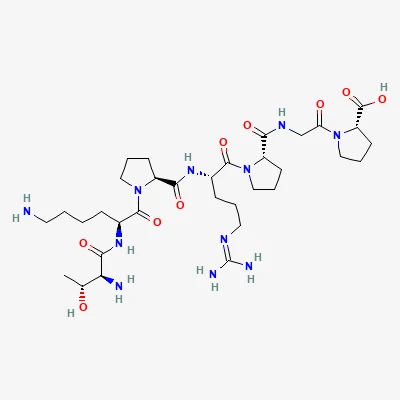
Sequence: TKPRPGP
Unmodified termini: free N-terminal amine and free C-terminal carboxylic acid
What Is Selank?
Selank is a synthetic heptapeptide, Thr-Lys-Pro-Arg-Pro-Gly-Pro, described in research as an analog of the endogenous immunomodulatory peptide tuftsin and studied mainly for anxiolytic activity. Its first four residues match tuftsin, and a C-terminal Pro-Gly-Pro tripeptide is added.[1][2]
Published papers characterize Selank as a peptide anxiolytic and report that clinical studies have shown a spectrum of effects similar to that of classical benzodiazepines such as diazepam and phenazepam. That observation has driven much of the laboratory work on how Selank interacts with the GABA system.[3][4]
Most of the indexed research consists of rat studies of stress, anxiety, memory and withdrawal, plus gene-expression experiments in rat brain and human neuroblastoma cells. A 2026 review of therapeutic peptides grouped Selank with other neuroactive peptides and noted a general lack of clinical trials for this class.[5]
Chemical Structure and Molecular Identity
Selank is a linear seven-residue peptide, TKPRPGP, with a free N-terminal amine and a free C-terminal carboxylic acid. PubChem lists it under CID 11765600 with the molecular formula C33H57N11O9 and a molecular weight of 751.9 g/mol.
The Thr-Lys-Pro-Arg segment corresponds to tuftsin, and the Pro-Gly-Pro extension places Selank among the glyprolines; one rat study refers to it as a glyproline neuropeptide.[6] Semax ends in the same Pro-Gly-Pro motif, and a 2006 study compared Selank, Semax and other glyprolines as regulatory proline-containing oligopeptides with effects on blood coagulation.[7]
Key identifiers
- InChIKey: JTDTXGMXNXBGBZ-YVHUGQOKSA-N
- CAS number: 129954-34-3
- UNII: TS9JR8EP1G
- Synonyms: TP-7; Selanc; threonyl-lysyl-prolyl-arginyl-prolyl-glycyl-proline
With lysine and arginine side chains and three proline residues, Selank is basic and highly polar. PubChem’s computed XLogP of -6.1 and topological polar surface area of 322 are consistent with a water-soluble short peptide. Its formula contains no sulfur, which distinguishes it from methionine-containing Semax in elemental and mass spectrometric analysis.
Research History and Development
Selank was designed by extending the tuftsin sequence with Pro-Gly-Pro, and its research record centers on anxiety and stress models. The indexed literature runs from 2006 comparative work on proline-containing peptides to studies published in the 2020s.[7][1]
Several lines of work stand out:
- GABAergic mechanism studies (2016 to 2017): gene-expression profiling in rat frontal cortex and in IMR-32 neuroblastoma cells, and a behavioral study combining Selank with diazepam.[3][4][8]
- Stress models (2019 to 2021): chronic foot-shock stress with liver morphology, and male confrontation (“social”) stress with serum cytokines.[9][6]
- Memory and dependence models (2019 to 2022): chronic ethanol exposure with hippocampal and cortical BDNF, and naloxone-precipitated morphine withdrawal.[2][1]
- Human imaging (2020): a resting-state fMRI study in healthy participants comparing Selank, Semax and placebo.[10]
Much of this work appears in Russian journals such as the Bulletin of Experimental Biology and Medicine and Doklady Biological Sciences, alongside papers in Frontiers in Pharmacology and Behavioural Neurology.[9][10][3][8]
Mechanisms Studied in Research
The leading hypothesis in published studies is that Selank modulates the GABAergic system allosterically, with additional evidence pointing to BDNF and cytokine regulation. None of these mechanisms has been confirmed as primary.
GABAergic gene expression
In rat frontal cortex, real-time PCR of 84 neurotransmission genes found that 45 changed expression 1 hour after Selank or GABA administration and 22 after 3 hours, with a positive correlation between the changes produced by the two compounds. The authors concluded that one possible mechanism is allosteric modulation of the GABAergic system.[3]
The hypothesis draws on how classical benzodiazepines work: they enhance the inhibitory effect of GABA through allosteric modulation of GABA-A receptors, and Selank’s reported anxiolytic profile resembles theirs.[4] In human IMR-32 neuroblastoma cells, Selank alone did not change mRNA levels of the same gene panel. However, when combined with GABA it almost completely suppressed the expression changes GABA produced, and combined with olanzapine it altered more genes than olanzapine alone. The authors interpreted this as partial support for an effect on GABA’s interaction with GABA-A receptors.[4]
BDNF and cytokines
In rats given ethanol as their only fluid for 30 weeks, Selank prevented the ethanol-induced increase in BDNF content in the hippocampus and frontal cortex, which the authors took as evidence of a neurotrophin-related mechanism.[2] In a rat male-confrontation stress model, stress raised serum IL-1beta, IL-6 and TGF-beta1, and the authors reported that results in the Selank group indicated stress-protective activity.[6]
Key Findings From Published Studies
Published findings on Selank come mostly from rat models of anxiety, stress, memory impairment and opioid withdrawal, with one small human imaging study. The table summarizes the main results.
| Model | Evidence type | Reported finding |
|---|---|---|
| Morphine-dependent outbred rats, naloxone-precipitated withdrawal | Animal | Total withdrawal index reduced by 39.6% versus active control; diazepam reduced it by 49.3%[1] |
| Rats with chronic ethanol exposure | Animal | Prevented ethanol-related memory and attention disturbances in object recognition testing[2] |
| Rats under unpredictable chronic mild stress | Animal | Selank plus diazepam most effective at reducing anxiety in the elevated plus maze[8] |
| Wistar rats, chronic foot-shock stress | Animal | Reduced stress-induced degenerative changes in hepatocytes[9] |
| Healthy adults, resting-state fMRI | Human | Changes in right amygdala to temporal cortex connectivity[10] |
Anxiety and withdrawal models
In the chronic mild stress study, a course of either test substance alone worsened anxiety measures in unstressed rats, but less so with Selank. Under chronic stress, anxiety values after combined Selank and diazepam did not differ from pre-stress values.[8] In the morphine withdrawal model, Selank attenuated convulsive reactions, ptosis and posture disorders and raised the tactile sensitivity threshold ninefold, while being slightly less active than diazepam overall.[1]
Memory and organ-level effects
In 9-month-old rats not exposed to ethanol, Selank produced a cognitive-stimulating effect in object recognition testing; in ethanol-exposed rats it prevented memory and attention deficits that developed during withdrawal.[2] In the foot-shock model, stress caused hydropic degeneration, focal necrosis and altered nucleus-to-cytoplasm ratios in hepatocytes, and Selank reduced the intensity of these changes at all levels tested.[9]
Human data
In 52 healthy participants, resting-state fMRI was recorded before and 5 and 20 minutes after Selank, Semax or placebo. The authors reported group differences in connectivity between the right amygdala and right temporal cortex regions, with both shared and peptide-specific effects.[10]
Selank lacks sulfur and differs in mass from its capped analogs, so mass spectrometry on a certificate of analysis gives a clear identity check.
Regulatory and Research Status
Selank is not approved by the US Food and Drug Administration for any use and is studied in the United States as a research compound. Papers cite clinical studies comparing it with benzodiazepines, but those trials are not among the indexed abstracts reviewed for this page.[3][4]
A 2026 review of therapeutic peptides stated that, although preclinical studies of neuroactive peptides including Selank are promising, clinical trials are lacking.[5] The findings summarized here come mainly from rat models and one small imaging study, and should be read with that limitation in mind.
Selank is also distinct from N-acetyl Selank amidate, a modified analog with terminal capping groups. Published data on Selank do not automatically apply to that analog, and the two can be distinguished by mass spectrometry.
Commonly Supplied Research Formats
Selank is listed by 11 of the 11 major U.S. research-peptide suppliers we track. The most commonly listed formats are:
- 10mg
- 5mg
- 20mg
- 40mg (nasal/atomized spray)
Supplier catalog survey, October 2026. Quantities refer to net peptide per vial as labeled.
Frequently Asked Questions
What is Selank?
Selank is a synthetic heptapeptide, Thr-Lys-Pro-Arg-Pro-Gly-Pro, made by adding a Pro-Gly-Pro tripeptide to the tuftsin sequence. Research papers describe it as a peptide anxiolytic and a tuftsin analog. Most published studies are in rats and examine anxiety, stress, memory, opioid withdrawal and GABA-related gene expression.
What is the molecular weight of Selank?
PubChem lists Selank (CID 11765600) with a molecular weight of 751.9 g/mol and the molecular formula C33H57N11O9. Its CAS number is 129954-34-3 and its InChIKey is JTDTXGMXNXBGBZ-YVHUGQOKSA-N. The seven-residue peptide has a free N-terminal amine and a free C-terminal carboxylic acid.
Is Selank FDA approved?
No. Selank is not approved by the US Food and Drug Administration for any indication. Published research consists mainly of rat studies and cell experiments plus a small human brain-imaging study, and a 2026 review noted that clinical trials of neuroactive peptides such as Selank are lacking.
Is Selank the same as tuftsin?
No. Tuftsin is the four-residue peptide Thr-Lys-Pro-Arg. Selank contains that sequence followed by Pro-Gly-Pro, making it a seven-residue analog. Research papers describe Selank as a tuftsin analog studied primarily for anxiolytic activity rather than the immune-related effects associated with tuftsin.
How is Selank different from Semax?
Both are synthetic heptapeptides ending in Pro-Gly-Pro. Selank begins with the tuftsin sequence Thr-Lys-Pro-Arg, while Semax begins with the ACTH(4-7) sequence Met-Glu-His-Phe. Studies generally describe Selank as anxiolytic and Semax as nootropic, and a 2020 fMRI study compared their effects on brain connectivity directly.
Does Selank act on GABA receptors?
Studies suggest an indirect effect. In rat frontal cortex, Selank and GABA changed the expression of many of the same neurotransmission genes, and in neuroblastoma cells Selank altered GABA's effects without acting alone. The authors proposed allosteric modulation of the GABAergic system, but direct receptor binding has not been shown in these abstracts.
What does the research on Selank show?
Rat studies report reduced anxiety measures under chronic stress, attenuated signs of morphine withdrawal, prevention of ethanol-related memory deficits with changes in brain BDNF, and reduced stress-induced liver damage. A small fMRI study in healthy adults found changes in amygdala connectivity. Controlled clinical outcome data are not among the indexed abstracts.
References
- Konstantinopolsky MA, Chernyakova IV, Kolik LG. Selank, a Peptide Analog of Tuftsin, Attenuates Aversive Signs of Morphine Withdrawal in Rats. Bulletin of experimental biology and medicine 2022. PMID 36322304 · DOI
- Kolik LG, Nadorova AV, Antipova TA, et al. Selank, Peptide Analogue of Tuftsin, Protects Against Ethanol-Induced Memory Impairment by Regulating of BDNF Content in the Hippocampus and Prefrontal Cortex in Rats. Bulletin of experimental biology and medicine 2019. PMID 31625062 · DOI
- Volkova A, Shadrina M, Kolomin T, et al. Selank Administration Affects the Expression of Some Genes Involved in GABAergic Neurotransmission. Frontiers in pharmacology 2016. PMID 26924987 · DOI
- Filatova E, Kasian A, Kolomin T, et al. GABA, Selank, and Olanzapine Affect the Expression of Genes Involved in GABAergic Neurotransmission in IMR-32 Cells. Frontiers in pharmacology 2017. PMID 28293190 · DOI
- Rahman OF, Lee SJ, Seeds WA. Therapeutic Peptides in Orthopaedics: Applications, Challenges, and Future Directions. Journal of the American Academy of Orthopaedic Surgeons. Global research & reviews 2026. PMID 41490200 · DOI
- Leonidovna YA, Aleksandrovna SM, Aleksandrovna TA, et al. The Influence of Selank on the Level of Cytokines Under the Conditions of "Social" Stress. Current reviews in clinical and experimental pharmacology 2021. PMID 32621722 · DOI
- Liapina LA, Pastorova VE, Obergan TIu, et al. [Comparison of anticoagulant effects of regulatory proline-containing oligopeptides. Specificity of glyprolines, semax, and selank and potential of their practical application]. Izvestiia Akademii nauk. Seriia biologicheskaia 2006. PMID 16634437
- Kasian A, Kolomin T, Andreeva L, et al. Peptide Selank Enhances the Effect of Diazepam in Reducing Anxiety in Unpredictable Chronic Mild Stress Conditions in Rats. Behavioural neurology 2017. PMID 28280289 · DOI
- Fomenko EV, Bobyntsev II, Ivanov AV, et al. Effect of Selank on Morphological Parameters of Rat Liver in Chronic Foot-Shock Stress. Bulletin of experimental biology and medicine 2019. PMID 31243679 · DOI
- Panikratova YR, Lebedeva IS, Sokolov OY, et al. Functional Connectomic Approach to Studying Selank and Semax Effects. Doklady biological sciences : proceedings of the Academy of Sciences of the USSR, Biological sciences sections 2020. PMID 32342318 · DOI
Related Compounds
This profile summarizes chemical data and peer-reviewed literature for educational and laboratory-research reference. It is not medical advice, and nothing here describes or recommends use in humans or animals. How we source and verify data.