Semax
Also known as: ACTH(4-7)-Pro-Gly-Pro
Semax is a synthetic seven-amino-acid peptide (Met-Glu-His-Phe-Pro-Gly-Pro) that joins the ACTH(4-7) fragment of adrenocorticotropic hormone to a Pro-Gly-Pro tripeptide. Described in research as an ACTH(4-10) analogue, it has been studied for nootropic and neuroprotective activity, mainly in cell and rodent models examining BDNF, copper binding and amyloid-beta aggregation. It is not FDA approved.
Last reviewed · Identity data matched to PubChem · 12 peer-reviewed sources
Key facts
- Class: synthetic regulatory heptapeptide; ACTH(4-10) analogue studied as a nootropic
- Sequence: Met-Glu-His-Phe-Pro-Gly-Pro (ACTH(4-7) plus Pro-Gly-Pro)
- Formula C37H51N9O10S; molecular weight 813.9 g/mol (PubChem CID 9811102)
- CAS number 80714-61-0
- Reported to raise BDNF in rat basal forebrain and to chelate Cu(II)
- Evidence mostly in-vitro and rodent; one small human fMRI study
- Not approved by the US FDA for any use
Chemical Identity
| Molecular formula | C37H51N9O10S |
|---|---|
| Molecular weight | 813.9 g/mol |
| Monoisotopic mass | 813.3480 Da |
| CAS number | 80714-61-0 |
| PubChem CID | 9811102 |
| UNII | I5FAL2585H |
| InChIKey | AFEHBIGDWIGTEH-AQRCPPRCSA-N |
| Length | 7 amino acids |
| Compound type | Peptide |
| H-bond donors / acceptors | 8 / 13 |
| XLogP3 | -2.8 |
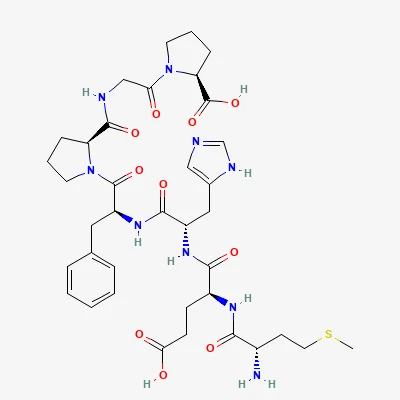
Sequence: MEHFPGP
Unmodified termini: free N-terminal amine and free C-terminal carboxylic acid
What Is Semax?
Semax is a synthetic heptapeptide with the sequence Met-Glu-His-Phe-Pro-Gly-Pro, made by joining the adrenocorticotropic hormone fragment ACTH(4-7) to a C-terminal Pro-Gly-Pro tripeptide. Published papers describe it as an analogue of ACTH(4-10) that has been studied for nootropic and neuroprotective activity.[1][2][3]
Most research on Semax concerns the central nervous system. A 2006 rat study summarized earlier work reporting effects on learning and memory formation in rodents and humans, and connected those effects in part to brain-derived neurotrophic factor (BDNF) in the basal forebrain.[1] Later laboratory work has examined copper binding, amyloid-beta aggregation, neuronal calcium signaling and recovery after spinal cord injury.[4][5][6][3]
The evidence base is dominated by cell, biochemical and animal studies. A 2026 review of therapeutic peptides noted a general lack of clinical trials for neuroactive peptides including Semax, and a 2026 gerontology review described non-approved peptides as having promising preclinical but limited clinical evidence and lacking long-term safety data.[7][8]
Chemical Structure and Molecular Identity
Semax is a linear seven-residue peptide, MEHFPGP, with a free N-terminal amine and a free C-terminal carboxylic acid. PubChem lists it under CID 9811102 with the molecular formula C37H51N9O10S and a molecular weight of 813.9 g/mol.
The first four residues, Met-Glu-His-Phe, correspond to positions 4 to 7 of ACTH; the Pro-Gly-Pro extension completes the heptapeptide.[3] The same C-terminal Pro-Gly-Pro motif ends the sequence of Selank, and a 2006 study grouped Semax, Selank and glyprolines together as regulatory proline-containing oligopeptides when comparing their effects on blood coagulation.[9] The single sulfur atom in the formula comes from the N-terminal methionine.
Key identifiers
- InChIKey: AFEHBIGDWIGTEH-AQRCPPRCSA-N
- CAS number: 80714-61-0
- UNII: I5FAL2585H
- Synonyms: ACTH(4-7)-Pro-Gly-Pro; Pro-Gly-Pro-ACTH(4-7); MEHFPGP
Semax is strongly polar, with a computed XLogP of -2.8 and a topological polar surface area of 312. Biochemically, it is notable for a high affinity for Cu(II) ions and the ability to form a stable complex with copper, a property central to several recent in-vitro studies.[4][5]
Research History and Development
Semax was built around a short fragment of ACTH, and its indexed literature runs from receptor-binding work in the 2000s to mechanistic studies published in 2025 and 2026. Much of it appears in Russian journals such as Doklady Biological Sciences, the Bulletin of Experimental Biology and Medicine and Acta Naturae.[10][6][11]
A 2006 paper in the Journal of Neurochemistry addressed how the peptide might act. It built on an earlier observation that Semax stimulates BDNF synthesis in cultured basal forebrain astrocytes and went on to identify specific Semax binding sites in rat brain membranes.[1]
Subsequent research broadened in several directions:
- Behavioral models: rat models of 6-hydroxydopamine-induced parkinsonism and of early-life exposure to the antidepressant fluvoxamine.[10][2]
- Human imaging: a resting-state fMRI study of brain connectivity in healthy participants.[12]
- Neurodegeneration chemistry: in-vitro work on copper, amyloid-beta and reactive oxygen species, followed by a transgenic Alzheimer’s mouse study that also tested a Semax derivative.[5][4][11]
- Injury models: a 2025 mouse spinal cord injury study using RNA sequencing and molecular docking.[3]
Mechanisms Studied in Research
Studies have linked Semax to several mechanisms: increased BDNF, specific high-affinity brain binding sites, copper chelation, modulation of neuronal calcium activity and, in one mouse study, the mu-opioid receptor. None of these has been established as its single primary mechanism.
BDNF and specific binding sites
In rat basal forebrain membranes, tritium-labelled Semax bound in a time-dependent, specific and reversible way that required calcium ions, with a dissociation constant (KD) of 2.4 nM. After intranasal application in rats, BDNF protein rose in the basal forebrain within 3 hours but not in the cerebellum.[1] A 2026 review likewise grouped Semax with neuroactive peptides described as enhancing BDNF pathways.[7]
Copper binding and amyloid-beta
In vitro, Semax extracted Cu(II) from Cu(II)-amyloid-beta complexes, altered the complex’s redox cycling and lowered associated reactive oxygen species; it also protected SH-SY5Y neuroblastoma cells from copper-catalyzed oxidative stress.[4] A separate study using spectrofluorometric, calorimetric and MTT assays found that Semax prevented formation of amyloid-beta:Cu2+ complexes and inhibited fiber formation, with the strongest effect in the presence of copper.[5]
Calcium signaling and opioid receptor targets
In rat hippocampal slices, Semax increased the frequency of spontaneous intracellular calcium fluctuations in CA1 pyramidal neurons but did not change proton-induced calcium rises in cerebellar granule cells, suggesting its neuroprotective action is not explained by blocking acid-sensing ion channels.[6] In a mouse spinal cord injury model, network pharmacology and docking identified the mu-opioid receptor as a target, with downstream regulation of the deubiquitinase USP18 and the protein FTO.[3]
Key Findings From Published Studies
Published findings on Semax come almost entirely from animal and in-vitro models, with one small human imaging study. The table summarizes the main results by model.
| Model | Evidence type | Reported finding |
|---|---|---|
| Female C57BL/6 mice, T9-T10 spinal cord injury | Animal and cell | Improved functional recovery; reduced lysosomal membrane permeabilization-related pyroptosis and oxidative stress[3] |
| Transgenic APPswe/PS1dE9/Blg mice | Animal | Improved cognitive test performance; fewer amyloid inclusions in cortex and hippocampus[11] |
| Rats exposed to fluvoxamine as neonates | Animal | Reduced anxiety-like behavior, improved learning, normalized brain monoamines[2] |
| Rats with 6-OHDA-induced parkinsonism | Animal | No effect on motor activity or passive defensive behavior[10] |
| Healthy adults, resting-state fMRI | Human | Changes in right amygdala to temporal cortex connectivity[12] |
Animal studies
In the spinal cord injury study, recovery was assessed with footprint analysis, Basso scores and inclined plane tests, and knockdown of USP18 confirmed its role in the effect.[3] In the Alzheimer’s model, both Semax and an unnamed derivative improved results in open field, novel object recognition and Barnes maze tests.[11] In the fluvoxamine study, rat pups were exposed to the drug during a window equivalent to late human fetal development, then given Semax; treated animals showed less anxiety-like behavior and better maze learning than untreated exposed animals.[2] In the parkinsonism model, neither Semax nor Selank altered motor activity, although Selank lowered anxiety measures.[10]
Human data
In a study of 52 healthy participants, resting-state fMRI was recorded before and 5 and 20 minutes after Semax, Selank or placebo. The authors reported between-group differences in functional connectivity between the right amygdala and regions of the right temporal cortex, and described both shared and peptide-specific effects.[12] No randomized clinical outcome trials appear in the abstracts reviewed for this page.
Semax differs from its acetylated, amidated analog by only a few atoms, so mass spectrometry on a certificate of analysis is the clearest identity check.
Regulatory and Research Status
Semax is not approved by the US Food and Drug Administration for any use and is studied in the United States as a research compound. A 2026 review of peptides in aging research noted that non-approved peptides, Semax among them, have limited clinical evidence and lack long-term safety data.[8]
A 2026 orthopaedic review stated that, although preclinical studies of neuroactive peptides such as Semax are promising, clinical trials are lacking.[7] Findings described on this page come from cell cultures, brain slices, rodent models and one small imaging study, and should be read with that limitation in mind.
Because Semax is a short, unmodified peptide that differs from related research compounds such as N-acetyl Semax amidate only by terminal groups, analytical confirmation of identity and purity matters for laboratory work. Mass spectrometry readily separates Semax (813.9 g/mol) from its N-acetylated, C-amidated analog (855.0 g/mol in PubChem).
Commonly Supplied Research Formats
Semax is listed by 11 of the 11 major U.S. research-peptide suppliers we track. The most commonly listed formats are:
- 10mg
- 5mg
- 30mg
- 25mg
- 50mg (nasal/atomized spray)
Supplier catalog survey, October 2026. Quantities refer to net peptide per vial as labeled.
Frequently Asked Questions
What is Semax?
Semax is a synthetic heptapeptide, Met-Glu-His-Phe-Pro-Gly-Pro, that combines the ACTH(4-7) fragment with a C-terminal Pro-Gly-Pro tripeptide. Researchers describe it as an ACTH(4-10) analogue with nootropic and neuroprotective activity in experimental models. Most published work is preclinical, covering BDNF levels, copper binding, amyloid-beta aggregation and rodent behavior.
What is the molecular weight of Semax?
PubChem lists Semax (CID 9811102) with a molecular weight of 813.9 g/mol and the molecular formula C37H51N9O10S. Its CAS number is 80714-61-0 and its InChIKey is AFEHBIGDWIGTEH-AQRCPPRCSA-N. The peptide has seven residues with a free N-terminal amine and a free C-terminal carboxylic acid.
Is Semax FDA approved?
No. Semax is not approved by the US Food and Drug Administration for any indication. Published research consists mainly of cell, biochemical and rodent studies plus a small human brain-imaging study, and recent reviews note that clinical trials of neuroactive peptides such as Semax are lacking.
Is Semax the same as ACTH?
No. Semax contains only a short piece of adrenocorticotropic hormone, the ACTH(4-7) sequence Met-Glu-His-Phe, followed by an added Pro-Gly-Pro tripeptide. Full-length ACTH is a 39-residue hormone. Research papers describe Semax as an analogue of the ACTH(4-10) fragment rather than of the whole hormone.
How is Semax different from Selank?
Both are synthetic heptapeptides ending in Pro-Gly-Pro, but their first four residues differ. Semax starts with the ACTH(4-7) sequence Met-Glu-His-Phe, while Selank starts with Thr-Lys-Pro-Arg and is described as an analog of tuftsin. Studies typically characterize Semax as nootropic and Selank as anxiolytic, and some papers compare them directly.
What does the research on Semax show?
Studies report that Semax binds specific sites in rat basal forebrain and raises BDNF there, chelates copper and reduces amyloid-beta aggregation in vitro, and improved recovery in a mouse spinal cord injury model. It also improved cognitive tests in transgenic Alzheimer's mice. Human evidence is limited to a small fMRI connectivity study.
Is Semax the same as N-acetyl Semax amidate?
No. N-acetyl Semax amidate has the same seven-residue backbone but carries an acetyl group on the N-terminus and an amide at the C-terminus. PubChem lists it with the formula C39H54N10O10S and a molecular weight of 855.0 g/mol, compared with 813.9 g/mol for Semax. Peer-reviewed data on the modified analog are limited.
References
- Dolotov OV, Karpenko EA, Seredenina TS, et al. Semax, an analogue of adrenocorticotropin (4-10), binds specifically and increases levels of brain-derived neurotrophic factor protein in rat basal forebrain. Journal of neurochemistry 2006. PMID 16635254 · DOI
- Glazova NY, Manchenko DM, Volodina MA, et al. Semax, synthetic ACTH(4-10) analogue, attenuates behavioural and neurochemical alterations following early-life fluvoxamine exposure in white rats. Neuropeptides 2021. PMID 33418449 · DOI
- Liu R, Chen Y, Huang H, et al. Semax peptide targets the μ opioid receptor gene Oprm1 to promote deubiquitination and functional recovery after spinal cord injury in female mice. British journal of pharmacology 2025. PMID 40692165 · DOI
- Tomasello MF, Di Rosa MC, Naletova I, et al. Semax, a Copper Chelator Peptide, Decreases the Cu(II)-Catalyzed ROS Production and Cytotoxicity of aβ by Metal Ion Stripping and Redox Silencing. Bioinorganic chemistry and applications 2025. PMID 40496623 · DOI
- Sciacca MFM, Naletova I, Giuffrida ML, et al. Semax, a Synthetic Regulatory Peptide, Affects Copper-Induced Abeta Aggregation and Amyloid Formation in Artificial Membrane Models. ACS chemical neuroscience 2022. PMID 35080861 · DOI
- Kolbaev SN, Sharonova IN, Skrebitsky VG. The Effect of Peptide Semax, an ACTH(4-10) Analogue, on Intracellular Calcium Dynamics in Rat Brain Neurons. Bulletin of experimental biology and medicine 2025. PMID 41171324 · DOI
- Rahman OF, Lee SJ, Seeds WA. Therapeutic Peptides in Orthopaedics: Applications, Challenges, and Future Directions. Journal of the American Academy of Orthopaedic Surgeons. Global research & reviews 2026. PMID 41490200 · DOI
- Mavrych V, Shypilova I, Bolgova O. Therapeutic peptides in gerontology: mechanisms and applications for healthy aging. Frontiers in aging 2026. PMID 42021992 · DOI
- Liapina LA, Pastorova VE, Obergan TIu, et al. [Comparison of anticoagulant effects of regulatory proline-containing oligopeptides. Specificity of glyprolines, semax, and selank and potential of their practical application]. Izvestiia Akademii nauk. Seriia biologicheskaia 2006. PMID 16634437
- Slominsky PA, Shadrina MI, Kolomin TA, et al. Peptides semax and selank affect the behavior of rats with 6-OHDA induced PD-like parkinsonism. Doklady biological sciences : proceedings of the Academy of Sciences of the USSR, Biological sciences sections 2017. PMID 28702721 · DOI
- Radchenko AI, Kuzubova EV, Apostol AA, et al. The Potential of the Peptide Drug Semax and Its Derivative for Correcting Pathological Impairments in the Animal Model of Alzheimer's Disease. Acta naturae 2025. PMID 41479572 · DOI
- Panikratova YR, Lebedeva IS, Sokolov OY, et al. Functional Connectomic Approach to Studying Selank and Semax Effects. Doklady biological sciences : proceedings of the Academy of Sciences of the USSR, Biological sciences sections 2020. PMID 32342318 · DOI
Related Compounds
This profile summarizes chemical data and peer-reviewed literature for educational and laboratory-research reference. It is not medical advice, and nothing here describes or recommends use in humans or animals. How we source and verify data.