Pinealon
Also known as: Glu-Asp-Arg · EDR peptide
Pinealon is a synthetic tripeptide made of three amino acids, L-glutamic acid, L-aspartic acid and L-arginine (Glu-Asp-Arg, or EDR). It belongs to the short peptide bioregulators studied mainly by Russian gerontology researchers, and has been examined in cell cultures, animal models and small human studies for antioxidant and neuroprotective activity. It is not an FDA-approved drug.
Last reviewed · Identity data matched to PubChem · 9 peer-reviewed sources
Key facts
- Class: short peptide bioregulator (synthetic tripeptide)
- Sequence: Glu-Asp-Arg (EDR), three L-amino acids with free termini
- Formula C15H26N6O8; molecular weight 418.40 g/mol (PubChem CID 10273502)
- CAS 175175-23-2; also listed as H-Glu-Asp-Arg-OH
- Research focus: oxidative stress, hypoxia, neuronal survival and gene expression
- Evidence base: mostly in-vitro and animal studies, plus small human studies from one research school
- Regulatory status: not FDA approved; no approved medical indication in the United States
Chemical Identity
| Molecular formula | C15H26N6O8 |
|---|---|
| Molecular weight | 418.40 g/mol |
| Monoisotopic mass | 418.1812 Da |
| CAS number | 175175-23-2 |
| PubChem CID | 10273502 |
| InChIKey | QPRZKNOOOBWXSU-CIUDSAMLSA-N |
| Length | 3 amino acids |
| Compound type | Peptide |
| H-bond donors / acceptors | 8 / 10 |
| XLogP3 | -6.1 |
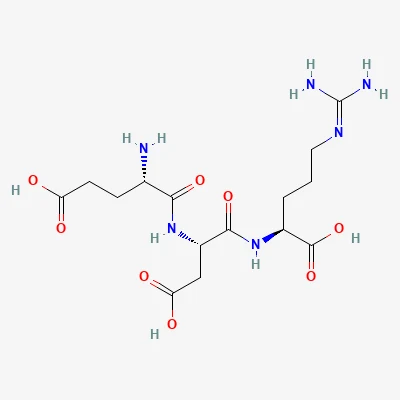
Sequence: EDR
Free N-terminal amine and free C-terminal carboxylic acid; no modifications. Often supplied as an acetate salt.
What Is Pinealon?
Pinealon is a synthetic tripeptide with the sequence Glu-Asp-Arg (EDR), studied as a short peptide bioregulator with antioxidant and neuroprotective activity. It was characterized in laboratory work as able to limit the build-up of reactive oxygen species in several cell types.[1]
Pinealon belongs to a family of very short peptides, mostly two to four amino acids long, studied largely by Vladimir Khavinson and colleagues. A 2020 review describes the EDR peptide as having established neuroprotective properties, activating the expression of genes and the synthesis of proteins involved in maintaining neuronal function, and reducing neuronal apoptosis in in-vitro and in-vivo studies.[2]
In the Russian gerontology literature, pinealon is grouped with other short neuroprotective peptides such as semax and cortagen, and contrasted with polypeptide complexes extracted from animal brain tissue.[3] Unlike those extracts, pinealon is a single, chemically defined molecule.
Pinealon is often studied alongside the tetrapeptides from the same research school. In the same set of HeLa cell experiments, fluorescence-labeled pinealon, epitalon (Ala-Glu-Asp-Gly) and testagen (Lys-Glu-Asp-Gly) all entered the cell nucleus, and each showed its own pattern of binding to short DNA sequences.[4] This shared focus on gene regulation is the main reason these peptides are discussed together.
Chemical Structure and Molecular Identity
Pinealon is a linear tripeptide of L-glutamic acid, L-aspartic acid and L-arginine joined by two peptide bonds, with a free amine at the N-terminus and a free carboxylic acid at the C-terminus. PubChem (CID 10273502) lists the molecular formula C15H26N6O8 and a molecular weight of 418.40 g/mol.
The molecule is small and highly polar. Two of its three residues carry acidic side chains (glutamate and aspartate), while arginine contributes a strongly basic guanidino group. PubChem’s computed XLogP of -6.1 reflects very high water solubility and low lipophilicity.
Key identifiers
- CAS number: 175175-23-2
- InChIKey: QPRZKNOOOBWXSU-CIUDSAMLSA-N
- Synonyms: Glu-Asp-Arg, EDR peptide, L-glutamyl-L-aspartyl-L-arginine, H-Glu-Asp-Arg-OH
Pinealon should not be confused with longer peptides that happen to contain the Glu-Asp-Arg motif, or with synthetic arginine-aspartate peptides designed for other purposes. The name refers specifically to the free tripeptide EDR.
Research History and Development
Pinealon research comes almost entirely from Russian gerontology groups, beginning with studies of hypoxia and oxidative stress and later extending to gene regulation and neurodegeneration models. Much of the work appears in the journal Advances in Gerontology and in papers co-authored by Khavinson.
A 2008 study compared several short regulatory peptides, including vilon, epitalon, vesugen and pinealon, in an experimental model of hypobaric hypoxia and reported antihypoxic properties for all four, with pinealon showing the most pronounced effect.[5] A 2011 paper then described its effects on reactive oxygen species, cell death and the cell cycle in cultured neurons and other cells.[1]
Later reviews placed pinealon among short peptides proposed as multitarget agents for Alzheimer’s disease research, alongside Lys-Glu, Glu-Trp, Lys-Glu-Asp and others.[6][2] A 2026 orthopaedics review published outside Russia mentioned pinealon with epithalon and delta sleep-inducing peptide as agents discussed for circadian and mitochondrial targets, while noting a general lack of clinical trials for these peptides.[7]
Mechanisms Studied in Research
Two main mechanisms have been proposed for pinealon: reduction of oxidative stress and direct interaction with DNA and chromatin that may alter gene expression. Both rest largely on cell-culture and biophysical experiments.
Antioxidant and cell-survival effects
In cerebellar granule cells, neutrophils and PC12 pheochromocytoma cells exposed to oxidative stress, pinealon restricted reactive oxygen species accumulation in a concentration-dependent way and reduced necrotic cell death. The protective effect was accompanied by delayed ERK 1/2 activation and changes in the cell cycle. Because cell-cycle effects continued at concentrations above those that saturated the antioxidant effect, the authors proposed that pinealon also acts directly on the genome.[1] In hypoxia experiments, its protective action was attributed less to blocking reactive oxygen species and more to stimulating internal antioxidant enzymes and possibly limiting NMDA-mediated excitotoxicity.[5]
Nuclear entry and DNA binding
Fluorescence-labeled pinealon entered the cytoplasm, nucleus and nucleolus of HeLa cells. In vitro, it quenched the fluorescence of labeled deoxyribooligonucleotides in a sequence-dependent way, binding preferentially to sequences containing CNG and CAG sites, which are targets of cytosine methylation.[4] Spectral, NMR, viscosity and molecular dynamics studies indicated that EDR can partly enter the major groove of DNA and interact with guanine N7 and O6 atoms, and that magnesium ions promote this interaction.[8]
Proposed signaling targets
A 2020 review proposed that EDR binds histone proteins or nucleic acids and may change MAPK/ERK signaling and the synthesis of caspase-3, p53, the antioxidant enzymes SOD2 and GPX1, the transcription factors PPARA and PPARG, serotonin and calmodulin.[2] These links are presented as hypotheses rather than established pathways.
Key Findings From Published Studies
Published findings on pinealon are mostly from cell and animal models, with a few small human studies; no large randomized controlled trials appear in the indexed literature. Results should be read with that limitation in mind.
In-vitro studies
- In cultured cerebellar granule cells, neutrophils and PC12 cells under oxidative stress, pinealon lowered reactive oxygen species levels and necrotic cell death.[1]
- According to a 2020 review, EDR reduced the elimination of dendritic spines in neuronal cultures from mouse models of Alzheimer’s and Huntington’s disease, and promoted antioxidant enzyme synthesis in rat cerebellar neuron cultures.[2]
Animal studies
- In a hypobaric hypoxia model, pinealon showed the strongest antihypoxic effect of four short peptides tested, and it increased neuronal resistance to hypoxic stress in experiments with prenatal hypoxia.[5]
- The same 2020 review states that EDR normalized behavioral responses in animal studies.[2]
Human studies
- The 2020 review reports that EDR improved memory problems in elderly patients, citing earlier clinical work by the same research group.[2]
- In a comparative monitoring study of 110 people of different ages, oligopeptide preparations containing Lys-Glu-Asp and Glu-Asp-Arg showed the most pronounced effect on biological age indicators when the two were combined, and were rated among the safest of the techniques compared.[9]
The human data come from small studies by a single research school, and the abstracts do not describe randomized, blinded designs. Independent replication outside this group is lacking.
Since studies concern the defined EDR tripeptide, researchers typically confirm identity and purity using HPLC and mass spectrometry certificates of analysis.
Regulatory and Research Status
Pinealon is not approved by the US Food and Drug Administration for any medical use and has no approved indication in the United States. It is available as a research chemical and appears in the scientific literature as an investigational short peptide.
Most published studies come from Russian research groups, especially work led by Khavinson, and many appear in Russian-language journals with English abstracts. Reviews from outside this school mention pinealon only briefly and note that clinical evidence is limited.[7]
Open questions include its stability and fate in the body, whether the DNA-binding interactions seen in vitro occur in living tissue, and whether the cell and animal findings can be reproduced by independent laboratories using controlled study designs. In the 110-person geroprotection comparison, the strongest effect was reported when pinealon was combined with another peptide preparation, which makes its individual contribution hard to isolate.[9]
Commonly Supplied Research Formats
Pinealon is listed by 9 of the 11 major U.S. research-peptide suppliers we track. The most commonly listed formats are:
- 20mg
- 10mg
Supplier catalog survey, October 2026. Quantities refer to net peptide per vial as labeled.
Frequently Asked Questions
What is pinealon made of?
Pinealon is a tripeptide made of three amino acids: L-glutamic acid, L-aspartic acid and L-arginine, in that order (Glu-Asp-Arg, or EDR). It has a free N-terminal amine and a free C-terminal carboxylic acid, with no chemical modifications. Its molecular formula is C15H26N6O8, and it is often supplied as an acetate salt.
What is the molecular weight of pinealon?
PubChem lists pinealon (CID 10273502) with a molecular weight of 418.40 g/mol and the molecular formula C15H26N6O8. Its CAS number is 175175-23-2. These values refer to the free tripeptide; salt forms such as the acetate have a higher formula weight because they include the counterion.
Is pinealon FDA approved?
No. Pinealon is not approved by the US Food and Drug Administration for any medical use, and it has no approved indication in the United States. It is sold as a research chemical and studied as an investigational short peptide, mainly by Russian gerontology research groups.
What does the research on pinealon show?
Research on pinealon is mostly preclinical. Cell studies report reduced reactive oxygen species and less necrotic cell death under oxidative stress, and an animal hypoxia model showed antihypoxic effects. Biophysical studies suggest it can enter cell nuclei and bind DNA. Human data are limited to small studies from one research school without large randomized trials.
How is pinealon different from epitalon?
Pinealon is the tripeptide Glu-Asp-Arg, while epitalon is the tetrapeptide Ala-Glu-Asp-Gly. Both are short peptide bioregulators from the same research school and both have been reported to enter cell nuclei and bind DNA in vitro. Pinealon has been studied mainly for neuronal protection and hypoxia, while epitalon research has focused on aging and telomeres.
Is pinealon the same as the EDR peptide?
Yes. EDR is the one-letter amino-acid code for Glu-Asp-Arg, the sequence of pinealon, and research papers use the two names interchangeably. The name pinealon refers only to this free tripeptide, not to longer peptides that contain an EDR motif within their sequence.
References
- Khavinson V, Ribakova Y, Kulebiakin K, et al. Pinealon increases cell viability by suppression of free radical levels and activating proliferative processes. Rejuvenation research 2011. PMID 21978084 · DOI
- Khavinson V, Linkova N, Kozhevnikova E, et al. EDR Peptide: Possible Mechanism of Gene Expression and Protein Synthesis Regulation Involved in the Pathogenesis of Alzheimer's Disease. Molecules (Basel, Switzerland) 2020. PMID 33396470 · DOI
- Umnov RS, Lin'kova NS, Khavinson VKh. [Neuroprotective effects of peptides bioregulators in people of various age]. Advances in gerontology = Uspekhi gerontologii 2013. PMID 24738258
- Fedoreyeva LI, Kireev II, Khavinson VKh, et al. Penetration of short fluorescence-labeled peptides into the nucleus in HeLa cells and in vitro specific interaction of the peptides with deoxyribooligonucleotides and DNA. Biochemistry. Biokhimiia 2011. PMID 22117547 · DOI
- Kozina LS. [Investigation of antihypoxic properties of short peptides]. Advances in gerontology = Uspekhi gerontologii 2008. PMID 18546825
- Ilina AR, Popovich IG, Ryzhak GA, et al. [Prospects for use of short peptides in pharmacotherapeutic correction of Alzheimer's disease.]. Advances in gerontology = Uspekhi gerontologii 2024. PMID 38944767
- Rahman OF, Lee SJ, Seeds WA. Therapeutic Peptides in Orthopaedics: Applications, Challenges, and Future Directions. Journal of the American Academy of Orthopaedic Surgeons. Global research & reviews 2026. PMID 41490200 · DOI
- Silanteva IA, Komolkin AV, Morozova EA, et al. Role of Mono- and Divalent Ions in Peptide Glu-Asp-Arg-DNA Interaction. The journal of physical chemistry. B 2019. PMID 30762356 · DOI
- Myakotnykh VS, Torgashov MN, Egorin KV, et al. [Comparative analysis of different methods of geroprotective]. Advances in gerontology = Uspekhi gerontologii 2016. PMID 28539017
Related Compounds
This profile summarizes chemical data and peer-reviewed literature for educational and laboratory-research reference. It is not medical advice, and nothing here describes or recommends use in humans or animals. How we source and verify data.