Pentapeptide-18
Pentapeptide-18 is a synthetic five-residue peptide, Tyr-D-Ala-Gly-Phe-Leu, that is structurally identical to the enkephalin analog [D-Ala2]leucine-enkephalin. It has the formula C29H39N5O7 and a molecular weight of 569.6 g/mol. Used as a cosmetic anti-wrinkle ingredient, it has been studied in lipid-nanoparticle formulations, computational models and a D-tyrosine-modified variant. It is not an FDA-approved drug.
Last reviewed · Identity data matched to PubChem · 4 peer-reviewed sources
Key facts
- Class: synthetic cosmetic peptide; enkephalin analog ([D-Ala2]leucine-enkephalin)
- Sequence: Tyr-D-Ala-Gly-Phe-Leu, five residues with a D-alanine at position 2
- Formula C29H39N5O7; molecular weight 569.6 g/mol (PubChem CID 10099522)
- CAS 64963-01-5; UNII PO4D55T1IG
- Evidence base: formulation, computational and cell or 3D skin model studies; no trials of the peptide alone
- Regulatory status: not an FDA-approved drug; used as a cosmetic ingredient
Chemical Identity
| Molecular formula | C29H39N5O7 |
|---|---|
| Molecular weight | 569.6 g/mol |
| Monoisotopic mass | 569.2849 Da |
| CAS number | 64963-01-5 |
| PubChem CID | 10099522 |
| UNII | PO4D55T1IG |
| InChIKey | ZHUJMSMQIPIPTF-JMBSJVKXSA-N |
| Compound type | Peptide |
| H-bond donors / acceptors | 7 / 8 |
| XLogP3 | -1.9 |
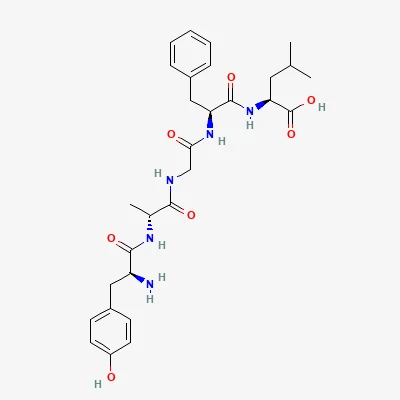
Structure notes: Tyr-D-Ala-Gly-Phe-Leu: contains D-alanine at position 2 (all other chiral residues L); free N-terminal amine and free C-terminal carboxylic acid. Same structure as [D-Ala2]leucine-enkephalin.
What Is Pentapeptide-18?
Pentapeptide-18 is a synthetic linear peptide of five amino acids, tyrosine, D-alanine, glycine, phenylalanine and leucine, used as an anti-wrinkle ingredient in cosmetics. Its structure is the same as [D-Ala2]leucine-enkephalin, an analog of the endogenous opioid pentapeptide leucine-enkephalin.
Researchers describe pentapeptide-18 as a commercial anti-wrinkle peptide.[1] The authors of a 2026 computational study characterize it as a neuromodulatory peptide that is reported to reduce wrinkle formation by inhibiting neurotransmitter release, and to improve skin hydration, elasticity and texture.[2] These descriptions summarize prior claims; the underlying efficacy data are not presented in the abstracts reviewed here.
The indexed literature on pentapeptide-18 is small. It includes two 2024 studies of lipid nanoparticles combining the peptide with retinol,[3][4] a 2020 study of a D-tyrosine-modified version,[1] and the 2026 spectroscopic and computational study.[2]
Chemical Structure and Molecular Identity
Pentapeptide-18 is L-tyrosyl-D-alanylglycyl-L-phenylalanyl-L-leucine (Tyr-D-Ala-Gly-Phe-Leu), a pentapeptide with a free N-terminal amine and a free C-terminal carboxylic acid. PubChem (CID 10099522) lists the molecular formula C29H39N5O7 and a molecular weight of 569.6 g/mol.
The defining feature is the D-alanine at position 2. Natural leucine-enkephalin has the sequence Tyr-Gly-Gly-Phe-Leu; pentapeptide-18 differs only by replacing the second glycine with D-alanine. Because it contains a D-amino acid, it cannot be represented by a standard all-L one-letter sequence, although it is sometimes written H-Y(dA)GFL-OH.
Key identifiers
- CAS number: 64963-01-5
- InChIKey: ZHUJMSMQIPIPTF-JMBSJVKXSA-N
- UNII: PO4D55T1IG
- Other registry numbers: NSC 374895; EINECS 265-291-0
- Synonyms: [D-Ala2]leucine-enkephalin, (D-Ala2)-Leu-enkephalin, H-Tyr-D-Ala-Gly-Phe-Leu-OH
A 2026 study characterized the molecule’s structure in detail. Researchers optimized its geometry and electronic properties with density functional theory using the 6-31++G(d,p) basis set, analyzed frontier molecular orbitals (HOMO-LUMO) and the molecular electrostatic potential, and assigned theoretical vibrational frequencies that were then compared with FTIR, ATR-FTIR and Raman spectra.[2]
Research History and Development
Pentapeptide-18 entered the peer-reviewed literature mainly as a cosmetic ingredient to be formulated, modified or modeled, not as a subject of mechanistic biology. The available studies date from 2020 onward.
In 2020, researchers used pentapeptide-18 as a test case for adding a terminal D-tyrosine to short cosmetic peptides. The goal was to add an anti-melanogenic effect to a peptide’s existing activity, and the same approach was applied to the peptides GEKG and GHK.[1]
In 2024, two studies paired pentapeptide-18 with retinol in solid lipid nanoparticles. The first optimized and characterized the nanoparticle dispersion as a cosmetic raw material,[3] and the second incorporated it into semi-solid formulations and tested them in volunteers.[4] The authors framed lipid nanocarriers as a way to use the properties of pentapeptide-18 and retinol while reducing the undesirable effects of retinoid therapy.[4]
Most recently, a 2026 study combined spectroscopy with molecular docking, molecular dynamics and ADMET (absorption, distribution, metabolism, excretion and toxicity) predictions to assess pentapeptide-18 as an anti-aging candidate.[2]
Mechanisms Studied in Research
Proposed mechanisms for pentapeptide-18 center on inhibition of neurotransmitter release and, in computational work, interactions with skin-aging signaling proteins; direct experimental confirmation is not described in the abstracts. The neuromodulatory mechanism is presented as background in the 2026 study rather than tested there.[2]
Computational target modeling
The 2026 study used molecular docking and molecular dynamics simulations to examine how pentapeptide-18 might bind targets implicated in skin aging, including TGF-beta, TNF-alpha, MAPK, PI3K/AKT and NF-kappaB. The authors chose these pathways because they regulate inflammation, oxidative stress and extracellular matrix remodeling.[2] Binding results are not reported in the available abstract, and docking predictions do not demonstrate activity in cells or skin.
Anti-melanogenic modification
A separate line of work added a mechanism rather than studying an existing one. D-tyrosine inhibits tyrosinase activity, and attaching a terminal D-tyrosine to pentapeptide-18 gave the modified peptide the ability to reduce tyrosinase activity and melanin content in pigment cells.[1] This effect belongs to the D-tyrosine-modified peptide, not to unmodified pentapeptide-18.
Receptor pharmacology
Although pentapeptide-18 shares its structure with an enkephalin analog, the cosmetic studies reviewed here do not report opioid-receptor binding or signaling measurements for it.
Key Findings From Published Studies
Published findings on pentapeptide-18 cover nanoparticle stability, a volunteer study of a combined retinol formulation, and cell and 3D skin model results for a D-tyrosine-modified variant. No study isolates the effect of unmodified pentapeptide-18 in human skin.
Retinol and pentapeptide-18 lipid nanoparticles (formulation study)
Solid lipid nanoparticles were produced by high-shear homogenization in three versions: empty, retinol only, and retinol plus pentapeptide-18. After four weeks of storage at 25 °C, the optimized retinol and peptide dispersion had a mean particle size of 134.7 nm, a polydispersity index of 0.269 and a zeta potential of 42.7 mV, values the authors considered suitable for a cosmetic raw material.[3]
Semi-solid formulations (volunteer study)
Creams enriched with retinol and pentapeptide-18-loaded lipid nanocarriers remained stable regardless of storage temperature, with 25 °C recommended. In volunteers, the products significantly reduced sebum secretion and decreased the number of facial wrinkles, and the lipid nanoparticles reduced the irritation usually associated with retinol.[4] Because retinol was present, the results cannot be credited to the peptide alone.
D-tyrosine-modified pentapeptide-18 (cell and 3D skin models)
Adding a terminal D-tyrosine to pentapeptide-18 reduced melanin content and tyrosinase activity in human MNT-1 melanoma cells and primary melanocytes. The modified peptide also inhibited melanogenesis induced by alpha-melanocyte-stimulating hormone or UV irradiation in MNT-1 cells and reduced melanin synthesis in the epidermal basal layer of a 3D human skin model.[1] When the same D-tyrosine addition was applied to the peptides GEKG and GHK, it conferred anti-melanogenic effects without altering their intrinsic activities.[1]
Spectroscopic and computational profiling
The 2026 study confirmed calculated vibrational assignments against experimental FTIR, ATR-FTIR and Raman spectra and assessed pharmacokinetic and drug-likeness properties in silico.[2]
Because pentapeptide-18 depends on a single D-alanine for its identity, researchers typically confirm identity and purity with HPLC and mass spectrometry certificates of analysis.
Because pentapeptide-18 depends on a single D-alanine for its identity, researchers typically confirm identity and purity with HPLC and mass spectrometry certificates of analysis.
Regulatory and Research Status
Pentapeptide-18 is not an FDA-approved drug. It is used as a cosmetic ingredient under the name pentapeptide-18 and has not been evaluated in drug-development clinical trials.
The published evidence is limited in scope. The only human data come from a formulation that also contained retinol,[4] the anti-melanogenic findings apply to a modified peptide,[1] and the 2026 work is largely computational.[2] The neuromodulatory mechanism commonly attributed to the peptide is cited as background rather than demonstrated in the indexed abstracts.[2]
Evidence at a glance
| Study | Model | Material tested | Peptide isolated? |
|---|---|---|---|
| D-tyrosine modification (2020) | Pigment cells and 3D human skin model | Pentapeptide-18 with a terminal D-tyrosine | No, a modified peptide |
| Lipid nanoparticles (2024) | Formulation and storage stability | Retinol plus pentapeptide-18 | No |
| Semi-solid formulations (2024) | Stability testing and volunteers | Retinol plus pentapeptide-18 nanocarriers | No |
| Spectroscopy and modeling (2026) | DFT, FTIR/Raman, docking, molecular dynamics | Pentapeptide-18 | Yes, computational and spectroscopic only |
Open questions include direct measurement of its effect on neurotransmitter release in skin-relevant models, its skin penetration as an unformulated peptide, and controlled studies that separate its contribution from co-ingredients such as retinol.
Commonly Supplied Research Formats
Pentapeptide-18 is listed by 2 of the 11 major U.S. research-peptide suppliers we track. The most commonly listed formats are:
- 200mg
Supplier catalog survey, October 2026. Quantities refer to net peptide per vial as labeled.
Frequently Asked Questions
What is the molecular weight of pentapeptide-18?
PubChem lists pentapeptide-18 (CID 10099522) with a molecular weight of 569.6 g/mol and the molecular formula C29H39N5O7. Its sequence is Tyr-D-Ala-Gly-Phe-Leu with a free C-terminal acid. The CAS number is 64963-01-5 and the InChIKey is ZHUJMSMQIPIPTF-JMBSJVKXSA-N. PubChem also lists it under the synonym [D-Ala2]leucine-enkephalin.
Is pentapeptide-18 the same as leucine-enkephalin?
Not exactly. Pentapeptide-18 is identical to [D-Ala2]leucine-enkephalin, an analog of the natural opioid peptide leucine-enkephalin. Natural leucine-enkephalin is Tyr-Gly-Gly-Phe-Leu, while pentapeptide-18 replaces the second glycine with D-alanine, giving Tyr-D-Ala-Gly-Phe-Leu. The cosmetic studies on pentapeptide-18 do not report opioid-receptor measurements for it.
Is pentapeptide-18 FDA approved?
No. Pentapeptide-18 is not an FDA-approved drug and has not been tested in drug-development clinical trials. It is used as a cosmetic ingredient. Published research consists of lipid-nanoparticle formulation studies, a volunteer study of a cream that also contained retinol, cell work on a D-tyrosine-modified variant, and a computational study.
What does the research on pentapeptide-18 show?
Studies show pentapeptide-18 can be formulated with retinol into stable solid lipid nanoparticles, and a cream containing both reduced sebum and facial wrinkle counts in volunteers. A D-tyrosine-modified version reduced melanin and tyrosinase activity in pigment cells and a 3D skin model. The peptide's own effect in human skin has not been isolated.
How is pentapeptide-18 different from acetyl hexapeptide-3?
They are different molecules. Pentapeptide-18 is a five-residue enkephalin analog, Tyr-D-Ala-Gly-Phe-Leu, with free termini and a molecular weight of 569.6 g/mol. Acetyl hexapeptide-3 is a six-residue peptide with an acetylated N-terminus. Both are used in anti-wrinkle cosmetics, but research findings for one should not be applied to the other.
Why is pentapeptide-18 combined with retinol in research?
Two 2024 studies loaded pentapeptide-18 and retinol together into solid lipid nanoparticles. The authors described lipid nanocarriers as a way to use the properties of both ingredients while reducing the irritation typical of retinoid therapy. In volunteers, the resulting creams reduced sebum and wrinkle counts, and the nanoparticles lessened retinol-associated irritation.
References
- Park J, Jung H, Jang B, et al. D-tyrosine adds an anti-melanogenic effect to cosmetic peptides. Scientific reports 2020. PMID 31937863 · DOI
- Akhan D, Bicak B, Akalin E, et al. Pentapeptide-18 as an anti-aging candidate: Spectroscopic characterization and molecular interaction analysis. Computational biology and chemistry 2026. PMID 41722287 · DOI
- Pawłowska M, Marzec M, Jankowiak W, et al. Solid Lipid Nanoparticles Incorporated with Retinol and Pentapeptide-18-Optimization, Characterization, and Cosmetic Application. International journal of molecular sciences 2024. PMID 39337562 · DOI
- Pawłowska M, Marzec M, Jankowiak W, et al. Retinol and Oligopeptide-Loaded Lipid Nanocarriers as Effective Raw Material in Anti-Acne and Anti-Aging Therapies. Life (Basel, Switzerland) 2024. PMID 39459512 · DOI
Related Compounds
This profile summarizes chemical data and peer-reviewed literature for educational and laboratory-research reference. It is not medical advice, and nothing here describes or recommends use in humans or animals. How we source and verify data.