SS-31 (Elamipretide)
Also known as: Elamipretide · MTP-131 · Bendavia
SS-31 (elamipretide) is a synthetic, mitochondria-targeting tetrapeptide, D-Arg-Dmt-Lys-Phe-NH2, that binds cardiolipin in the inner mitochondrial membrane. Studied in heart failure, mitochondrial myopathy, neuroinflammation and Barth syndrome models, it received US accelerated approval in September 2025 for Barth syndrome, a rare mitochondrial disorder. Other uses remain investigational, and a phase 3 myopathy trial missed its primary endpoints.
Last reviewed · Identity data matched to PubChem · 11 peer-reviewed sources
Key facts
- Class: synthetic aromatic-cationic, mitochondria-targeting tetrapeptide
- Structure: D-Arg-Dmt-Lys-Phe-NH2, where Dmt is 2',6'-dimethyltyrosine
- Formula C32H49N9O5; molecular weight 639.8 g/mol; CAS 736992-21-5
- Generic name elamipretide; development code MTP-131
- Main studied target: cardiolipin in the inner mitochondrial membrane
- US accelerated approval in September 2025 for Barth syndrome
- Phase 3 MMPOWER-3 trial in mitochondrial myopathy did not meet its primary endpoints
Chemical Identity
| Molecular formula | C32H49N9O5 |
|---|---|
| Molecular weight | 639.8 g/mol |
| Monoisotopic mass | 639.3857 Da |
| CAS number | 736992-21-5 |
| PubChem CID | 11764719 |
| UNII | 87GWG91S09 |
| InChIKey | SFVLTCAESLKEHH-WKAQUBQDSA-N |
| Compound type | Peptide |
| H-bond donors / acceptors | 9 / 8 |
| XLogP3 | 0 |
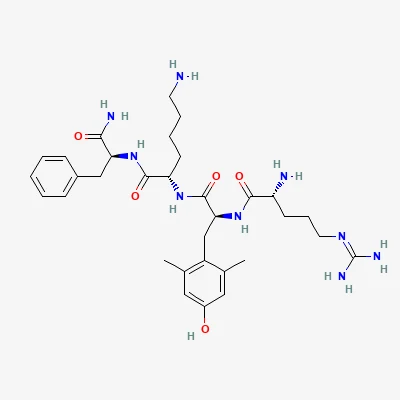
Structure notes: Tetrapeptide D-Arg-Dmt-Lys-Phe-NH2: N-terminal D-arginine; position 2 is the non-standard residue 2',6'-dimethyl-L-tyrosine (Dmt); C-terminal phenylalanine amide.
What Is SS-31?
SS-31, known by the generic name elamipretide, is a synthetic mitochondria-targeting tetrapeptide that binds cardiolipin in the inner mitochondrial membrane. A 2025 review lists MTP-131 among its other designations and describes a structure that allows uptake into many cell types with highly selective mitochondrial targeting[1].
Reviews describe elamipretide as a water-soluble, aromatic-cationic peptide that crosses the outer mitochondrial membrane and transiently localizes to the inner membrane, where it associates with cardiolipin[2]. Through that interaction it has been studied as a way to stabilize cristae structure, reduce oxidative stress, and support ATP production[1].
Unlike most compounds discussed as research peptides, elamipretide has reached regulatory approval. In September 2025 it received accelerated approval in the United States for Barth syndrome, an ultra-rare X-linked genetic disorder[3]. All other applications remain investigational.
Chemical Structure and Molecular Identity
SS-31 is a four-residue peptide amide, D-Arg-Dmt-Lys-Phe-NH2, with the molecular formula C32H49N9O5 and a molecular weight of 639.8 g/mol. PubChem lists it under CID 11764719 with CAS number 736992-21-5 and InChIKey SFVLTCAESLKEHH-WKAQUBQDSA-N.
Two of the four residues are non-standard. The N-terminal arginine is the D-enantiomer, and the second residue, Dmt, is 2′,6′-dimethyltyrosine, a tyrosine with two methyl groups on its aromatic ring. The C-terminus is amidated. Because of these features, SS-31 cannot be written as a standard one-letter amino-acid sequence.
- Alternating motif: basic (D-Arg), aromatic (Dmt), basic (Lys), aromatic (Phe)
- Charge: the N-terminal amine, the arginine guanidino group and the lysine side chain give a net charge of about +3 at physiological pH
- C-terminal amide: removes the negatively charged carboxylate
This alternating layout underlies the aromatic-cationic description used in the literature[2]. PubChem also lists the synonym Szeto-Schiller peptide, the source of the SS prefix. Drug-information literature describes the salt form as elamipretide hydrochloride[4].
Research History and Development
Elamipretide moved from preclinical mitochondrial research into clinical trials in heart failure, mitochondrial myopathy and Barth syndrome, and received its first approval in 2025. It has been developed by Stealth BioTherapeutics for disorders featuring mitochondrial dysfunction[3].
Preclinical work covered heart failure, neurodegeneration, ischemia-reperfusion injury, metabolic syndromes, and muscle atrophy and weakness[1]. Named clinical programs include PROGRESS-HF, TAZPOWER, MMPOWER-3 and ReCLAIM[1]. Cardiovascular research was an early focus, with animal heart failure models followed by early-phase human trials[5].
The phase 3 MMPOWER-3 trial in primary mitochondrial myopathy, published in 2023, did not meet its primary endpoints[6]. A post hoc analysis then looked for genotype-specific responders to design a more targeted phase 3 trial[7]. In September 2025 the US granted accelerated approval to improve muscle strength in adult and pediatric patients with Barth syndrome, the first disease-specific treatment for that condition, while phase 3 development continued in dry age-related macular degeneration and mitochondrial myopathies[3].
Mechanisms Studied in Research
The central mechanism studied for SS-31 is selective binding to cardiolipin, a phospholipid of the inner mitochondrial membrane. Reviews report that this binding stabilizes cristae structure, reduces oxidative stress and enhances ATP production[1].
Cardiolipin-cytochrome c interaction
Heart failure research frames the target as the cardiolipin-cytochrome c supercomplex. By stabilizing it, elamipretide is studied for maintaining cellular bioenergetics and preventing damage induced by reactive oxygen species, at a site where mitochondria link energy production with the initiation of programmed cell death[5].
Reported effects by model
| Model | Reported effect |
|---|---|
| Induced pluripotent stem cells from patients with Barth syndrome | Rapid improvement in mitochondrial bioenergetics and morphology[2] |
| Lipopolysaccharide-treated mice (hippocampus) | Protection against mitochondrial dysfunction and oxidative stress; regulation of BDNF signaling[8] |
| Retinal aging and AMD (review) | Listed among candidate therapies, with mechanisms of cytoprotection discussed[9] |
| Kidney disease (review) | Cited with MitoQ as a mitochondria-targeted antioxidant strategy[10] |
Terminology varies across papers. Some describe elamipretide as a mitochondrion-targeted antioxidant[8], while the 2026 approval summary calls it a mitochondrial cardiolipin binder[3].
Key Findings From Published Studies
Elamipretide has randomized human trial data, and the results are mixed: a pivotal myopathy trial missed its primary endpoints, while the compound gained accelerated approval for Barth syndrome. Animal studies span cardiac and neurological models.
Primary mitochondrial myopathy (human)
MMPOWER-3 was a phase 3, randomized, double-blind, placebo-controlled trial in 218 adults with genetically confirmed primary mitochondrial myopathy, randomized 1:1 to elamipretide or placebo for 24 weeks. Primary endpoints were change in six-minute walk test (6MWT) distance and total fatigue on the Primary Mitochondrial Myopathy Symptom Assessment. About 74% of participants had mitochondrial DNA alterations. The trial did not meet its primary endpoints[6].
In the post hoc analysis, participants with nuclear DNA variants in mtDNA replisome genes, mostly POLG and TWNK, showed a 6MWT change of 25.2 ± 8.7 m with elamipretide versus 2.0 ± 8.6 m with placebo (p = 0.06). In the replisome subgroup with chronic progressive external ophthalmoplegia, the change was 37.3 ± 9.5 m versus −8.0 ± 10.7 m (p = 0.0024)[7]. These are post hoc, hypothesis-generating results.
Heart failure (animal and early human)
Elamipretide increased left ventricular ejection fraction in dog models of heart failure with reduced ejection fraction and prevented left ventricular remodeling in rats. In early-phase clinical trials it produced no severe adverse events and showed improvements in cardiac hemodynamics in the highest-dose groups[5].
Neuroinflammation (animal)
In mice given lipopolysaccharide, elamipretide significantly ameliorated learning and memory impairment in the Morris water maze and contextual fear conditioning tests. It also reversed changes in key synaptic-signaling proteins and increased synaptic structural complexity in the hippocampus[8].
Barth syndrome
A 2022 review argued that available evidence supports durable effects on cardiomyopathy progression after treatment stops and an ability to structurally reverse-remodel the failing left ventricle[2].
Because SS-31 contains a D-amino acid and the non-standard residue Dmt, researchers confirm its identity with HPLC and mass-spectrometry certificates of analysis.
Because SS-31 contains a D-amino acid and the non-standard residue Dmt, researchers confirm its identity with HPLC and mass-spectrometry certificates of analysis.
Regulatory and Research Status
Elamipretide is FDA approved under accelerated approval for one indication, Barth syndrome, and remains investigational for all other conditions. The September 2025 approval covers improving muscle strength in adult and pediatric patients with Barth syndrome[3]. US accelerated approval generally requires confirmatory evidence of clinical benefit.
Phase 3 programs in dry age-related macular degeneration and mitochondrial myopathies were under way at the time of the approval summary[3], and a 2026 drug monograph on elamipretide hydrochloride appeared in the American Journal of Health-System Pharmacy[4].
Research-grade SS-31 is not the approved drug product and is not covered by its approval. A 2026 narrative review in Sports Medicine listed SS-31 among peptides marketed directly to patients and cautioned that, for unapproved peptides, rigorous human safety data are scarce[11].
Open research questions include which patient genotypes respond to treatment, as the MMPOWER-3 post hoc work suggests[7], and the long-term efficacy and safety of the drug, which reviews identify as areas needing further study[1].
Commonly Supplied Research Formats
SS-31 is listed by 7 of the 11 major U.S. research-peptide suppliers we track. The most commonly listed formats are:
- 10mg
- 50mg
- 30mg
Supplier catalog survey, October 2026. Quantities refer to net peptide per vial as labeled.
Frequently Asked Questions
What is SS-31?
SS-31 is a synthetic tetrapeptide, D-Arg-Dmt-Lys-Phe-NH2, that targets mitochondria and binds cardiolipin in the inner mitochondrial membrane. Its generic name is elamipretide and its development code is MTP-131. It has been studied in heart failure, mitochondrial myopathy, neuroinflammation and Barth syndrome, and received US accelerated approval for Barth syndrome in 2025.
Is SS-31 the same as elamipretide?
Yes. SS-31 and elamipretide are the same molecule. SS-31 is the original research name, derived from the Szeto-Schiller peptide series, while elamipretide is the generic name used in clinical development and regulatory documents. MTP-131 is another development designation for the same tetrapeptide, which has the formula C32H49N9O5.
Is elamipretide FDA approved?
Yes, for one use. In September 2025 elamipretide received US accelerated approval to improve muscle strength in adult and pediatric patients with Barth syndrome, a rare X-linked mitochondrial disorder. It was the first disease-specific treatment for that condition. Other uses, including mitochondrial myopathy and dry age-related macular degeneration, remain investigational.
What is the molecular weight of SS-31?
SS-31 has a molecular weight of 639.8 g/mol according to PubChem (CID 11764719). Its molecular formula is C32H49N9O5 and its CAS number is 736992-21-5. The peptide contains four residues: D-arginine, 2',6'-dimethyltyrosine, lysine and phenylalanine, with an amidated C-terminus, so it cannot be written as a standard one-letter sequence.
How does SS-31 work?
SS-31 crosses the outer mitochondrial membrane and associates with cardiolipin, a phospholipid of the inner membrane. Reviews report that this binding stabilizes cristae structure and the cardiolipin-cytochrome c complex, reduces oxidative stress and enhances ATP production. Its alternating aromatic and positively charged residues are thought to underlie this selective mitochondrial targeting.
What did the MMPOWER-3 trial of elamipretide show?
MMPOWER-3 was a phase 3, randomized, placebo-controlled trial in 218 adults with primary mitochondrial myopathy. It did not meet its primary endpoints of six-minute walk distance and total fatigue. A post hoc analysis suggested larger walk-test changes in participants with nuclear DNA replisome variants, especially those with chronic progressive external ophthalmoplegia.
How is SS-31 different from MOTS-c?
SS-31 is a synthetic four-residue peptide containing non-standard amino acids, designed to bind cardiolipin inside mitochondria. MOTS-c is a naturally occurring 16-amino-acid peptide encoded in mitochondrial DNA and studied mainly for metabolic signaling through AMPK. SS-31 also has human trial data and one approved indication, which MOTS-c lacks.
References
- Tung C, Varzideh F, Farroni E, et al. Elamipretide: A Review of Its Structure, Mechanism of Action, and Therapeutic Potential. International journal of molecular sciences 2025. PMID 39940712 · DOI
- Sabbah HN. Elamipretide for Barth syndrome cardiomyopathy: gradual rebuilding of a failed power grid. Heart failure reviews 2022. PMID 34623544 · DOI
- Shirley M. Elamipretide: First Approval. Drugs 2026. PMID 41335372 · DOI
- Elamipretide Hydrochloride. American journal of health-system pharmacy : AJHP : official journal of the American Society of Health-System Pharmacists 2026. PMID 41206662 · DOI
- Obi C, Smith AT, Hughes GJ, et al. Targeting mitochondrial dysfunction with elamipretide. Heart failure reviews 2022. PMID 35037146 · DOI
- Karaa A, Bertini E, Carelli V, et al. Efficacy and Safety of Elamipretide in Individuals With Primary Mitochondrial Myopathy: The MMPOWER-3 Randomized Clinical Trial. Neurology 2023. PMID 37268435 · DOI
- Karaa A, Bertini E, Carelli V, et al. Genotype-specific effects of elamipretide in patients with primary mitochondrial myopathy: a post hoc analysis of the MMPOWER-3 trial. Orphanet journal of rare diseases 2024. PMID 39574155 · DOI
- Zhao W, Xu Z, Cao J, et al. Elamipretide (SS-31) improves mitochondrial dysfunction, synaptic and memory impairment induced by lipopolysaccharide in mice. Journal of neuroinflammation 2019. PMID 31747905 · DOI
- Nashine S. Potential Therapeutic Candidates for Age-Related Macular Degeneration (AMD). Cells 2021. PMID 34572131 · DOI
- Pavlović N, Križanac M, Kumrić M, et al. Mitochondrial Dysfunction: The Silent Catalyst of Kidney Disease Progression. Cells 2025. PMID 40497970 · DOI
- Mendias CL, Awan TM. Safety and Efficacy of Approved and Unapproved Peptide Therapies for Musculoskeletal Injuries and Athletic Performance. Sports medicine (Auckland, N.Z.) 2026. PMID 41966639 · DOI
Related Compounds
This profile summarizes chemical data and peer-reviewed literature for educational and laboratory-research reference. It is not medical advice, and nothing here describes or recommends use in humans or animals. How we source and verify data.