Pentapeptide-3
Also known as: Pentapeptide-3V
Pentapeptide-3 is a synthetic five-residue peptide, glycyl-L-prolyl-L-arginyl-L-prolyl-L-alaninamide (Gly-Pro-Arg-Pro-Ala-NH2), used as a cosmetic ingredient. It has the molecular formula C21H37N9O5 and a molecular weight of 495.6 g/mol. No peer-reviewed studies specifically on pentapeptide-3 were found in PubMed as of October 2026, so its documented profile is limited to chemical identity.
Last reviewed · Identity data matched to PubChem
Key facts
- Class: synthetic cosmetic peptide; five amino-acid residues
- Sequence: Gly-Pro-Arg-Pro-Ala with a C-terminal amide (GPRPA-NH2)
- Formula C21H37N9O5; molecular weight 495.6 g/mol (PubChem CID 11605666)
- CAS 135679-88-8
- Peer-reviewed literature: no PubMed studies on this molecule found as of October 2026
- Not the same molecule as palmitoyl pentapeptide-3 (Pal-KTTKS)
- Regulatory status: not an FDA-approved drug; used as a cosmetic ingredient
Chemical Identity
| Molecular formula | C21H37N9O5 |
|---|---|
| Molecular weight | 495.6 g/mol |
| Monoisotopic mass | 495.2918 Da |
| CAS number | 135679-88-8 |
| PubChem CID | 11605666 |
| InChIKey | BYWJFRMLHFQWSR-AJNGGQMLSA-N |
| Compound type | Peptide |
| H-bond donors / acceptors | 6 / 7 |
| XLogP3 | -3.4 |
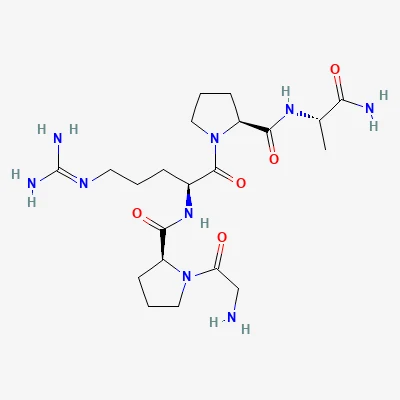
Structure notes: Gly-Pro-Arg-Pro-Ala (GPRPA), all L-amino acids, with a C-terminal amide (alaninamide); free N-terminal amine.
What Is Pentapeptide-3?
Pentapeptide-3 is a synthetic linear peptide of five amino acids, glycine, proline, arginine, proline and alanine, with an amidated C-terminus. It is sold as an ingredient for cosmetic formulations and is identified by the name pentapeptide-3 in cosmetic ingredient nomenclature.
Peer-reviewed data on pentapeptide-3 are essentially absent. A PubMed search for this page found no studies that specifically examine this molecule as of October 2026. Statements about how it works or what it does in skin therefore rest on manufacturer materials rather than on independent published research, and they are not repeated here.
Chemical Structure and Molecular Identity
Pentapeptide-3 is glycyl-L-prolyl-L-arginyl-L-prolyl-L-alaninamide, written in three-letter code as Gly-Pro-Arg-Pro-Ala-NH2. PubChem (CID 11605666) lists the molecular formula C21H37N9O5 and a molecular weight of 495.6 g/mol.
All four chiral residues are in the L-configuration, and glycine is achiral. The N-terminus is a free amine, and the C-terminal alanine carries an amide in place of the usual carboxylic acid. The two proline residues restrict backbone flexibility, and the arginine side chain carries a guanidino group. The molecule is highly polar, with a computed XLogP of -3.4 in PubChem.
Residue composition
| Position | Residue | Note |
|---|---|---|
| 1 | Glycine (G) | Free N-terminal amine; achiral |
| 2 | L-Proline (P) | Cyclic side chain |
| 3 | L-Arginine (R) | Basic guanidino side chain |
| 4 | L-Proline (P) | Cyclic side chain |
| 5 | L-Alanine (A) | C-terminal amide |
Key identifiers
- CAS number: 135679-88-8
- InChIKey: BYWJFRMLHFQWSR-AJNGGQMLSA-N
- Systematic name: glycyl-L-prolyl-L-arginyl-L-prolyl-L-alaninamide
- Short form: GPRPA-NH2
Pentapeptide-3 is often sold as an acetate or trifluoroacetate salt, and these salt forms have different formula weights from the free peptide listed above.
What the Published Literature Covers
No peer-reviewed studies on pentapeptide-3 itself were found in PubMed as of October 2026. There are no indexed cell, animal or human studies of this sequence to summarize.
Part of the confusion around the name comes from a similarly named but unrelated ingredient. Palmitoyl pentapeptide-3 was an earlier name for the lipopeptide Pal-KTTKS (palmitoyl-lysine-threonine-threonine-lysine-serine), which is now usually called palmitoyl pentapeptide-4. The only article returned by the PubMed search for this page concerned analogues of that KTTKS peptide, not Gly-Pro-Arg-Pro-Ala-NH2, and it was excluded.
Readers comparing sources should check the sequence rather than the name. A study or label describing a palmitoylated KTTKS peptide does not apply to pentapeptide-3.
With no published reference data, researchers typically rely on HPLC and mass spectrometry certificates of analysis to confirm pentapeptide-3 identity and purity.
Regulatory and Research Status
Pentapeptide-3 is not an FDA-approved drug. It is used as a cosmetic ingredient and has not been studied in drug-development clinical trials.
With no peer-reviewed literature, its biological activity, skin penetration and safety profile have not been independently characterized. Any future research would need to establish basic properties, such as stability in formulations and activity in standardized cell or skin models, before effects in people could be assessed.
The name itself carries little structural information. In cosmetic ingredient nomenclature, a name such as pentapeptide-3 indicates the number of residues plus an identifying number, not the sequence. This is why unrelated molecules share similar names, and why the sequence and CAS number (135679-88-8) are the reliable way to identify this compound.
Commonly Supplied Research Formats
Pentapeptide-3 is listed by 2 of the 11 major U.S. research-peptide suppliers we track. The most commonly listed formats are:
- 200mg
Supplier catalog survey, October 2026. Quantities refer to net peptide per vial as labeled.
Frequently Asked Questions
What is the molecular weight of pentapeptide-3?
PubChem lists pentapeptide-3 (CID 11605666) with a molecular weight of 495.6 g/mol and the molecular formula C21H37N9O5. That value applies to the free peptide, Gly-Pro-Arg-Pro-Ala-NH2. Acetate or trifluoroacetate salt forms have higher formula weights. Its CAS number is 135679-88-8 and its InChIKey is BYWJFRMLHFQWSR-AJNGGQMLSA-N.
Is pentapeptide-3 the same as palmitoyl pentapeptide-3?
No. Pentapeptide-3 is Gly-Pro-Arg-Pro-Ala-NH2, a short unacylated peptide. Palmitoyl pentapeptide-3 was an earlier name for Pal-KTTKS, a palmitoylated lysine-threonine-threonine-lysine-serine peptide now usually called palmitoyl pentapeptide-4. The two have different sequences, structures and molecular weights, so research on one does not apply to the other.
Is pentapeptide-3 FDA approved?
No. Pentapeptide-3 is not an FDA-approved drug and has not been tested in drug-development clinical trials. It is used as a cosmetic ingredient. No peer-reviewed studies specifically on pentapeptide-3 were found in PubMed as of October 2026, so its activity and safety have not been independently characterized in published research.
What does the research on pentapeptide-3 show?
There is no peer-reviewed research to summarize. A PubMed search found no studies on Gly-Pro-Arg-Pro-Ala-NH2 as of October 2026. Descriptions of how pentapeptide-3 works come from manufacturer materials rather than independent publications. The only search result concerned an unrelated KTTKS lipopeptide that shares part of the name.
Related Compounds
This profile summarizes chemical data and peer-reviewed literature for educational and laboratory-research reference. It is not medical advice, and nothing here describes or recommends use in humans or animals. How we source and verify data.