Thymogen
Also known as: Glu-Trp · Thymagen
Thymogen is a synthetic dipeptide, L-glutamyl-L-tryptophan (Glu-Trp), with the formula C16H19N3O5 and a molecular weight of 333.34 g/mol. Its international nonproprietary name is oglufanide. The dipeptide was first isolated from a calf thymus peptide complex and studied as an immunomodulator. Published research consists mainly of rodent, rabbit and laboratory studies. It is not an FDA-approved drug.
Last reviewed · Identity data matched to PubChem · 7 peer-reviewed sources
Key facts
- Class: short peptide bioregulator; synthetic thymic dipeptide
- Sequence: H-Glu-Trp-OH (L-alpha-glutamyl-L-tryptophan), two residues
- Formula C16H19N3O5; molecular weight 333.34 g/mol (PubChem CID 100094)
- INN: oglufanide; CAS 38101-59-6; other identifiers include NSC 334073
- Origin: isolated from the calf thymic peptide complex thymalin by reverse-phase HPLC
- Evidence base: rat, mouse and rabbit models, Caco-2 cell work and chemistry studies
- Regulatory status: not approved by the FDA
Chemical Identity
| Molecular formula | C16H19N3O5 |
|---|---|
| Molecular weight | 333.34 g/mol |
| Monoisotopic mass | 333.1325 Da |
| CAS number | 38101-59-6 |
| PubChem CID | 100094 |
| UNII | 4RHY598T5U |
| InChIKey | LLEUXCDZPQOJMY-AAEUAGOBSA-N |
| Length | 2 amino acids |
| Compound type | Peptide |
| H-bond donors / acceptors | 5 / 6 |
| XLogP3 | -2.7 |
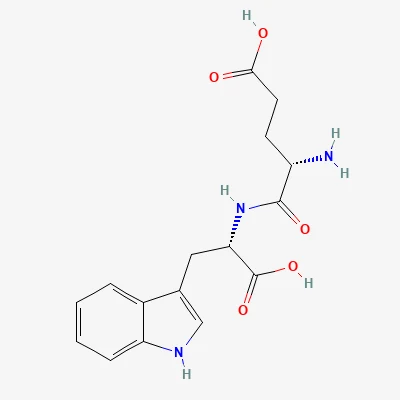
Sequence: EW
No modifications; free N-terminal amine and free C-terminal carboxylic acid, joined by an alpha-peptide bond. Some studies used the sodium salt (Glu-Trp-ONa).
What Is Thymogen?
Thymogen is the dipeptide L-glutamyl-L-tryptophan, a two-residue immunomodulatory peptide originally identified in calf thymus extract. Researchers isolated the molecule from the natural thymic peptide complex thymalin using reverse-phase high-performance liquid chromatography, then synthesized it and designed a pharmaceutical preparation around it.[1]
The compound carries the international nonproprietary name oglufanide and is also written as Glu-Trp, EW dipeptide or H-Glu-Trp-OH. It belongs to the group often called short peptide bioregulators, which also includes molecules such as vilon (Lys-Glu) and epitalon (Ala-Glu-Asp-Gly).
Most published work on Thymogen falls into four areas: immune and aging studies in rats, tissue-repair models in rabbits and rats, stereochemistry studies in mice, and chemistry work aimed at improving the dipeptide’s poor membrane permeability. Human clinical data are not represented in the abstracts reviewed for this page.
Chemical Structure and Molecular Identity
Thymogen is a linear dipeptide of L-glutamic acid and L-tryptophan with a free amino terminus and a free carboxyl terminus. PubChem (CID 100094) lists the molecular formula C16H19N3O5, a molecular weight of 333.34 g/mol and the InChIKey LLEUXCDZPQOJMY-AAEUAGOBSA-N. The primary CAS number is 38101-59-6; PubChem also lists 122933-59-9 among the compound’s registry numbers.
The molecule is highly polar, with a computed XLogP of -2.7, because the glutamyl side chain and the C-terminus both carry carboxylic acid groups. A 2008 study described L-Glu-L-Trp as a hydrophilic compound with low membrane permeability, which limits its passage across intestinal cells.[2]
Isomers and related molecules
Stereochemistry matters for this dipeptide. A mouse study compared all four optical isomers (L-L, L-D, D-L and D-D) of alpha-linked Glu-Trp, along with gamma-linked analogs, and found that their effects on bone marrow stem cells depended on the optical orientation of glutamic acid and the type of peptide bond.[3] Thymogen corresponds to the L-L, alpha-linked form. The gamma-glutamyl isomer and the reversed sequence Trp-Glu are distinct compounds.
The tryptophan indole ring also makes the molecule a target for synthetic chemistry. A 2023 paper used oglufanide as a substrate to demonstrate metal-free, site-selective C7-H borylation of tryptophan in finished peptides.[4]
Research History and Development
Thymogen emerged from work on thymus-derived peptide extracts, when L-Glu-L-Trp was identified as an active component of the thymalin complex. A 2000 paper by Anisimov, Khavinson and Morozov describes this isolation and the subsequent design of a pharmaceutical containing the synthetic dipeptide.[1]
Later research moved in several directions. A gerontology review compared thymic peptides, including thymalin and Thymogen, with pineal peptides and concluded that the pineal peptides had the stronger effect on age-related thymus involution than the thymic peptides had on pineal involution.[5]
Medicinal chemists also tried to address the dipeptide’s poor oral uptake. In the 2008 study, researchers built a library of Glu-Trp derivatives carrying lipoamino acid or sugar groups and tested their stability and permeability in Caco-2 intestinal cell models before an initial rat absorption experiment.[2] More recent work has produced analogs with an added D-alanine residue at either terminus.[6]
A parallel line of research examined tissue repair. A 2015 rabbit study compared the sodium salt of Glu-Trp with an acylated version of the same dipeptide in chronic skin wounds and reported that acylation improved the dipeptide’s healing performance. That study, and the 2023 liver-injury work with D-alanine analogs, show a shift from the original immune and aging questions toward structure-activity comparisons between Thymogen and modified derivatives.[7][6]
Mechanisms Studied in Research
Research attributes Thymogen’s activity mainly to effects on T cells and neutrophils, with later studies adding matrix metalloproteinase and antioxidant measures. The original characterization reported that the dipeptide activated T-cell differentiation and T-cell recognition of peptide-MHC complexes, changed intracellular cyclic nucleotide levels, and activated neutrophil chemotaxis and phagocytosis.[1]
- Matrix metalloproteinases: in a rabbit chronic wound model, the sodium salt of Glu-Trp and an acylated analog lowered MMP-9, MMP-8 and MMP-2 activity in the early inflammatory phase and raised MMP-9, MMP-8 and MMP-1 activity during remodeling.[7]
- Oxidative stress: in a rat model of carbon tetrachloride liver injury, Thymogen and its analogs suppressed lipid peroxidation, measured by malondialdehyde, and counteracted the drop in catalase activity.[6]
- Stem cell responses: in mice, L-glutamyl isomers were inert toward committed bone marrow colony-forming units, while D-glutamyl isomers inhibited them.[3]
None of these studies identified a specific receptor for the dipeptide. The available abstracts describe downstream cellular effects rather than a defined molecular binding target.
Key Findings From Published Studies
Published findings on Thymogen come from animal models and laboratory systems; the reviewed abstracts include no controlled human trials. The main results are summarized below by model.
Aging and spontaneous tumors in rats
In a study of 76 outbred female rats given long-term treatment with L-Glu-L-Trp or saline and followed until natural death, mean lifespan did not differ between groups. The longest-lived 10% of treated rats, however, survived 1,048 days on average versus 949 days in controls, and the Gompertz aging-rate parameter was lower in the treated group. Total tumor incidence was 1.5 times lower, malignant tumor incidence 1.7 times lower, and leukemias and lymphomas 3.4 times lower in treated rats.[1]
Wound healing in rabbits
In a rabbit model of nonhealing dermal wounds, assessed by wound closure, zymography and histology, both Glu-Trp-ONa and its acylated analog shortened healing time compared with saline and with a reference wound-healing agent. Histology showed more granulation tissue and re-epithelialization, and the acylated analog performed better than the parent dipeptide.[7]
Liver injury in rats
In acute carbon tetrachloride hepatopathy, Thymogen stimulated hepatocyte regeneration and reduced oxidative markers. Analogs with D-alanine added to the molecule produced stronger hepatotropic and antioxidant effects than Thymogen itself, with the C-terminal addition performing best.[6]
Absorption and stability
Several lipid and sugar conjugates of Glu-Trp showed greater resistance to enzymatic breakdown in Caco-2 homogenates and higher apparent permeability, and one conjugate released the parent dipeptide after crossing Caco-2 monolayers. The conjugates showed no red blood cell toxicity in a hemolysis assay.[2]
Because Glu-Trp isomers behave differently in experiments, researchers typically confirm identity and stereochemistry with HPLC and mass spectrometry data on a certificate of analysis.
Regulatory and Research Status
Thymogen (oglufanide) is not approved by the US Food and Drug Administration and is handled as a research compound in the United States. Its published record is small and concentrated in gerontology and experimental medicine journals, alongside a few chemistry and drug-delivery papers.
Key gaps remain. The abstracts reviewed here contain no randomized human trials, no defined receptor or binding target, and limited pharmacokinetic data beyond cell-based permeability work. The rat lifespan and tumor findings come from a single study and have not been confirmed in independent replications within this source set.[1]
Because isomers of Glu-Trp behave differently in experimental systems, researchers working with the compound typically confirm that material is the L-L, alpha-linked form.[3] Results reported for the sodium salt or acylated and D-alanine analogs should not be treated as interchangeable with the free dipeptide.
Commonly Supplied Research Formats
Thymogen is listed by 2 of the 11 major U.S. research-peptide suppliers we track. The most commonly listed formats are:
- 20mg
Supplier catalog survey, October 2026. Quantities refer to net peptide per vial as labeled.
Frequently Asked Questions
What is Thymogen made of?
Thymogen is a dipeptide made of two amino acids, L-glutamic acid and L-tryptophan, joined by a standard alpha-peptide bond (Glu-Trp). It was originally isolated from thymalin, a peptide complex extracted from calf thymus, and is now produced synthetically. PubChem lists its formula as C16H19N3O5.
What is the molecular weight of Thymogen?
The molecular weight of Thymogen is 333.34 g/mol, according to PubChem (CID 100094). Its molecular formula is C16H19N3O5 and its InChIKey is LLEUXCDZPQOJMY-AAEUAGOBSA-N. Some studies use the sodium salt, Glu-Trp-ONa, which has a slightly different weight from the free dipeptide form.
Is Thymogen the same as oglufanide?
Yes. Oglufanide is the international nonproprietary name for L-glutamyl-L-tryptophan, the same dipeptide known as Thymogen. PubChem lists Thymogen, oglufanide, Glu-Trp, EW dipeptide and H-Glu-Trp-OH as synonyms for CID 100094. The gamma-glutamyl isomer and the reversed sequence Trp-Glu are different molecules.
How is Thymogen different from thymalin?
Thymalin is a complex mixture of peptides extracted from calf thymus, while Thymogen is a single defined dipeptide, L-Glu-L-Trp. Researchers isolated Glu-Trp from the thymalin complex by reverse-phase HPLC and then synthesized it, so Thymogen can be described as one identified component derived from the broader extract.
Is Thymogen FDA approved?
No. Thymogen, also called oglufanide, is not approved by the US Food and Drug Administration for any use. In the United States it is handled as a research compound. Its published literature consists mainly of animal, cell and chemistry studies rather than controlled human clinical trials.
What does the research on Thymogen show?
Research on Thymogen is mostly preclinical. A rat study reported longer survival among the longest-lived animals and fewer spontaneous tumors with long-term treatment. Rabbit studies reported faster healing of chronic skin wounds, and a rat study reported reduced oxidative markers in chemically induced liver injury. Independent human trial data are lacking.
References
- Anisimov VN, Khavinson VK, Morozov VG. Immunomodulatory synthetic dipeptide L-Glu-L-Trp slows down aging and inhibits spontaneous carcinogenesis in rats. Biogerontology 2000. PMID 11707921 · DOI
- Bergeon JA, Chan YN, Charles BG, et al. Oral absorption enhancement of dipeptide L-Glu-L-Trp-OH by lipid and glycosyl conjugation. Biopolymers 2008. PMID 18428206 · DOI
- Semina OV, Semenets TN, Zamulaeva IA, et al. Effects of structural and "mixed" isomers of Glu-Trp dipeptide on normal hemopoietic stem cells. Bulletin of experimental biology and medicine 2006. PMID 16984110 · DOI
- Meena R, Shekhar S, Ansari SB, et al. Metal-free sp2 -C7-H Borylation of Tryptophan Containing Peptides and Late-stage Modification. Chemistry, an Asian journal 2023. PMID 37847482 · DOI
- Lin'kova NS, Poliakova VO, Kvetnoĭ IM, et al. [Characteristics of the pineal gland and thymus relationship in aging]. Advances in gerontology = Uspekhi gerontologii 2011. PMID 21809618
- Chulanova AA, Smakhtin MY, Bobyntsev II, et al. Reparative and Antioxidant Effects of New Analogues of Immunomodulator Thymogen in Experimental Model of Liver Damage. Bulletin of experimental biology and medicine 2023. PMID 37861903 · DOI
- Shevtsov MA, Smagina LV, Kudriavtceva TA, et al. Glu-Trp-ONa or its acylated analogue (R-Glu-Trp-ONa) administration enhances the wound healing in the model of chronic skin wounds in rabbits. Drug design, development and therapy 2015. PMID 25848208 · DOI
Related Compounds
This profile summarizes chemical data and peer-reviewed literature for educational and laboratory-research reference. It is not medical advice, and nothing here describes or recommends use in humans or animals. How we source and verify data.