Epitalon (Epithalon)
Also known as: Epithalon · Ala-Glu-Asp-Gly · AEDG peptide
Epitalon (also spelled Epithalon) is a synthetic tetrapeptide with the sequence Ala-Glu-Asp-Gly (AEDG), designed from the amino acid composition of a bovine pineal gland extract. It is a short peptide bioregulator studied in cell cultures and animal models for effects on telomerase, oxidative stress, cell aging and lifespan. It is not an FDA-approved drug.
Last reviewed · Identity data matched to PubChem · 9 peer-reviewed sources
Key facts
- Class: short peptide bioregulator (synthetic tetrapeptide)
- Sequence: Ala-Glu-Asp-Gly (AEDG), four L-amino acids with free termini
- Origin: designed from the amino acid composition of epithalamin, a bovine pineal extract
- Formula C14H22N4O9; molecular weight 390.35 g/mol (PubChem CID 219042)
- CAS 307297-39-8; UNII O65P17785G
- Evidence base: in-vitro, animal and in-silico studies; no large controlled human trials of the synthetic peptide
- Regulatory status: not FDA approved; no approved medical indication in the United States
Chemical Identity
| Molecular formula | C14H22N4O9 |
|---|---|
| Molecular weight | 390.35 g/mol |
| Monoisotopic mass | 390.1387 Da |
| CAS number | 307297-39-8 |
| PubChem CID | 219042 |
| UNII | O65P17785G |
| InChIKey | HGHOBRRUMWJWCU-FXQIFTODSA-N |
| Length | 4 amino acids |
| Compound type | Peptide |
| H-bond donors / acceptors | 7 / 10 |
| XLogP3 | -5.5 |
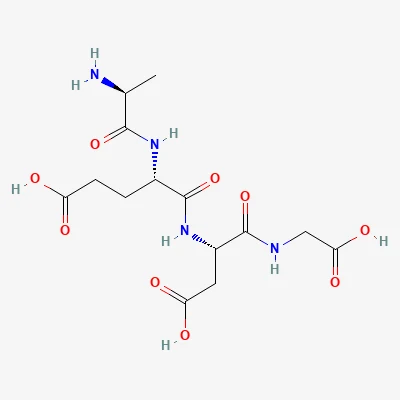
Sequence: AEDG
Free N-terminal amine and free C-terminal carboxylic acid; no modifications.
What Is Epitalon?
Epitalon is a synthetic tetrapeptide, Ala-Glu-Asp-Gly (AEDG), studied as a pineal-derived short peptide bioregulator with antioxidant, neuroendocrine and anti-aging activity in laboratory models. It is also spelled Epithalon or Epithalone.[1]
The peptide was synthesized based on the amino acid composition of epithalamin, a polypeptide extract of bovine pineal gland, and was later identified in pineal polypeptide complex solution itself. Over roughly 25 years it has been examined with in-vitro, in-vivo and in-silico methods, and reviewers describe geroprotective and neuroendocrine effects attributed to antioxidant, neuroprotective and antimutagenic actions.[1]
Epitalon is one of several short peptides, typically two to four amino acids long, designed by Vladimir Khavinson and colleagues as chemically defined counterparts to tissue extracts.[2] Most early work came from this Russian research school, but other research groups have published cell studies on it in recent years.[3][4]
Chemical Structure and Molecular Identity
Epitalon is a linear peptide of four L-amino acids, alanine, glutamic acid, aspartic acid and glycine, with a free amine at the N-terminus and a free carboxylic acid at the C-terminus. PubChem (CID 219042) lists the molecular formula C14H22N4O9 and a molecular weight of 390.35 g/mol.
Two acidic residues (glutamate and aspartate) make the molecule highly polar and negatively charged at neutral pH. PubChem’s computed XLogP of -5.5 reflects high water solubility. A 2025 review notes that despite extensive biological research, physico-chemical and structural studies of epitalon remain quite limited.[1]
Key identifiers
- CAS number: 307297-39-8 (PubChem also lists 64082-79-7)
- InChIKey: HGHOBRRUMWJWCU-FXQIFTODSA-N
- UNII: O65P17785G
- Synonyms: Epithalon, Epithalone, AEDG peptide, L-alanyl-L-glutamyl-L-aspartyl-glycine
Epitalon is distinct from epithalamin, the pineal extract it was modeled on. The extract is a mixture of polypeptides, while epitalon is a single defined molecule. It is also distinct from N-acetyl epitalon, a modified analog with an acetyl group on the N-terminus.
Research History and Development
Epitalon emerged from decades of Russian research on tissue-derived peptide preparations, beginning with the pineal extract epithalamin and moving to small synthetic peptides designed from those extracts.
A 2002 review by Khavinson summarized work on epithalamin, reporting that the extract increased melatonin production by the pineal gland of rats, improved immunological parameters in rodents, produced anticarcinogenic effects in experimental models and increased lifespan in rats, mice and fruit flies. The same review described how amino acid composition data from such extracts led to principles for designing short peptides with tissue-specific activity, including tetrapeptides that stimulated outgrowth of pineal explants in vitro.[2] These findings concern the extract, not synthetic epitalon, and should not be transferred to it automatically.
Research on the synthetic tetrapeptide then expanded to rodent lifespan and tumor studies, organ function in aged animals and, more recently, cell-culture work on telomeres, stem cells and oocytes.[5][6][4] A 2026 orthopaedics review grouped epithalon with pinealon and delta sleep-inducing peptide as agents discussed for circadian and mitochondrial targets, while noting the lack of clinical trials for this class.[7]
Mechanisms Studied in Research
Proposed mechanisms for epitalon include telomerase activation, antioxidant effects, influence on melatonin synthesis and epigenetic regulation of gene expression. Reviewers caution that it remains uncertain whether these account for all of its reported effects.[1]
Telomerase and telomere length
In a 2025 study using normal human epithelial cells, fibroblasts and the breast cancer cell lines 21NT and BT474, epitalon produced concentration-dependent telomere lengthening in normal cells through increased hTERT mRNA expression and telomerase activity. In the cancer cell lines, telomere extension occurred mainly through the alternative lengthening of telomeres (ALT) pathway, which was only slightly increased in normal cells.[4]
Neuroendocrine and enzyme effects
A 2025 review lists direct influence on melatonin synthesis, changes in interleukin-2 mRNA levels, modulation of mitogenic activity in murine thymocytes and enhanced activity of acetylcholinesterase, butyrylcholinesterase and telomerase among reported effects.[1]
Gene regulation and differentiation
Khavinson’s group proposes that short peptides cross cell and nuclear membranes and regulate gene expression epigenetically by interacting with histones, influencing gene methylation or binding DNA directly. In this framework, AEDG has been reported to induce differentiation of pluripotent cells toward epidermal, mesenchymal and nervous tissue lineages, and to activate neural differentiation specifically. The same review reports that AEDG also induced differentiation in plant cells, alongside the related peptides KE and AEDL.[8]
Mitochondria and oxidative stress
In aging mouse oocytes in vitro, epitalon lowered intracellular reactive oxygen species and raised mitochondrial membrane potential, which the authors linked to reduced apoptosis.[3]
Key Findings From Published Studies
Most published evidence on synthetic epitalon comes from cell-culture and rodent studies; controlled human trials of the synthetic peptide are not represented in the indexed abstracts reviewed here.
In-vitro studies
- Telomeres: in normal human epithelial cells and fibroblasts, epitalon extended telomere length via hTERT and telomerase upregulation; cancer cell lines showed ALT-mediated extension.[4]
- Oocyte aging: in post-ovulatory aging mouse oocytes, epitalon reduced spindle defects and abnormal cortical granule distribution at 12 and 24 hours, increased mitochondrial DNA copy number and decreased apoptosis by 24 hours.[3]
- Stem cell senescence: in human periodontal ligament and gingival mesenchymal stem cells at the 25th passage, AEDG lowered p16 and p21 senescence-marker mRNA by 1.56 to 2.44 times compared with untreated controls, a result confirmed by immunofluorescence. The authors proposed AEDG as a culture-medium additive to delay senescence during long-term stem cell expansion.[9]
Animal studies
- Lifespan and tumors in rats: in female rats kept under standard, natural (North-Western Russia) or constant light, epitalon did not change lifespan under the standard light regimen. Under natural and constant light, it extended maximum lifespan by 95 and 24 days, respectively, and significantly inhibited spontaneous tumor development only in the natural-light group.[5]
- Kidney function in old rats: AEDG reduced glomerular filtration rate by 21%, urine protein level by 3.1 times and protein excretion by 2.5 times, reduced absolute sodium reabsorption by 1.3 times and increased distal sodium transport by 1.4 times. Kidney tissue showed stimulated antioxidant enzyme activity and no morphological signs of nephrotoxicity.[6]
Human evidence
Clinical reports of geroprotective activity in the older Russian literature concern the pineal extract epithalamin rather than synthetic epitalon.[2] Recent reviews note that clinical trials for peptides in this group are lacking.[7]
Because epitalon and its N-acetyl analog differ by one group, researchers typically confirm identity with HPLC and mass spectrometry certificates of analysis.
Regulatory and Research Status
Epitalon is not approved by the US Food and Drug Administration for any medical use and has no approved indication in the United States. It is available as a research chemical and remains an investigational compound.
The research base has broadened beyond the original Russian school, with recent cell studies from other groups on telomere biology and oocyte quality.[4][3] Still, key gaps remain: structural and physico-chemical data are limited,[1] human pharmacokinetic data are not described in the abstracts reviewed, and the rodent lifespan findings depended strongly on lighting conditions.[5]
The finding that epitalon can extend telomeres through the ALT pathway in cancer cell lines is relevant to safety research, since telomere maintenance is a feature of many tumors.[4] Independent, controlled studies would be needed to clarify how cell and animal findings translate to living human tissue.
Commonly Supplied Research Formats
Epitalon is listed by 10 of the 11 major U.S. research-peptide suppliers we track. The most commonly listed formats are:
- 10mg
- 50mg
- 25mg
- 3mg x 60 (capsules)
- 100mg
- 5mg
Supplier catalog survey, October 2026. Quantities refer to net peptide per vial as labeled.
Frequently Asked Questions
Is Epitalon the same as Epithalon?
Yes. Epitalon, Epithalon and Epithalone are spellings of the same synthetic tetrapeptide, Ala-Glu-Asp-Gly (AEDG). PubChem lists all three under CID 219042. It should not be confused with epithalamin, the bovine pineal extract it was modeled on, or with N-acetyl epitalon, a chemically modified analog.
What is the molecular weight of Epitalon?
PubChem lists Epitalon (CID 219042) with a molecular weight of 390.35 g/mol and the molecular formula C14H22N4O9. Its primary CAS number is 307297-39-8. These values refer to the free tetrapeptide with an unmodified N-terminal amine and C-terminal carboxylic acid.
Is Epitalon FDA approved?
No. Epitalon is not approved by the US Food and Drug Administration for any medical use and has no approved indication in the United States. It is sold as a research chemical and studied as an investigational short peptide in cell culture and animal models.
Does Epitalon increase telomere length?
In cell culture, yes. A 2025 study found that epitalon lengthened telomeres in normal human epithelial cells and fibroblasts by increasing hTERT expression and telomerase activity. In breast cancer cell lines, telomere extension occurred mainly through the ALT pathway. These are in-vitro results and have not been confirmed in controlled human studies.
What is the difference between Epitalon and epithalamin?
Epitalon is a single synthetic tetrapeptide, Ala-Glu-Asp-Gly. Epithalamin is a polypeptide extract of bovine pineal gland. Epitalon was designed from the amino acid composition of that extract. Much of the older animal and clinical literature, including lifespan studies in several species, concerns epithalamin rather than synthetic epitalon.
What does the research on Epitalon show?
Published research is mostly preclinical. Cell studies report telomere lengthening, lower senescence markers in stem cells and protection of aging mouse oocytes. In female rats, epitalon extended maximum lifespan under natural and constant light but not under a standard light cycle. Controlled human trials of the synthetic peptide are lacking.
References
- Araj SK, Brzezik J, Mądra-Gackowska K, et al. Overview of Epitalon-Highly Bioactive Pineal Tetrapeptide with Promising Properties. International journal of molecular sciences 2025. PMID 40141333 · DOI
- Khavinson VKh. Peptides and Ageing. Neuro endocrinology letters 2002. PMID 12374906
- Yue X, Liu SL, Guo JN, et al. Epitalon protects against post-ovulatory aging-related damage of mouse oocytes in vitro. Aging 2022. PMID 35413689 · DOI
- Al-Dulaimi S, Thomas R, Matta S, et al. Epitalon increases telomere length in human cell lines through telomerase upregulation or ALT activity. Biogerontology 2025. PMID 40908429 · DOI
- Vinogradova IA, Bukalev AV, Zabezhinski MA, et al. Effect of Ala-Glu-Asp-Gly peptide on life span and development of spontaneous tumors in female rats exposed to different illumination regimes. Bulletin of experimental biology and medicine 2007. PMID 18856211 · DOI
- Zamorskii II, Shchudrova TS, Zeleniuk VG, et al. [The influence of peptides on the morphofunctional state of old rats kidneys.]. Advances in gerontology = Uspekhi gerontologii 2018. PMID 30607912
- Rahman OF, Lee SJ, Seeds WA. Therapeutic Peptides in Orthopaedics: Applications, Challenges, and Future Directions. Journal of the American Academy of Orthopaedic Surgeons. Global research & reviews 2026. PMID 41490200 · DOI
- Khavinson V, Linkova N, Diatlova A, et al. Peptide Regulation of Cell Differentiation. Stem cell reviews and reports 2020. PMID 31808038 · DOI
- Sinjari B, Diomede F, Khavinson V, et al. Short Peptides Protect Oral Stem Cells from Ageing. Stem cell reviews and reports 2020. PMID 31677028 · DOI
Related Compounds
This profile summarizes chemical data and peer-reviewed literature for educational and laboratory-research reference. It is not medical advice, and nothing here describes or recommends use in humans or animals. How we source and verify data.