Crystagen
Also known as: Pro-Glu-Asp
Crystagen is a synthetic tripeptide bioregulator identified as Pro-Glu-Asp (L-prolyl-L-glutamyl-L-aspartic acid), with molecular formula C14H21N3O8 and molecular weight 359.33 g/mol. It is grouped with the short peptide bioregulators such as vilon. Peer-reviewed data are very limited: one indexed study reports effects on spleen immune cells during aging. Crystagen is not approved by the FDA for any use.
Last reviewed · Identity data matched to PubChem · 1 peer-reviewed sources
Key facts
- Class: short peptide bioregulator (synthetic tripeptide)
- Sequence: Pro-Glu-Asp (PED), three L-amino acids with free termini
- Formula C14H21N3O8; molecular weight 359.33 g/mol
- PubChem CID 145457458; InChIKey MGDFPGCFVJFITQ-CIUDSAMLSA-N; no CAS number listed
- Literature: one indexed study, on spleen immune cells during aging
- Regulatory status: not approved by the FDA for any use
Chemical Identity
| Molecular formula | C14H21N3O8 |
|---|---|
| Molecular weight | 359.33 g/mol |
| Monoisotopic mass | 359.1329 Da |
| PubChem CID | 145457458 |
| InChIKey | MGDFPGCFVJFITQ-CIUDSAMLSA-N |
| Length | 3 amino acids |
| Compound type | Peptide |
| H-bond donors / acceptors | 6 / 9 |
| XLogP3 | -5.7 |
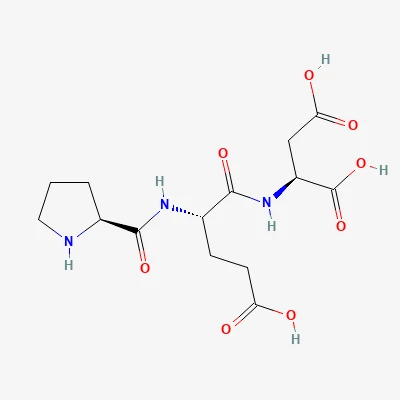
Sequence: PED
No modifications; free N-terminal amine (on proline) and free C-terminal carboxylic acid, consistent with PubChem CID 145457458 (C14H21N3O8).
What Is Crystagen?
Crystagen is a synthetic tripeptide, Pro-Glu-Asp, classed among the short peptide bioregulators. In the one indexed study that names it, crystagen was examined alongside vilon and other short peptides for immune effects in the spleen during aging[1].
Peer-reviewed data on crystagen are limited. A search of PubMed returned only one article that clearly concerns this compound, so its biological profile is largely uncharacterized in the published record.
Chemical Structure and Molecular Identity
Crystagen corresponds to the linear tripeptide L-prolyl-L-glutamyl-L-aspartic acid, with a free N-terminal amine on proline and a free C-terminal carboxylic acid. PubChem lists this structure as Pro-Glu-Asp under CID 145457458, with molecular formula C14H21N3O8, molecular weight 359.33 g/mol and InChIKey MGDFPGCFVJFITQ-CIUDSAMLSA-N. No CAS number is listed in that record, and the PubChem synonyms do not include the name Crystagen.
| Position | Residue | Side-chain character |
|---|---|---|
| 1 (N-terminus) | Proline (P) | Cyclic, conformationally constrained |
| 2 | Glutamic acid (E) | Acidic, negatively charged |
| 3 (C-terminus) | Aspartic acid (D) | Acidic, negatively charged |
With two acidic side chains plus the C-terminal carboxyl group and one secondary amine, the tripeptide carries a net negative charge at neutral pH. PubChem’s computed descriptors list an exact mass of 359.13286464 Da, an XLogP of -5.7, 6 hydrogen-bond donors, 9 hydrogen-bond acceptors, 10 rotatable bonds and a topological polar surface area of 182 Ų, describing a very hydrophilic molecule. The same structure is cross-referenced in ChEBI as CHEBI:162265. The Glu-Asp motif it contains also appears in other short bioregulator peptides, such as bronchogen (Ala-Glu-Asp-Leu) and vesugen (Lys-Glu-Asp).
What the Published Literature Covers
The indexed literature on crystagen consists of a single 2014 paper on immune function in the aging spleen[1]. It appeared in Advances in Gerontology (Uspekhi Gerontologii) as an article with an English-language abstract. No studies of its chemistry, pharmacokinetics or effects in humans were found.
That paper compared several short peptides, including vilon and crystagen, for immunoprotective effects in the spleen during aging. It reported that crystagen activated B cells of the immune system but, unlike some of the other peptides tested, did not produce cell renewal in the aging spleen[1]. By contrast, vilon was reported to activate T-helper cells through reduced apoptosis[1].
The abstract does not specify the experimental model, group sizes or quantitative results, so the strength of these observations cannot be judged from the available record. No independent replication was found.
Other PubMed results for this compound concerned unrelated proteins or peptides that merely contain a Pro-Glu-Asp stretch, such as growth factors and catalytic peptides, and were not used here.
Because crystagen's literature is sparse, researchers typically confirm the Pro-Glu-Asp identity of any material through HPLC and mass spectrometry certificates of analysis.
Regulatory and Research Status
Crystagen is not approved by the U.S. Food and Drug Administration for any medical use and has no published clinical trial record. It remains an essentially uncharacterized research compound.
Because only one indexed study addresses it, basic questions remain open, including its stability, its molecular targets and whether the reported B-cell effects can be reproduced in defined models.
Commonly Supplied Research Formats
Crystagen is listed by 2 of the 11 major U.S. research-peptide suppliers we track. The most commonly listed formats are:
- 20mg
Supplier catalog survey, October 2026. Quantities refer to net peptide per vial as labeled.
Frequently Asked Questions
What is crystagen?
Crystagen is a synthetic tripeptide with the sequence Pro-Glu-Asp, grouped with the short peptide bioregulators. Its molecular formula is C14H21N3O8 and its molecular weight is 359.33 g/mol. Published research on it is very limited, consisting of one indexed study that examined its effects on immune cells in the aging spleen.
What is the molecular weight of crystagen?
Crystagen, the tripeptide Pro-Glu-Asp with free termini, has a molecular weight of 359.33 g/mol and the molecular formula C14H21N3O8. PubChem lists the structure under CID 145457458 with InChIKey MGDFPGCFVJFITQ-CIUDSAMLSA-N. No CAS registry number is given in that record, and the record itself is titled Pro-Glu-Asp rather than Crystagen.
Is crystagen FDA approved?
No. Crystagen is not approved by the U.S. Food and Drug Administration for any medical use. No clinical trials of crystagen were found in PubMed, and the peer-reviewed literature consists of a single study on spleen immune cells during aging. It is regarded as a research compound with very limited published data.
What does the research on crystagen show?
One 2014 study compared several short peptides for immune effects in the aging spleen and reported that crystagen activated B cells but did not cause cell renewal in the spleen as it aged. The abstract does not describe the model or give quantitative results, and no other peer-reviewed studies on crystagen were found.
References
- Сhervyakova NA, Linkova NS, Chalisova NI, et al. [Molecular aspects of immunoprotective activity of peptides in spleen during the ageing process]. Advances in gerontology = Uspekhi gerontologii 2014. PMID 28976144
Related Compounds
This profile summarizes chemical data and peer-reviewed literature for educational and laboratory-research reference. It is not medical advice, and nothing here describes or recommends use in humans or animals. How we source and verify data.