Bronchogen
Also known as: Ala-Glu-Asp-Leu
Bronchogen is a synthetic tetrapeptide bioregulator with the sequence Ala-Glu-Asp-Leu (AEDL), molecular formula C18H30N4O9 and molecular weight 446.5 g/mol. It has been studied in a rat model of chronic obstructive pulmonary disease, in organotypic tissue cultures and in DNA-binding experiments. All published evidence is preclinical, and bronchogen is not approved by the FDA for any use.
Last reviewed · Identity data matched to PubChem · 6 peer-reviewed sources
Key facts
- Class: short peptide bioregulator (synthetic tetrapeptide)
- Sequence: Ala-Glu-Asp-Leu (AEDL), four L-amino acids with free termini
- Formula C18H30N4O9; molecular weight 446.5 g/mol; CAS 857267-12-0
- PubChem CID 11690869
- Research focus: bronchial epithelium, lung inflammation models and DNA binding
- Evidence: rat, tissue-culture, biophysical and plant-cell studies; no human trials found
- Regulatory status: not approved by the FDA for any use
Chemical Identity
| Molecular formula | C18H30N4O9 |
|---|---|
| Molecular weight | 446.5 g/mol |
| Monoisotopic mass | 446.2013 Da |
| CAS number | 857267-12-0 |
| PubChem CID | 11690869 |
| InChIKey | OFZRHTIWKZWPQF-BJDJZHNGSA-N |
| Length | 4 amino acids |
| Compound type | Peptide |
| H-bond donors / acceptors | 7 / 10 |
| XLogP3 | -3.8 |
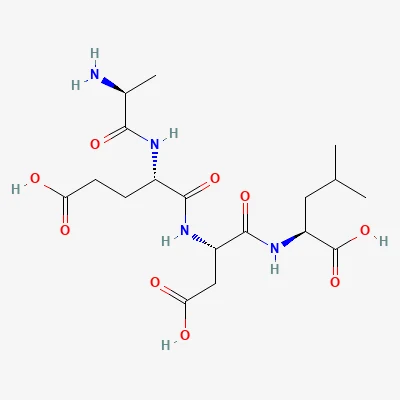
Sequence: AEDL
No modifications; free N-terminal amine and C-terminal carboxylic acid, consistent with PubChem CID 11690869 (C18H30N4O9). One 2011 paper title gives the order as Ala-Asp-Glu-Leu; other sources and PubChem give Ala-Glu-Asp-Leu.
What Is Bronchogen?
Bronchogen is a synthetic tetrapeptide, Ala-Glu-Asp-Leu, studied as a short peptide bioregulator associated with bronchial and lung tissue[1][2]. Research has examined its effects on bronchial epithelium in a rat model of chronic obstructive pulmonary disease (COPD), on tissue explants, and on DNA.
It belongs to a family of short peptides from the same research program that includes epitalon (Ala-Glu-Asp-Gly), pinealon (Glu-Asp-Arg) and vilon (Lys-Glu), several of which have been tested side by side with bronchogen[2][3]. A 2006 rat study grouped it with cardiogen, prostamax and pancragen as tissue-specific synthetic bioregulators[4].
The evidence base is small and entirely preclinical. None of the indexed articles reviewed for this page reports a study of bronchogen in humans. The papers appear mainly in Bulletin of Experimental Biology and Medicine, Biochemistry (Moscow) and Russian physiology and gerontology journals.
Chemical Structure and Molecular Identity
Bronchogen is the linear tetrapeptide L-alanyl-L-glutamyl-L-aspartyl-L-leucine with a free N-terminal amine and a free C-terminal carboxylic acid. Its molecular formula is C18H30N4O9, its molecular weight is 446.5 g/mol, and it is listed in PubChem as CID 11690869 with CAS number 857267-12-0.
| Position | Residue | Side-chain character |
|---|---|---|
| 1 (N-terminus) | Alanine (A) | Small, hydrophobic |
| 2 | Glutamic acid (E) | Acidic, negatively charged |
| 3 | Aspartic acid (D) | Acidic, negatively charged |
| 4 (C-terminus) | Leucine (L) | Branched, hydrophobic |
With two acidic side chains plus the C-terminal carboxyl group and only one basic amine, bronchogen carries a net negative charge at neutral pH. PubChem’s computed descriptors list an exact mass of 446.20127855 Da, an XLogP of -3.8, 7 hydrogen-bond donors, 10 hydrogen-bond acceptors, 14 rotatable bonds and a topological polar surface area of 225 Ų, describing a flexible, highly polar molecule. Bronchogen differs from epitalon (Ala-Glu-Asp-Gly) only at the fourth position, where leucine replaces glycine.
One 2011 paper gives the sequence in its title as Ala-Asp-Glu-Leu[5]. Other studies, and the PubChem structure, give Ala-Glu-Asp-Leu[2][3].
Research History and Development
Bronchogen appears in the indexed literature from 2006 to 2017, moving from tissue-culture work to DNA-binding studies and then to a rat COPD model. Several papers list V. Kh. Khavinson as a co-author, while the two COPD studies come from a separate author group led by N. A. Kuzubova and O. N. Titova[1][6].
In 2006, an organotypic culture study applied bronchogen, cardiogen, prostamax and pancragen to explants of lung, heart, prostate and pancreas from young (3-week-old) and aged (18-month-old) rats, and reported stimulating effects in the matching tissue cultures[4]. In 2011, two biophysical papers examined how bronchogen interacts with DNA, one by differential scanning microcalorimetry and one by fluorescence quenching[5][2].
The rat COPD model studies followed in 2015 and 2017[1][6]. They were designed to test whether the peptide could restore the immune and barrier function of the bronchial epithelium and limit progression of lung inflammation[1]. A 2017 study extended the work to plants, testing bronchogen, epitalon and vilon in tobacco callus cultures[3].
Mechanisms Studied in Research
Proposed mechanisms center on direct binding of bronchogen to DNA and possible epigenetic regulation of gene expression. These proposals come from biophysical and plant-cell experiments rather than from lung tissue itself.
DNA stabilization
In differential scanning microcalorimetry experiments, bronchogen acted as a DNA-stabilizing agent, raising the melting temperature of calf thymus and mouse liver DNA by 3.1 °C within a narrow range of peptide-to-base-pair molar ratios (0.01 to 0.055); higher ratios produced no further change, and melting enthalpy was unaffected[5]. The authors concluded that bronchogen is not specific for adenine-thymine or guanine-cytosine pairs and binds both DNA strands, mainly at nitrogen bases.
Sequence-preferential oligonucleotide binding
In fluorescence-quenching studies with labeled deoxyribooligonucleotides, bronchogen, epitalon and pinealon bound preferentially to sequences containing CNG sites, which are targets for cytosine methylation in eukaryotes. Bronchogen showed a preference for CTG-containing sequences, whereas epitalon, testagen and pinealon favored CAG-containing sequences[2]. The authors proposed that such site-specific peptide-DNA interactions could regulate gene activity epigenetically.
Epithelial barrier and local immunity
In the rat COPD model, the authors linked bronchogen’s effects to restored immune and barrier function of the bronchial epithelium: higher secretory IgA as a marker of local immunity, higher surfactant protein B, which reduces alveolar surface tension, and a shift away from neutrophilic inflammation in the bronchoalveolar space[1][6]. The abstracts do not identify the molecular pathway behind these changes.
Gene expression in plant cells
In tobacco (Nicotiana tabacum) callus cultures, bronchogen and epitalon at low concentrations modulated expression of CLE, KNOX1 and GRF family genes, which are involved in tissue formation and cell differentiation[3].
Key Findings From Published Studies
The principal findings come from a rat COPD model, where bronchogen was reported to reverse bronchial epithelial remodeling and reduce neutrophilic inflammation. Other findings are from tissue explants and plant cell cultures.
| Model | Main reported outcome |
|---|---|
| Rat COPD model (nitrogen dioxide exposure) | Reversal of epithelial remodeling; reduced neutrophilic inflammation[1] |
| Rat organotypic lung explants | Tissue-specific stimulating effect[4] |
| Isolated DNA (in vitro) | Melting temperature raised by 3.1 °C[5] |
| Tobacco callus cultures | Increased callus growth and leaf formation[3] |
Rat model of COPD
In rats with COPD induced by 60 days of intermittent nitrogen dioxide exposure, a course of bronchogen eliminated features of bronchial epithelial and lung remodeling, including goblet cell hyperplasia, squamous metaplasia, lymphocytic infiltration and emphysema, and restored ciliated cells[1]. Secretory IgA, a marker of local immunity, increased, and the cell composition and proinflammatory cytokine profile of the bronchoalveolar space normalized.
A 2017 study in the same model analyzed bronchoalveolar lavage fluid. After treatment, neutrophilic inflammation decreased, the cellular composition and the profile of proinflammatory cytokines and enzymes normalized, and levels of secretory IgA and surfactant protein B rose, alongside restored bronchial epithelial structure[6].
Tissue explants and plant cells
In organotypic cultures from young and aged rats, bronchogen showed a stimulating effect in lung explant cultures, consistent with the tissue-specific pattern reported for the other peptides tested[4]. In tobacco callus cultures, bronchogen and epitalon increased callus growth and stimulated leaf formation and growth in regenerated plants[3].
Limitations
All animal data come from a single nitrogen dioxide-induced COPD model in rats, and the abstracts do not report group sizes or effect magnitudes. No human or clinical data were found in the literature reviewed.
Because published bronchogen data depend on the exact Ala-Glu-Asp-Leu sequence, researchers typically confirm identity and purity through HPLC and mass spectrometry certificates of analysis.
Regulatory and Research Status
Bronchogen is not approved by the U.S. Food and Drug Administration for any medical use and remains a preclinical research compound. No clinical trials or other human studies appear in the literature reviewed for this page.
Suggestions in the source abstracts, such as use of bioregulatory peptides in clinical practice to stimulate tissue repair[4] or use of bronchogen as a plant growth regulator[3], are the authors’ proposals rather than established applications.
Open research questions include confirmation of the lung findings in independent models, identification of a defined molecular target beyond nonspecific DNA binding, and resolution of the sequence-order discrepancy in one early report.
Commonly Supplied Research Formats
Bronchogen is listed by 1 of the 11 major U.S. research-peptide suppliers we track. The most commonly listed formats are:
- 20mg
Supplier catalog survey, October 2026. Quantities refer to net peptide per vial as labeled.
Frequently Asked Questions
What is bronchogen?
Bronchogen is a synthetic tetrapeptide with the sequence Ala-Glu-Asp-Leu (AEDL), classed as a short peptide bioregulator. It has been studied mainly in a rat model of chronic obstructive pulmonary disease, in organotypic tissue cultures and in DNA-binding experiments. All published evidence on bronchogen is preclinical, and no human studies were found in the indexed literature reviewed.
What is the molecular weight of bronchogen?
Bronchogen has a molecular weight of 446.5 g/mol and the molecular formula C18H30N4O9, according to PubChem (CID 11690869). These values correspond to the tetrapeptide Ala-Glu-Asp-Leu with a free N-terminal amine and a free C-terminal carboxylic acid. Its CAS registry number is 857267-12-0.
Is bronchogen FDA approved?
No. Bronchogen is not approved by the U.S. Food and Drug Administration for any medical use. Published research on it consists of rat studies, tissue and plant cell cultures, and biophysical DNA-binding experiments. No human clinical trials of bronchogen appear in the literature reviewed, so it remains a preclinical research compound.
How is bronchogen different from epitalon?
Bronchogen (Ala-Glu-Asp-Leu) and epitalon (Ala-Glu-Asp-Gly) share their first three residues and differ only at the C-terminus, where bronchogen has leucine and epitalon has glycine. In fluorescence-quenching studies, bronchogen preferred CTG-containing DNA sequences, while epitalon favored CAG-containing sequences. Bronchogen has been studied mainly in lung models.
What does the research on bronchogen show?
In a rat model of COPD induced by nitrogen dioxide, bronchogen was reported to reverse bronchial epithelial remodeling, restore ciliated cells, raise secretory IgA and surfactant protein B, and reduce neutrophilic inflammation. In vitro, it stabilized DNA against melting and bound preferentially to CTG-containing sequences. The evidence is limited to a small number of preclinical studies.
Has bronchogen been studied in humans?
No human studies of bronchogen were found in the indexed literature reviewed for this page. Its published evidence comes from a rat model of chronic obstructive pulmonary disease, organotypic cultures of rat tissue, tobacco callus cultures, and biophysical studies of DNA binding. Any effects in people therefore remain untested in the peer-reviewed record.
References
- Kuzubova NA, Lebedeva ES, Dvorakovskaya IV, et al. Modulating Effect of Peptide Therapy on the Morphofunctional State of Bronchial Epithelium in Rats with Obstructive Lung Pathology. Bulletin of experimental biology and medicine 2015. PMID 26468022 · DOI
- Fedoreyeva LI, Kireev II, Khavinson VKh, et al. Penetration of short fluorescence-labeled peptides into the nucleus in HeLa cells and in vitro specific interaction of the peptides with deoxyribooligonucleotides and DNA. Biochemistry. Biokhimiia 2011. PMID 22117547 · DOI
- Fedoreyeva LI, Dilovarova TA, Ashapkin VV, et al. Short Exogenous Peptides Regulate Expression of CLE, KNOX1, and GRF Family Genes in Nicotiana tabacum. Biochemistry. Biokhimiia 2017. PMID 28371610 · DOI
- Zakutskiĭ AN, Chalisova NI, Ryzhak GA, et al. [The tissue-specific effect of synthetic peptides-biologic regulators in organotypic tissues culture in young and old rats]. Advances in gerontology = Uspekhi gerontologii 2006. PMID 17152728
- Monaselidze JR, Khavinson VKh, Gorgoshidze MZ, et al. Effect of the peptide bronchogen (Ala-Asp-Glu-Leu) on DNA thermostability. Bulletin of experimental biology and medicine 2011. PMID 21240358 · DOI
- Titova ON, Kuzubova NA, Lebedeva ES, et al. [ANTIINFLAMMATORY AND REGENERATIVE EFFECT OF PEPTIDE THERAPY IN THE MODEL OF OBSTRUCTIVE LUNG PATHOLOGY]. Rossiiskii fiziologicheskii zhurnal imeni I.M. Sechenova 2017. PMID 30199201
Related Compounds
This profile summarizes chemical data and peer-reviewed literature for educational and laboratory-research reference. It is not medical advice, and nothing here describes or recommends use in humans or animals. How we source and verify data.