Cartalax
Also known as: Ala-Glu-Asp
Cartalax is a synthetic tripeptide bioregulator with the sequence Ala-Glu-Asp (AED), also known by the research code T-31. PubChem lists its formula as C12H19N3O8 and its molecular weight as 333.29 g/mol. Peer-reviewed data are limited to a few cell and tissue culture studies, and it is not FDA approved for any use.
Last reviewed · Identity data matched to PubChem · 3 peer-reviewed sources
Key facts
- Class: short peptide bioregulator (synthetic tripeptide)
- Sequence: Ala-Glu-Asp (AED), three standard L-amino acids with free termini
- Formula C12H19N3O8; molecular weight 333.29 g/mol (PubChem CID 87815447)
- CAS number 85806-95-7; research code T-31
- Evidence: three cell and tissue culture studies; no animal or human trials found
- Regulatory status: not FDA approved; research compound only
Chemical Identity
| Molecular formula | C12H19N3O8 |
|---|---|
| Molecular weight | 333.29 g/mol |
| Monoisotopic mass | 333.1172 Da |
| CAS number | 85806-95-7 |
| PubChem CID | 87815447 |
| InChIKey | KXEVYGKATAMXJJ-ACZMJKKPSA-N |
| Length | 3 amino acids |
| Compound type | Peptide |
| H-bond donors / acceptors | 6 / 9 |
| XLogP3 | -4.9 |
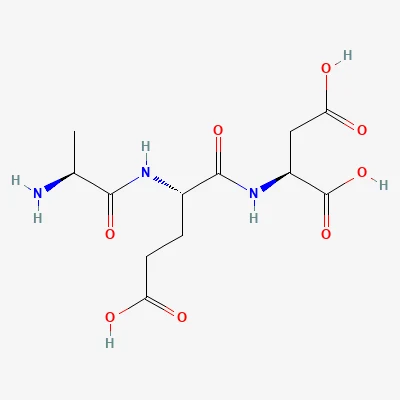
Sequence: AED
What Is Cartalax?
Cartalax is a synthetic tripeptide with the sequence Ala-Glu-Asp (AED), classed among the short peptide bioregulators. In the research literature the same tripeptide appears under the code T-31 or simply as AED rather than under the name cartalax.[1]
Peer-reviewed data on this peptide are limited. The PubMed record contains a few short cell and tissue culture studies from bioregulator research groups, and no animal efficacy studies or human clinical trials were found for it as of October 2026.[1][2][3]
Chemical Structure and Molecular Identity
Cartalax is L-alanyl-L-glutamyl-L-aspartic acid, a linear tripeptide with a free amino terminus and a free carboxylic acid terminus. PubChem lists it under CID 87815447 with the molecular formula C12H19N3O8, a molecular weight of 333.29 g/mol and CAS number 85806-95-7.
PubChem records cartalax, Ala-Glu-Asp, H-Ala-Glu-Asp-OH and T-31 peptide as synonyms for this compound. Its InChIKey is KXEVYGKATAMXJJ-ACZMJKKPSA-N, and all three residues have the natural L (S) configuration.
Two of its three residues, glutamic acid and aspartic acid, carry acidic side chains, which makes the molecule highly polar; PubChem gives a computed XLogP of -4.9. The Ala-Glu-Asp sequence also forms the first three residues of several other bioregulator peptides:
- Epithalon (Ala-Glu-Asp-Gly)
- Bronchogen (Ala-Glu-Asp-Leu)
- Cardiogen (Ala-Glu-Asp-Arg)
- Cortagen (Ala-Glu-Asp-Pro)
What the Published Literature Covers
The published research on AED (T-31) consists of three in vitro or ex vivo culture studies, with mixed results. None tested the peptide in living animals or people.
Kidney tissue cultures
In organotypic kidney tissue cultures from young and old rats, T-31 (AED) and a second short peptide, T-35 (EDL), stimulated proliferation and reduced apoptosis of kidney cells, measured as higher Ki-67 and lower p53 expression. Both short peptides had a smaller effect than a polypeptide complex isolated from calf kidneys, which was the main focus of the study.[1]
Aging skin fibroblasts
In skin fibroblasts aged in culture, AED was one of four peptides, alongside KE, KED and AEDG, tested with immunofluorescent confocal microscopy. All four inhibited synthesis of the matrix-remodeling enzyme MMP-9 and increased expression of Ki-67 and CD98hc. AED and AEDG also suppressed caspase-dependent apoptosis, which rises as fibroblast cultures age.[2]
Aging thymocyte cultures
A study of late-passage thymocyte cultures compared T-31 with two other peptides, AB-17 and AB-9. Only AB-9 showed a complex geroprotective effect on proliferation, differentiation and apoptosis, so T-31 did not show that effect in this model.[3]
No published studies on cartilage, joints or connective tissue in animals were found for this peptide, and none of the abstracts describe a molecular mechanism specific to AED.
With so few published studies, confirming a sample is the Ala-Glu-Asp tripeptide through HPLC and mass spectrometry certificates of analysis is a basic first step.
Regulatory and Research Status
Cartalax is not an FDA-approved drug and has no approved medical use in the United States. It is a research compound, and no human clinical trials of it were found in PubMed.
The evidence is limited to cell and tissue culture work from a small number of related research groups, and the thymocyte study reported no geroprotective effect for T-31.[3] Claims about effects in animals or humans are not supported by the peer-reviewed abstracts available for this page.
Commonly Supplied Research Formats
Cartalax is listed by 7 of the 11 major U.S. research-peptide suppliers we track. The most commonly listed formats are:
- 20mg
Supplier catalog survey, October 2026. Quantities refer to net peptide per vial as labeled.
Frequently Asked Questions
What is the molecular weight of cartalax?
Cartalax has a molecular weight of 333.29 g/mol and the molecular formula C12H19N3O8, according to PubChem (CID 87815447). It is the tripeptide Ala-Glu-Asp, built from L-alanine, L-glutamic acid and L-aspartic acid with free amino and carboxyl termini. Its CAS number is 85806-95-7.
Is cartalax the same as T-31?
Yes. PubChem lists T-31 peptide as a synonym for cartalax, and a 2015 kidney tissue culture study identifies T-31 as the tripeptide AED (Ala-Glu-Asp). Published research uses the T-31 or AED labels rather than the name cartalax, so searches for the name alone return few or no peer-reviewed papers.
Is cartalax FDA approved?
No. Cartalax is not approved by the FDA for any medical use. No human clinical trials of the Ala-Glu-Asp tripeptide were found in PubMed as of October 2026. The available research consists of a few cell and tissue culture studies, so it remains a research compound with limited peer-reviewed data.
What does the research on cartalax show?
Research is limited to culture studies. AED increased proliferation markers and reduced apoptosis markers in rat kidney tissue cultures, though less than a kidney polypeptide complex, and it lowered MMP-9 and caspase-dependent apoptosis in aging skin fibroblasts. In aging thymocyte cultures, T-31 did not show a geroprotective effect. No animal or human studies were found.
How is cartalax different from epitalon?
Cartalax is the tripeptide Ala-Glu-Asp, while epitalon is the tetrapeptide Ala-Glu-Asp-Gly, with an added C-terminal glycine. Epitalon has a much larger research record, including animal studies. The two were tested side by side in one skin fibroblast culture study, where both inhibited MMP-9 and suppressed caspase-dependent apoptosis.
References
- Chalisova NI, Lin'kova NS, Nichik TE, et al. Peptide Regulation of Cells Renewal Processes in Kidney Tissue Cultures from Young and Old Animals. Bulletin of experimental biology and medicine 2015. PMID 26033601 · DOI
- Lin'kova NS, Drobintseva AO, Orlova OA, et al. Peptide Regulation of Skin Fibroblast Functions during Their Aging In Vitro. Bulletin of experimental biology and medicine 2016. PMID 27259496 · DOI
- Lin'kova NS, Polyakova VO, Trofimov AV, et al. Peptidergic regulation of thymocyte differentiation, proliferation, and apoptosis during aging of the thymus. Bulletin of experimental biology and medicine 2011. PMID 22238759 · DOI
Related Compounds
This profile summarizes chemical data and peer-reviewed literature for educational and laboratory-research reference. It is not medical advice, and nothing here describes or recommends use in humans or animals. How we source and verify data.