N-Acetyl Epitalon
Also known as: N-Acetyl Epithalon Amidate
N-Acetyl Epitalon is a chemically modified analog of the tetrapeptide epitalon (Ala-Glu-Asp-Gly) that carries an acetyl group on its N-terminal alanine. PubChem lists it with the formula C16H24N4O10 and a molecular weight of 432.38 g/mol. No peer-reviewed studies specifically on this analog were found in PubMed as of October 2026, and it is not an FDA-approved drug.
Last reviewed · Identity data matched to PubChem
Key facts
- Class: short peptide bioregulator analog (acetylated synthetic tetrapeptide)
- Backbone: Ala-Glu-Asp-Gly (AEDG), the epitalon sequence, with an N-terminal acetyl group
- Formula C16H24N4O10; molecular weight 432.38 g/mol (PubChem CID 171390141)
- No CAS number listed in PubChem
- Also sold as N-Acetyl Epithalon Amidate, a name implying an additional C-terminal amide
- Peer-reviewed literature: no PubMed studies on this analog found as of October 2026
- Regulatory status: not FDA approved; research chemical only
Chemical Identity
| Molecular formula | C16H24N4O10 |
|---|---|
| Molecular weight | 432.38 g/mol |
| Monoisotopic mass | 432.1492 Da |
| PubChem CID | 171390141 |
| InChIKey | QXYAPAXZRKPASL-HGNGGELXSA-N |
| Length | 4 amino acids |
| Compound type | Peptide |
| H-bond donors / acceptors | 7 / 10 |
| XLogP3 | -3 |
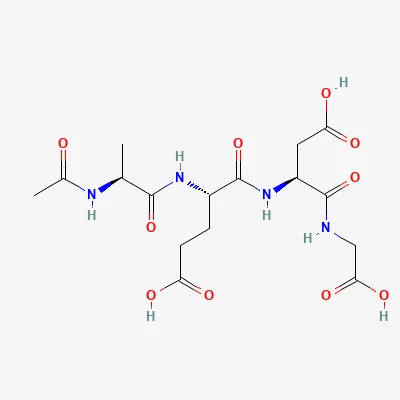
Sequence: AEDG
N-terminal acetyl group on alanine; free C-terminal carboxylic acid in PubChem CID 171390141. Material sold as 'N-acetyl epitalon amidate' would also carry a C-terminal amide, which this PubChem record does not include.
What Is N-Acetyl Epitalon?
N-Acetyl Epitalon is an acetylated form of epitalon, the synthetic tetrapeptide Ala-Glu-Asp-Gly, in which an acetyl group is attached to the free amine of the N-terminal alanine. It is offered as a research chemical and is sometimes labeled N-Acetyl Epithalon Amidate.
N-terminal acetylation is a common modification in synthetic peptide chemistry. It removes the positive charge on the N-terminal amine and is often used to reduce a peptide’s susceptibility to aminopeptidases. Whether this applies to N-acetyl epitalon in practice has not been reported in the peer-reviewed literature.
The analog is a separate molecule from epitalon. Findings reported for the unmodified tetrapeptide cannot be assumed to apply to the acetylated version without direct study.
Chemical Structure and Molecular Identity
N-Acetyl Epitalon consists of the four L-amino acids alanine, glutamic acid, aspartic acid and glycine, with an acetyl cap on the N-terminus and, in the PubChem record, a free carboxylic acid at the C-terminus. PubChem (CID 171390141) lists the molecular formula C16H24N4O10 and a molecular weight of 432.38 g/mol.
Compared with epitalon (C14H22N4O9, 390.35 g/mol), the analog adds one acetyl unit (C2H2O), which accounts for the 42 g/mol difference. The IUPAC name given by PubChem describes the N-terminal residue as a 2-acetamidopropanoyl group, confirming acetylation of the alanine amine.
Key identifiers
- PubChem CID: 171390141
- InChIKey: QXYAPAXZRKPASL-HGNGGELXSA-N
- CAS number: none listed in PubChem
- Synonyms: N-Acetyl Epitalon, N-Acetyl Epithalon, Ac-Ala-Glu-Asp-Gly-OH
A note on the “amidate” name
The commercial name N-Acetyl Epithalon Amidate implies that the C-terminal carboxylic acid has also been converted to a carboxamide. That would be a different molecule from the PubChem record above, with a different formula and a mass about 1 g/mol lower. Because the two forms are easily confused, the exact terminal chemistry of any sample can only be confirmed analytically, for example by mass spectrometry.
What the Published Literature Covers
No peer-reviewed studies specifically on N-acetyl epitalon were found in PubMed as of October 2026. Peer-reviewed data on this analog are effectively absent: its biological activity, stability, pharmacokinetics and safety have not been described in indexed journals.
Searches for the analog return papers about unmodified epitalon and its parent pineal extract, epithalamin. Those studies concern a different molecule, and their findings are not reported here as evidence for the acetylated form. Readers interested in that research can consult the separate epitalon reference page, which summarizes it with the original citations.
Any future work on N-acetyl epitalon would need to establish basic properties first, including whether acetylation changes enzymatic stability, cell uptake or the activities reported for the parent peptide.
Because acetylated and amidated forms differ by small mass shifts, researchers typically confirm identity with HPLC and mass spectrometry certificates of analysis.
Regulatory and Research Status
N-Acetyl Epitalon is not approved by the US Food and Drug Administration for any medical use and has no approved indication in the United States. It is sold only as a research chemical.
Because there is no published characterization of the analog, its research status is best described as unstudied. The PubChem record provides identity data but no linked bioactivity literature, and no CAS number is listed.
Researchers working with this compound should treat it as a distinct chemical entity from epitalon and document its identity, terminal modifications and purity independently.
Frequently Asked Questions
Is N-Acetyl Epitalon the same as Epitalon?
No. N-Acetyl Epitalon shares epitalon's Ala-Glu-Asp-Gly backbone but carries an acetyl group on the N-terminal alanine, giving it the formula C16H24N4O10 and a molecular weight of 432.38 g/mol, compared with 390.35 g/mol for epitalon. It is a separate molecule, and research on epitalon cannot be assumed to apply to it.
What is the molecular weight of N-Acetyl Epitalon?
PubChem lists N-Acetyl Epitalon (CID 171390141) with a molecular weight of 432.38 g/mol and the formula C16H24N4O10. This record has a free C-terminal carboxylic acid. A C-terminally amidated version, implied by the name N-Acetyl Epithalon Amidate, would have a different formula and a slightly lower mass.
Is N-Acetyl Epitalon FDA approved?
No. N-Acetyl Epitalon is not approved by the US Food and Drug Administration for any medical use. It is sold only as a research chemical, and no peer-reviewed studies on this specific analog were found in PubMed as of October 2026.
What does the research on N-Acetyl Epitalon show?
There is no peer-reviewed research specifically on N-Acetyl Epitalon in PubMed as of October 2026. Published studies concern unmodified epitalon or the pineal extract epithalamin. Its stability, biological activity and safety as an acetylated analog have not been reported in indexed journals.
Related Compounds
This profile summarizes chemical data and peer-reviewed literature for educational and laboratory-research reference. It is not medical advice, and nothing here describes or recommends use in humans or animals. How we source and verify data.