Vesugen
Also known as: Lys-Glu-Asp
Vesugen is a synthetic tripeptide bioregulator with the sequence Lys-Glu-Asp (KED), formula C15H26N4O8 and molecular weight 390.39 g/mol. Published research on it consists mainly of cell culture studies of aging markers, docking models of gene promoter binding and two small uncontrolled human studies. Vesugen is not FDA approved and remains a research compound.
Last reviewed · Identity data matched to PubChem · 11 peer-reviewed sources
Key facts
- Class: short peptide bioregulator (synthetic tripeptide)
- Sequence: Lys-Glu-Asp (KED), three standard L-amino acids with free termini
- Formula C15H26N4O8; molecular weight 390.39 g/mol (PubChem CID 87571363)
- CAS number 204271-66-9
- Evidence: mostly cell culture and docking studies; two small uncontrolled human studies
- Regulatory status: not FDA approved; research compound in the US
Chemical Identity
| Molecular formula | C15H26N4O8 |
|---|---|
| Molecular weight | 390.39 g/mol |
| Monoisotopic mass | 390.1751 Da |
| CAS number | 204271-66-9 |
| PubChem CID | 87571363 |
| InChIKey | LLSUNJYOSCOOEB-GUBZILKMSA-N |
| Length | 3 amino acids |
| Compound type | Peptide |
| H-bond donors / acceptors | 7 / 10 |
| XLogP3 | -7.4 |
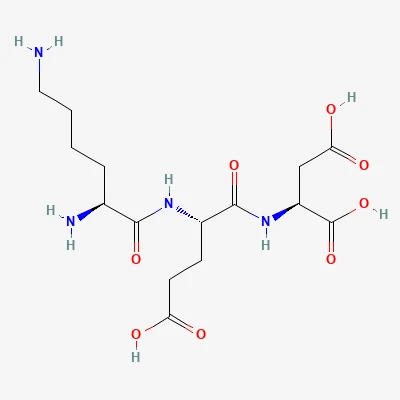
Sequence: KED
What Is Vesugen?
Vesugen is a synthetic tripeptide with the sequence Lys-Glu-Asp (KED), one of the short peptide bioregulators developed and studied mainly by Russian gerontology researchers. In the literature it appears both as vesugen and as KED or Lys-Glu-Asp.[1][2]
Published work frames vesugen as a vascular-oriented peptide: one paper describes a vasoprotective effect of vesugen reported earlier in older people and investigates it in vascular endothelial cell cultures.[2] More recent reviews from the same research program discuss KED as a neuroprotective candidate in Alzheimer’s disease research.[1][3]
Most of the evidence comes from cell and tissue culture experiments, reviews and computational docking. Two small human studies have also been published in a Russian gerontology journal, but neither is a randomized controlled trial.
Chemical Structure and Molecular Identity
Vesugen is L-lysyl-L-glutamyl-L-aspartic acid, a linear tripeptide with a free amino terminus and a free carboxylic acid terminus. PubChem lists it under CID 87571363 with the molecular formula C15H26N4O8, a molecular weight of 390.39 g/mol and CAS number 204271-66-9.
The molecule combines one basic residue, lysine, with two acidic residues, glutamic acid and aspartic acid, giving it several ionizable groups and high polarity; PubChem reports a computed XLogP of -7.4. All three residues have the natural L (S) configuration, and the InChIKey is LLSUNJYOSCOOEB-GUBZILKMSA-N.
Related sequences
The Lys-Glu-Asp motif forms the core of several other bioregulator peptides:
- Vilon (Lys-Glu) is the first two residues of vesugen.
- Testagen (Lys-Glu-Asp-Gly), livagen (Lys-Glu-Asp-Ala), prostamax (Lys-Glu-Asp-Pro) and pancragen (Lys-Glu-Asp-Trp) extend vesugen by one residue.
- Vesilut (Glu-Asp) is vesugen without its N-terminal lysine.
Research History and Development
In the PubMed record reviewed, research on vesugen dates from 2011, when it began appearing in organotypic tissue culture studies of aging cells. Early papers tested it alongside other short peptides such as vilon, epithalon, pancragen and bronchogen in pineal, pancreatic, bronchial and prostatic cell cultures.[4][5]
From 2014 onward the work shifted toward proposed gene-level mechanisms. Researchers used molecular docking to model vesugen binding to gene promoter regions and published reviews suggesting that KED, vilon and epithalon could influence genes linked to aging and vascular disease.[2][6][7]
Two clinical reports, published in 2015 and 2016, assessed vesugen together with pinealon in middle-aged and older adults using biological age indicators.[8][9] Since 2021, reviews have focused on KED in the context of Alzheimer’s disease and neurogenesis.[1][3] A 2024 review grouped Lys-Glu-Asp with other short peptides, including Lys-Glu, Glu-Trp and Glu-Asp-Arg, as multitarget agents with a wide range of activity and argued for a comprehensive approach to Alzheimer’s therapy over the classical one.[3]
Mechanisms Studied in Research
The proposed mechanism for vesugen is epigenetic: the tripeptide is suggested to bind specific DNA sequences in gene promoters and change gene expression. This idea rests mainly on computational docking and expression studies in cultured cells, not on direct experimental proof in living organisms.
In vascular endothelial cell cultures from young and old animals, vesugen and a second peptide, D-7, raised expression of the proliferation protein Ki-67, which declines with age. Docking models placed both peptides on the core promoter of the MKI67 gene, which encodes Ki-67, through a CATC sequence near the transcription start site.[2]
Reviews from the same research program report binding sites for Lys-Glu-Asp in the promoter of the gene for the cytokine MIC-1/GDF15 and propose that KED could influence F11R gene expression and synthesis of the adhesion molecule JAM-A.[6][7] Both proposals are presented as possibilities rather than demonstrated effects.
A 2021 review summarizing published and unpublished findings concluded that KED regulates genes tied to cell aging and apoptosis (p16, p21), neuronal differentiation (NES, GAP43 and their proteins nestin and GAP43) and Alzheimer’s disease pathogenesis (SUMO, APOE, IGF1). It also states that KED restored synaptic plasticity in an in vitro Alzheimer’s model and calls for testing in animal models.[1]
Key Findings From Published Studies
Published findings on vesugen are mostly cell culture results on proliferation and aging markers, plus two small uncontrolled human studies of biological age. Findings are grouped below by type of evidence.
Cell and tissue culture studies
- Neuroimmunoendocrine cultures: Lys-Glu-Asp stimulated proliferation and inhibited apoptosis in organotypic cultures, raising Ki-67 and lowering p53 in pineal tissue, with a stronger effect in cultures from old animals. The same report describes modulation of associative learning in honey bees in short- and long-term memory models.[10]
- Pineal immune cells: vesugen did not change the differentiation of pineal lymphoid cells but enhanced their proliferation potential, unlike vilon and epithalon, which shifted differentiation.[4]
- Prostatic fibroblasts: vesugen stimulated expression of differentiation factors in human prostatic fibroblast cultures, with a stronger effect in late-passage (aged) cultures.[5]
- Skin fibroblasts: KED inhibited MMP-9 synthesis and increased Ki-67 and CD98hc in aging fibroblast cultures, but unlike AED and AEDG it was not reported to suppress caspase-dependent apoptosis.[11]
Human studies
In a study of 32 adults aged 41 to 83 with chronic polymorbidity and organic brain syndrome in remission, the authors reported an anabolic effect and improved biological age indicators with both vesugen and pinealon, with a more visible effect for vesugen. They also observed prooxidant activity and a decrease in CD34+ hematopoietic cells, which they interpreted as inhibition of hemopoiesis. The abstract does not describe a placebo group or randomization.[8]
A comparative monitoring study of 110 people found the largest effect on biological age indicators when vesugen and pinealon were used together, compared with dry carbon dioxide baths, hyperbaric oxygen and therapeutic massage. Massage and the peptide preparations were rated the safest on biochemical, immunological and clinical parameters.[9] A 2021 review also states that KED improved memory and attention in elderly individuals with functional central nervous system disorders.[1]
Evidence at a glance
| Evidence type | Models | Main reported outcomes |
|---|---|---|
| Cell and tissue culture | Pineal, prostatic, skin fibroblast and vascular endothelial cultures | Higher Ki-67, lower p53 and MMP-9, more differentiation factor expression |
| Computational docking | MKI67 and GDF15 gene promoters | Predicted promoter binding |
| Invertebrate behavior | Honey bee associative learning | Modulation of memory performance |
| Human studies | 32 and 110 participants, no described control | Changes in biological age indicators |
Because several related peptides share the Lys-Glu-Asp motif, researchers typically confirm vesugen identity and purity with HPLC and mass spectrometry certificates of analysis.
Regulatory and Research Status
Vesugen is not an FDA-approved drug and has no approved medical use in the United States. It is a research compound in the US context.
The human data consist of small studies without a described control group, and the mechanistic work relies heavily on docking models and culture experiments from one research network. Independent replication, pharmacokinetic data and controlled clinical trials are not present in the PubMed record reviewed for this page.
Biological age, the main outcome in the human reports, is a composite of physiological and biochemical indicators rather than a clinical endpoint such as disease incidence or survival. Results on that measure are therefore hard to compare with conventional trial outcomes.
Findings such as changes in biological age indicators or memory measures are reported here as the authors’ results and should not be read as established effects of the peptide in humans.
Commonly Supplied Research Formats
Vesugen is listed by 4 of the 11 major U.S. research-peptide suppliers we track. The most commonly listed formats are:
- 20mg
Supplier catalog survey, October 2026. Quantities refer to net peptide per vial as labeled.
Frequently Asked Questions
What is the molecular weight of vesugen?
Vesugen has a molecular weight of 390.39 g/mol and the molecular formula C15H26N4O8, according to PubChem (CID 87571363). It is the tripeptide Lys-Glu-Asp, made of L-lysine, L-glutamic acid and L-aspartic acid with free amino and carboxyl termini. Its CAS number is 204271-66-9.
Is vesugen the same as KED peptide?
Yes. Vesugen is the tripeptide Lys-Glu-Asp, abbreviated KED in one-letter code. Research papers use both names, often within the same research program; the vascular and clinical studies tend to say vesugen, while Alzheimer's-focused reviews more often say KED. Both refer to the same unmodified sequence with free amino and carboxyl ends.
Is vesugen FDA approved?
No. Vesugen is not approved by the FDA for any medical use and has no US drug label. The published human data come from two small clinical studies whose abstracts do not describe placebo control or randomization. Most other research on vesugen consists of cell culture experiments, computational docking and reviews.
What does the research on vesugen show?
Cell culture studies report that vesugen increased proliferation markers such as Ki-67, reduced apoptosis markers and lowered MMP-9 in aging cells, often with stronger effects in cultures from older animals. Docking studies propose that it binds the promoter of the Ki-67 gene. Two small human studies reported changes in biological age indicators, but neither was a randomized controlled trial.
How is vesugen different from pinealon?
Vesugen is Lys-Glu-Asp, while pinealon is Glu-Asp-Arg. Both are tripeptides from the same bioregulator research program and were tested together in two human studies of biological age. In one of those studies, authors reported a more visible effect for vesugen than for pinealon, and the other found the largest effect when the two were used together.
How is vesugen related to testagen and prostamax?
Vesugen (Lys-Glu-Asp) is the shared core of testagen (Lys-Glu-Asp-Gly) and prostamax (Lys-Glu-Asp-Pro), which each add one residue at the C-terminal end. Despite the shared motif, each peptide has its own research record, and findings for one sequence cannot be assumed to apply to the others.
References
- Khavinson VK, Lin'kova NS, Umnov RS. Peptide KED: Molecular-Genetic Aspects of Neurogenesis Regulation in Alzheimer's Disease. Bulletin of experimental biology and medicine 2021. PMID 34173097 · DOI
- Khavinson VKh, Tarnovskaia SI, Lin'kova NS, et al. [Epigenetic aspects of peptidergic regulation of vascular endothelial cell proliferation during aging]. Advances in gerontology = Uspekhi gerontologii 2014. PMID 25051766
- Ilina AR, Popovich IG, Ryzhak GA, et al. [Prospects for use of short peptides in pharmacotherapeutic correction of Alzheimer's disease.]. Advances in gerontology = Uspekhi gerontologii 2024. PMID 38944767
- Linkova NS, Khavinson VKh, Chalisova NI, et al. Peptidegic stimulation of differentiation of pineal immune cells. Bulletin of experimental biology and medicine 2011. PMID 22803057 · DOI
- Khavinson VKh, Linkova NS, Polyakova VO, et al. Peptides tissue-specifically stimulate cell differentiation during their aging. Bulletin of experimental biology and medicine 2012. PMID 22808515 · DOI
- Khavinson VKh, Kuznik BI, Linkova NS, et al. [The Role of Cytokines MIC-1/GDF15 in Development of the Old Age Disease]. Uspekhi fiziologicheskikh nauk 2015. PMID 27183783
- Kuznik BI, Khavinson VK, Tarnovskaya SI, et al. [Adhesion molecule JAM-A, its function and mechanism of epigenetic regulation]. Advances in gerontology = Uspekhi gerontologii 2015. PMID 28509452
- Meshchaninov VN, Tkachenko EL, Zharkov SV, et al. [EFFECT OF SYNTHETIC PEPTIDES ON AGING OF PATIENTS WITH CHRONIC POLYMORBIDITY AND ORGANIC BRAIN SYNDROME OF THE CENTRAL NERVOUS SYSTEM IN REMISSION]. Advances in gerontology = Uspekhi gerontologii 2015. PMID 26390612
- Myakotnykh VS, Torgashov MN, Egorin KV, et al. [Comparative analysis of different methods of geroprotective]. Advances in gerontology = Uspekhi gerontologii 2016. PMID 28539017
- Chalisova NI, Lopatina NG, Kamishev NG, et al. Effect of tripeptide Lys-Glu-Asp on physiological activity of neuroimmunoendocrine system cells. Bulletin of experimental biology and medicine 2012. PMID 22977872 · DOI
- Lin'kova NS, Drobintseva AO, Orlova OA, et al. Peptide Regulation of Skin Fibroblast Functions during Their Aging In Vitro. Bulletin of experimental biology and medicine 2016. PMID 27259496 · DOI
Related Compounds
This profile summarizes chemical data and peer-reviewed literature for educational and laboratory-research reference. It is not medical advice, and nothing here describes or recommends use in humans or animals. How we source and verify data.