Prostamax
Also known as: Lys-Glu-Asp-Pro
Prostamax is a synthetic tetrapeptide bioregulator with the sequence Lys-Glu-Asp-Pro (KEDP), formula C20H33N5O9 and molecular weight 487.5 g/mol. Published research consists of laboratory studies showing chromatin decondensation in lymphocytes from elderly donors and one rat prostate tissue culture study. It is not FDA approved, and no clinical trials of it have been published.
Last reviewed · Identity data matched to PubChem · 5 peer-reviewed sources
Key facts
- Class: short peptide bioregulator (synthetic tetrapeptide)
- Sequence: Lys-Glu-Asp-Pro (KEDP), four standard L-amino acids with free termini
- Formula C20H33N5O9; molecular weight 487.5 g/mol (PubChem CID 9848296)
- CAS number 473578-47-1
- Evidence: lymphocyte chromatin studies and one rat tissue culture study; no clinical trials
- Regulatory status: not FDA approved; research compound only
Chemical Identity
| Molecular formula | C20H33N5O9 |
|---|---|
| Molecular weight | 487.5 g/mol |
| Monoisotopic mass | 487.2278 Da |
| CAS number | 473578-47-1 |
| PubChem CID | 9848296 |
| InChIKey | WUCUNGRTSFLCLI-XUXIUFHCSA-N |
| Length | 4 amino acids |
| Compound type | Peptide |
| H-bond donors / acceptors | 7 / 11 |
| XLogP3 | -9 |
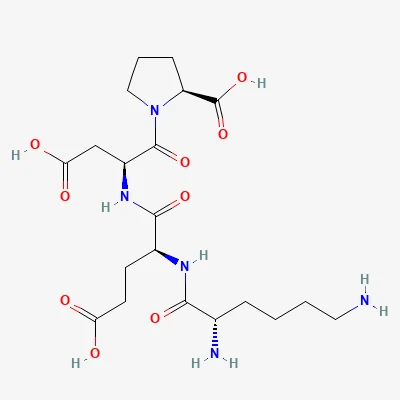
Sequence: KEDP
What Is Prostamax?
Prostamax is a synthetic tetrapeptide with the sequence Lys-Glu-Asp-Pro (KEDP), described in the research literature as an oligopeptide bioregulator. Published papers identify prostamax by this sequence and study it mainly for its effects on chromatin structure in human blood cells.[1]
Prostamax belongs to a set of tissue-oriented short peptides. In a rat tissue culture study it was tested on prostate gland explants, while related peptides were matched to heart, lung and pancreatic tissue.[2] Other studies compared it with vilon, epithalon, livagen and cortagen in leukocytes from elderly people.[3]
The published record is small. It consists of one organotypic culture study in rats and several laboratory studies of chromatin in lymphocytes from older donors, mostly from Russian and Georgian research groups. No clinical trials of prostamax were found in PubMed.
Chemical Structure and Molecular Identity
Prostamax is L-lysyl-L-glutamyl-L-aspartyl-L-proline, a linear tetrapeptide with a free amino terminus and a free carboxylic acid on its C-terminal proline. PubChem lists it under CID 9848296 with the molecular formula C20H33N5O9, a molecular weight of 487.5 g/mol and CAS number 473578-47-1.
The sequence pairs one basic residue, lysine, with two acidic residues, glutamic acid and aspartic acid, and ends in proline. Because proline’s side chain loops back onto its own backbone nitrogen, the aspartyl-proline bond is a tertiary amide, which restricts backbone flexibility at the C-terminus. All four residues have the natural L (S) configuration, and PubChem reports a computed XLogP of -9, reflecting very high polarity, along with seven hydrogen-bond donors, eleven hydrogen-bond acceptors and an exact mass of 487.22782765.
The InChIKey is WUCUNGRTSFLCLI-XUXIUFHCSA-N. PubChem lists few synonyms beyond the name prostamax and its CAS number, so the sequence Lys-Glu-Asp-Pro is the most reliable identifier when comparing sources.
Related sequences
- Vesugen (Lys-Glu-Asp) is prostamax without its C-terminal proline.
- Testagen (Lys-Glu-Asp-Gly), livagen (Lys-Glu-Asp-Ala) and pancragen (Lys-Glu-Asp-Trp) differ only at position four.
- Cortagen (Ala-Glu-Asp-Pro) shares the same C-terminal Glu-Asp-Pro but starts with alanine.
Research History and Development
Indexed research on prostamax appeared between 2004 and 2012 and centered on how short peptides affect chromatin in cells from elderly people. The earliest papers, published in 2004, examined lymphocyte chromatin by cytogenetic methods and by microcalorimetry.[3][4]
A 2006 study placed prostamax within a group of synthetic bioregulators designed to act on specific tissues, testing cardiogen, bronchogen, prostamax and pancragen on explants from the matching organs of young and aged rats.[2]
Later work by Georgian researchers studied prostamax in lymphocyte cultures from aging people together with copper and cadmium ions in 2009, and measured chromosomal markers of chromatin condensation in cells from people aged 75 to 86 in 2012.[5][1] No further studies of prostamax were found in PubMed after 2012. Three of the five papers share a common author, so the chromatin findings have had limited independent replication.[3][5][1]
Mechanisms Studied in Research
The main mechanism studied for prostamax is decondensation of heterochromatin, the tightly packed form of chromatin that accumulates in cells with age. Researchers proposed that loosening this chromatin could release genes that had been silenced by age-related condensation.
In leukocytes from people aged 75 to 88, prostamax and four other short peptides activated ribosomal genes, decondensed densely packed chromatin fibrils and released genes repressed by age-related condensation of euchromatin regions. Prostamax, epithalon and livagen also decondensed pericentromeric structural heterochromatin on chromosome 1, while only epithalon and livagen changed chromosome 9 in that study, suggesting some differences between the peptides.[3]
Microcalorimetry gave a physical view of the same process. The study first characterized two high-temperature denaturation stages of lymphocyte chromatin, near 94.4 and 105.1 degrees Celsius. In treated lymphocytes, prostamax redistributed heat between two chromatin denaturation endotherms and shifted them to lower temperatures by 2.9 and 1.0 degrees Celsius. The authors linked this to partial relaxation of the 30-nm chromatin fiber toward the 10-nm filament, with only small changes in nucleosome organization.[4]
The 2012 cytogenetic study reached a similar interpretation, concluding that prostamax decondenses chromatin during aging and that this modifying effect on chromatin may underlie the protective action the authors attribute to it.[1]
Key Findings From Published Studies
Published findings on prostamax come from laboratory studies of human blood cells and one rat tissue culture study; there are no animal efficacy studies or human trials. The results are summarized below by model, from organ explant culture to cell-level chromatin assays.
Rat organotypic tissue culture
In explant cultures from young (3-week-old) and aged (18-month-old) rats, cardiogen, bronchogen, prostamax and pancragen each had a stimulating effect on the tissue culture matching its intended target compared with control explants, in both age groups. The authors suggested these peptides could support reparative processes in aging tissues.[2]
Lymphocytes from elderly donors
- Ribosomal genes and heterochromatin: prostamax activated ribosomal genes and decondensed facultative and chromosome 1 pericentromeric heterochromatin in leukocytes from people aged 75 to 88.[3]
- Chromosomal markers: in cells from people aged 75 to 86, prostamax increased sister chromatid exchanges to 12.0 per cell versus 5.9 in untreated cells, raised Ag-positive nucleolar organizer regions to 2.5 per cell versus 0.95, and reduced large pericentromeric heterochromatin variants on chromosomes 1 and 9.[1]
- Thermal stability of chromatin: prostamax shifted chromatin denaturation endotherms to lower temperatures, consistent with partial chromatin relaxation.[4]
- Metal ions: a study combining prostamax with copper and cadmium ions reported that copper caused additional heterochromatin condensation and cadmium caused decondensation and partial denaturation; at these low concentrations neither ion changed the thermal stability of membrane, nuclear or cytoplasmic proteins. The abstract does not report a separate result for prostamax.[5]
Evidence at a glance
| Model | Method | Reported result with prostamax |
|---|---|---|
| Rat organ explants, young and aged | Organotypic culture | Stimulation of prostate explant cultures |
| Leukocytes, donors aged 75 to 88 | Cytogenetics | Ribosomal gene activation; heterochromatin decondensation |
| Human lymphocytes | Microcalorimetry | Lower chromatin denaturation temperatures |
| Cells, donors aged 75 to 86 | SCE and Ag-NOR counts | More exchanges and active NORs; fewer large heterochromatin variants |
Because prostamax differs from related peptides by a single residue, researchers typically verify its identity and purity with HPLC and mass spectrometry certificates of analysis.
Regulatory and Research Status
Prostamax is not an FDA-approved drug and has no approved medical use in the United States. It is a research compound, and no clinical trials of it were found in PubMed.
The available evidence is narrow: chromatin measurements in blood cells from elderly donors and a single rat tissue culture experiment, published between 2004 and 2012. None of these studies tested prostate function, and the human-derived data come from cell measurements rather than clinical outcomes.
Pharmacokinetic, toxicology and controlled clinical data are absent from the PubMed record, so effects in living animals or humans have not been established.
The chromatin measurements also describe structural states rather than cell function. The studies did not report downstream changes such as protein output or cell survival, so the practical meaning of the observed decondensation remains an open research question.
Commonly Supplied Research Formats
Prostamax is listed by 3 of the 11 major U.S. research-peptide suppliers we track. The most commonly listed formats are:
- 20mg
Supplier catalog survey, October 2026. Quantities refer to net peptide per vial as labeled.
Frequently Asked Questions
What is the molecular weight of prostamax?
Prostamax has a molecular weight of 487.5 g/mol and the molecular formula C20H33N5O9, according to PubChem (CID 9848296). It is the tetrapeptide Lys-Glu-Asp-Pro, built from L-lysine, L-glutamic acid, L-aspartic acid and L-proline with free amino and carboxyl termini. Its CAS number is 473578-47-1.
Is prostamax FDA approved?
No. Prostamax is not approved by the FDA for any medical use and has no US drug label. No clinical trials of prostamax were found in PubMed. Its published research consists of laboratory studies on blood cells from elderly donors and one tissue culture study in rats, so it remains a research compound.
What does the research on prostamax show?
Studies in lymphocytes from people in their late 70s and 80s reported that prostamax decondensed heterochromatin, activated ribosomal genes and changed chromosomal markers such as sister chromatid exchange frequency. A rat explant study reported a stimulating effect on prostate tissue cultures. No animal efficacy studies or human clinical trials have been published.
How is prostamax different from vesugen?
Prostamax is the tetrapeptide Lys-Glu-Asp-Pro, while vesugen is the tripeptide Lys-Glu-Asp. Prostamax adds a C-terminal proline, which increases its molecular weight from 390.39 to 487.5 g/mol and changes its backbone shape. The two have separate research records: prostamax studies focus on chromatin in blood cells, while vesugen studies focus on vascular and other cell cultures.
Is prostamax the same as cortagen?
No. Prostamax is Lys-Glu-Asp-Pro and cortagen is Ala-Glu-Asp-Pro. They share the same last three residues but differ at the first position, where prostamax has lysine and cortagen has alanine. Both were included in a 2004 study of lymphocyte chromatin in elderly donors, where prostamax was one of three peptides that also decondensed chromosome 1 heterochromatin.
Why is it called prostamax?
The name appears to reflect its place among tissue-oriented bioregulator peptides. In a 2006 rat tissue culture study, prostamax was tested on prostate gland explants, while cardiogen, bronchogen and pancragen were tested on heart, lung and pancreatic explants. However, no published study has examined prostate function in animals or humans.
References
- Dzhokhadze TA, Buadze TZh, Gaĭozishvili MN, et al. [Deheterochromatinization of the chromatin in old age induced by oligopeptide bioregulator (Lys-Glu-Asp-Pro)]. Georgian medical news 2012. PMID 23221144
- Zakutskiĭ AN, Chalisova NI, Ryzhak GA, et al. [The tissue-specific effect of synthetic peptides-biologic regulators in organotypic tissues culture in young and old rats]. Advances in gerontology = Uspekhi gerontologii 2006. PMID 17152728
- Khavinson VKh, Lezhava TA, Malinin VV. Effects of short peptides on lymphocyte chromatin in senile subjects. Bulletin of experimental biology and medicine 2004. PMID 15085253 · DOI
- Meskhi T, Khachidze D, Barbakadze Sh, et al. [The influence of the peptide bioregulator prostamax on heterochromatin of human lymphocytes in situ]. Biofizika 2004. PMID 15612551
- Kiladze M, Gorgoshidze M, Monaselidze J, et al. Microcalorimetric study of human blood lymphocytes culture at presence of copper, cadmium and prostamax. Georgian medical news 2009. PMID 19359734
Related Compounds
This profile summarizes chemical data and peer-reviewed literature for educational and laboratory-research reference. It is not medical advice, and nothing here describes or recommends use in humans or animals. How we source and verify data.