Vesilut
Also known as: Glu-Asp
Vesilut is a dipeptide bioregulator with the sequence Glu-Asp (ED), corresponding to L-alpha-glutamyl-L-aspartic acid, formula C9H14N2O7 and molecular weight 262.22 g/mol. No peer-reviewed studies on vesilut were found in PubMed as of October 2026, so its biological activity is undocumented. It is not FDA approved and is available only as a research compound.
Last reviewed · Identity data matched to PubChem
Key facts
- Class: short peptide bioregulator (dipeptide)
- Sequence: Glu-Asp (ED), L-alpha-glutamyl-L-aspartic acid with free termini
- Formula C9H14N2O7; molecular weight 262.22 g/mol (PubChem CID 99716)
- CAS number 3918-84-1; UNII 38Y324JU2X
- Evidence: no peer-reviewed studies found in PubMed as of October 2026
- Regulatory status: not FDA approved; research compound only
Chemical Identity
| Molecular formula | C9H14N2O7 |
|---|---|
| Molecular weight | 262.22 g/mol |
| Monoisotopic mass | 262.0801 Da |
| CAS number | 3918-84-1 |
| PubChem CID | 99716 |
| UNII | 38Y324JU2X |
| InChIKey | FYYSIASRLDJUNP-WHFBIAKZSA-N |
| Length | 2 amino acids |
| Compound type | Peptide |
| H-bond donors / acceptors | 5 / 8 |
| XLogP3 | -4.6 |
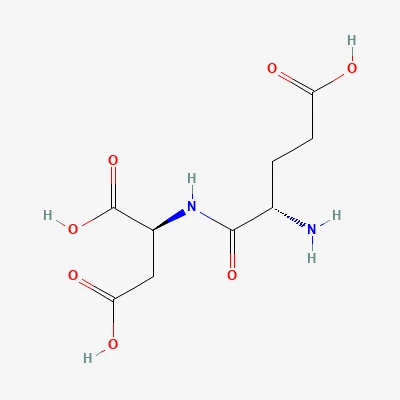
Sequence: ED
What Is Vesilut?
Vesilut is the dipeptide Glu-Asp (ED), L-alpha-glutamyl-L-aspartic acid, grouped with the short peptide bioregulators. It consists of just two standard amino acids, glutamic acid and aspartic acid, joined by a single peptide bond.
No peer-reviewed studies on vesilut, or on the Glu-Asp dipeptide under that name, were found in PubMed as of October 2026. This page therefore describes only the molecule’s identity and composition and explains what the available literature does and does not cover.
Chemical Structure and Molecular Identity
Vesilut corresponds to L-alpha-glutamyl-L-aspartic acid, a dipeptide with a free amino terminus on glutamic acid and a free carboxylic acid terminus on aspartic acid. PubChem lists this dipeptide under CID 99716 with the molecular formula C9H14N2O7, a molecular weight of 262.22 g/mol and CAS number 3918-84-1.
The peptide bond links the alpha-carboxyl group of glutamic acid to the amino group of aspartic acid, which distinguishes it from gamma-glutamyl dipeptides formed through the glutamate side chain. Both residues have the natural L (S) configuration. Other registry identifiers include UNII 38Y324JU2X and InChIKey FYYSIASRLDJUNP-WHFBIAKZSA-N.
With three carboxylic acid groups and one amino group, the molecule is strongly acidic and very polar; PubChem reports a computed XLogP of -4.6, a topological polar surface area of 167 square angstroms, five hydrogen-bond donors, eight hydrogen-bond acceptors and an exact mass of 262.08010079. The compound also appears in ChEBI (CHEBI:73503) and the NCI collection as NSC 186905. The PubChem record lists synonyms such as Glu-Asp, H-Glu-Asp-OH and alpha-L-glutamyl-L-aspartic acid but does not list the name vesilut itself.
Related sequences
The Glu-Asp pair appears inside several other bioregulator peptides, including vesugen (Lys-Glu-Asp), pinealon (Glu-Asp-Arg), chonluten (Glu-Asp-Gly) and ovagen (Glu-Asp-Leu). Each of these is a distinct molecule with its own properties.
What the Published Literature Covers
No published study in PubMed examines vesilut or the isolated Glu-Asp dipeptide as a bioregulator. Literature searches for it return papers about longer peptides that contain the same two residues, not about the dipeptide itself.
Those papers concern compounds such as epitalon (Ala-Glu-Asp-Gly), pinealon (Glu-Asp-Arg), vesugen (Lys-Glu-Asp) and livagen (Lys-Glu-Asp-Ala). Findings for those peptides cannot be transferred to vesilut, because adding or removing even one residue changes a peptide’s size and charge and makes it a different chemical entity.
As a result, there are no peer-reviewed data on vesilut’s biological activity, mechanism, pharmacokinetics or safety in cells, animals or humans.
With no published studies to compare against, an HPLC and mass spectrometry certificate of analysis is the main way to confirm a Glu-Asp sample's identity.
Regulatory and Research Status
Vesilut is not an FDA-approved drug and has no approved medical use in the United States. It is a research compound with no published clinical or preclinical studies in PubMed as of October 2026.
Any claims about specific biological effects of vesilut are not supported by peer-reviewed evidence. Researchers interested in the dipeptide would be working without a published baseline, so basic characterization of identity and purity is the main verifiable information available.
Commonly Supplied Research Formats
Vesilut is listed by 1 of the 11 major U.S. research-peptide suppliers we track. The most commonly listed formats are:
- 20mg
Supplier catalog survey, October 2026. Quantities refer to net peptide per vial as labeled.
Frequently Asked Questions
What is the molecular weight of vesilut?
Vesilut corresponds to the dipeptide Glu-Asp, which PubChem lists under CID 99716 with a molecular weight of 262.22 g/mol and the molecular formula C9H14N2O7. Its CAS number is 3918-84-1. The molecule is L-alpha-glutamyl-L-aspartic acid, with free amino and carboxyl termini and no other modifications.
Is vesilut FDA approved?
No. Vesilut is not approved by the FDA for any medical use. No peer-reviewed clinical or preclinical studies of vesilut or the Glu-Asp dipeptide as a bioregulator were found in PubMed as of October 2026, so it remains a research compound without published efficacy or safety data.
What does the research on vesilut show?
There is no published research on vesilut in PubMed as of October 2026. Searches return studies of longer peptides that share its Glu-Asp residues, such as epitalon, pinealon and vesugen, but those results apply only to those specific molecules. No cell, animal or human data on vesilut itself are available.
How is vesilut different from vesugen?
Vesilut is the dipeptide Glu-Asp, while vesugen is the tripeptide Lys-Glu-Asp, which adds a lysine at the amino end. That extra residue adds a basic side chain and changes the molecule's charge and size. The two are separate compounds, and research on vesugen cannot be assumed to apply to vesilut, for which no peer-reviewed studies were found.
Related Compounds
This profile summarizes chemical data and peer-reviewed literature for educational and laboratory-research reference. It is not medical advice, and nothing here describes or recommends use in humans or animals. How we source and verify data.